← On a small screen, scroll the diagram horizontally. →
01 /
Where Preferans comes from
Russian Preferans is one branch of the European Preference family. In a 2012 correction, researcher Thierry Depaulis reports references from Brno in 1801 and Vienna in 1803–1807. Rules were printed in a Viennese book in 1829. This evidence does not establish an exact invention date or place; he treats possible Russian play before 1800 as unverified.
Russian practice differs from Central European forms, notably in bidding for seven to ten tricks. An old description of Austrian Preference therefore cannot stand in for the rules of Sochi Preferans.
02 /
The game and its objective
On each deal, one player may become declarer and contract to win at least six tricks. The other two defend. There are no permanent partnerships: roles change with every deal. Special forms reverse the objective: in misère, declarer must avoid every trick; in an all-pass deal, everyone tries to take fewer tricks.
Results go on a shared pool score sheet. Filling your pool first does not necessarily make you the winner: penalties and whist balances also matter. No money is needed; abstract points work perfectly well.
03 /
Agree on the rules before dealing
“Sochi” alone does not fix every option. The examples in this guide use this profile:
- A pool target of 20 for each player; play ends when all three pools are closed.
- Fully responsible, greedy whisting: full penalties for defensive shortages. With one whister, that player records both defensive hands’ tricks; the passer receives only applicable consolation.
- Ten-level contracts are whisted with a defensive quota of one trick. This is an agreement; many groups instead check ten-level contracts without defensive liability.
- All-pass tricks cost 1 dump point, without escalation. The talon is exposed, the deal rotates, and the next auction may start at six. A genuine zero tricks earns 1 pool point.
- No Stalingrad, bombs, blind games, misère without the talon, or surrender “three down without whists”.
- Pass–half-whist is allowed at six and seven. Pool assistance follows the closing rules below.
Keep this list beside the score sheet. Do not change the agreements mid-session: a different form of whisting can change the result of the same deal.
04 /
Cards, seats and the deal
Use 32 cards: A, K, Q, J, 10, 9, 8, 7 in each suit. Aces are high, sevens low, and tens rank below jacks. Cards have no point values; it is the tricks that count.
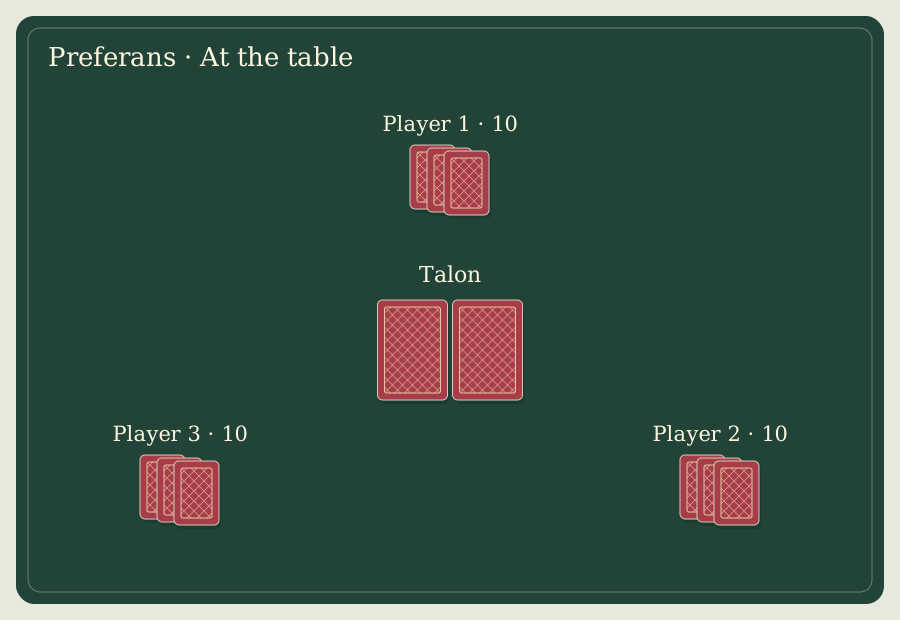
Choose the first dealer by lot. Shuffle and have the pack cut, then deal clockwise in pairs, starting on the dealer’s left. Each player receives ten cards. Set two cards face down as the talon, never as the first or last pair dealt.
The player on the dealer’s left is first hand, followed by second and third hand. With three players, the dealer also receives a ten-card hand. Check your card count before bidding, without showing your hand. Correct a misdeal noticed before the auction by dealing again. After every completed deal, including an all-pass deal, the next player deals.
05 /
Bidding: steps and “here”
First hand starts; turns move clockwise. The ordinary ladder is 6♠ → 6♣ → 6♦ → 6♥ → 6NT → 7♠, continuing through 10NT. NT means no trumps. In the step-by-step auction used here, ordinary bidding starts at 6♠ and does not jump steps. Misère is a special bid.
On your turn, raise to the next step or pass. Passing removes you from that auction. The earlier hand has priority: first hand may retain an opponent’s bid by saying “here” or “mine”, requiring the later hand to raise. If first hand has already passed, second hand has this priority over third.
Example: A bids 6♠, B 6♣, C passes; A says “6♣ here”, B 6♦; A says “6♦ here”, B 6♥; A says “6♥ here”, B passes. A wins the talon. Three initial passes lead to an all-pass deal.
Misère must be your first call, before any other bid. It outranks eight-level contracts and is overcalled at nine. This profile excludes misère without the talon; a player who bid misère does not switch to an ordinary contract after being overcalled.
06 /
The talon, discard and final contract
The last player in the auction reveals both talon cards, takes them and secretly discards any two cards. Declarer must again hold exactly ten cards before naming the contract. The discard takes no part in the tricks.
Name the final number of tricks and trump suit, or NT. The contract may be higher than the winning bid but not lower: after winning at 6♥, 7♠ is legal and 6♦ is not. You cannot switch to misère after an ordinary auction.
A poor talon does not release you from the contract. You cannot return it or simply decline to play. After naming the contract, do not change the discard; once play starts, do not inspect it. Passing in the auction does not prevent you from whisting later: that is a separate stage.
07 /
Playing the tricks
First hand leads to the opening trick, not necessarily declarer. Each player contributes one card in turn. You must follow the led suit if possible. If you cannot, you must trump if you have a trump. With neither the led suit nor a trump, discard any card.
You do not have to play a higher card when following suit. You also do not have to overtrump an opponent’s trump, although you must play a trump when void in the led suit. NT, misère and all-pass deals have no trumps.
The highest trump played wins; otherwise, the highest card of the led suit wins. The winner leads next. Ten rounds produce ten tricks. Keep completed tricks separately so everyone can verify the result.
← On a small screen, scroll the diagram horizontally. →
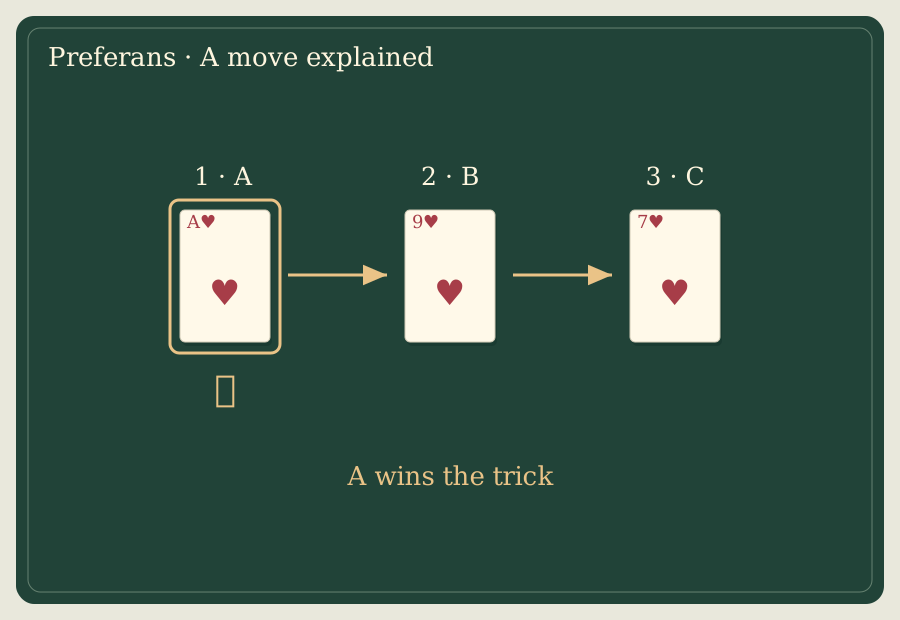
Try a single trick
Who wins this trick?
Hearts are trumps. The first player led the ace of spades. The second has no spades and played the seven of hearts.
Choose the winning card.
08 /
Whist, pass and half-whist
After the contract is named, the opponent clockwise from declarer speaks, followed by the other defender. Whist accepts a defensive obligation; pass declines liability, but does not remove that player’s cards from play. The combined defensive quota appears in the scoring table below.
With two whisters, both hands stay concealed. If the combined quota is met, neither is penalised, regardless of the split: 4–0 is enough against six. If defence falls short overall, each whister is responsible for two tricks against six or one against seven. Against eight, nine and a whisted ten, the second whister is liable for the missing defensive trick.
A sole whister accepts the whole quota and records the tricks won by both defensive hands. That player chooses concealed or open defence. For open defence, both hands are exposed before the opening lead and controlled by the whister; in concealed defence, each player plays their own hand. Two passes concede the contract: declarer records its pool value, with no ordinary defensive whists.
When half-whist is available
If the first defender passes, the second may offer half-whist against six or seven. Without playing, declarer records the contract in the pool and the defender receives half the quota: 4 whists against six or 4 whists against seven. Half-whist is unavailable at eight or higher.
The first defender may reopen with a whist. Play then proceeds; the half-whister must pass and the reopening player takes the whole defence. If declarer fails, the half-whister’s consolation is also credited to the reopening player. In our greedy-whist profile, “whist–pass–half-whist” is not allowed: an initial whister cannot withdraw after the other defender passes.
09 /
Contract values and the score sheet
Each player has three scoring areas: the pool for successful contracts, the dump or mountain for penalties, and a separate whist column against each opponent. Record cumulative totals immediately after each deal.
Making the contract earns its pool value, with no bonus for overtricks. A shortage, or remise, earns no pool points: record contract value × undertricks in the dump. A defender records contract value × credited tricks as whists against declarer. If declarer fails, each opponent additionally receives consolation equal to contract value × undertricks; see the whisting section for a sole whister’s allocation.
Three scoring examples
- 7♥, result 7–2–1, both defenders whist. Declarer records 4 pool points; the defenders record 8 and 4 whists against declarer. No dump penalties.
- 7♥, result 6–3–1, both whist. Declarer records 4 dump points; defenders record (3 + 1) × 4 = 16 and (1 + 1) × 4 = 8 whists against declarer.
- 6♣, declarer takes 8, defenders 2 and 0, both whist. Declarer gets 2 pool points. The first defender gets 4 whists; the second records 4 dump points for two missing tricks. Defence did not meet its combined quota of four.
With one whister against six and declarer taking five, the whister records 5 × 2 + 1 × 2 = 12 whists; the passer gets only 2 consolation whists. Declarer records 2 dump points.
Selected Sochi scoring table
| Contract | Pool if made | Dump per undertrick | Whists per defensive trick | Defensive quota |
|---|---|---|---|---|
| 6 | 2 | 2 | 2 | 4 |
| 7 | 4 | 4 | 4 | 2 |
| 8 | 6 | 6 | 6 | 1 |
| 9 | 8 | 8 | 8 | 1 |
| 10 | 10 | 10 | 10 | 1 |
| Misère | 10 | 10 per trick taken | 0 | — |
A defender’s undertrick penalty also uses the full contract value in this profile. The ten-level contract shown is whisted. Whists are separate score units; pool and dump points are converted during final settlement.
10 /
Misère: take no tricks
Misère commits declarer to zero tricks. Reveal the talon and discard two as usual. There are no trumps; the normal ranking and obligation to follow suit remain.
Both defensive hands are exposed. If declarer has the opening lead, declarer plays first and the defenders then expose their hands. If a defender leads, the hands are exposed immediately. The defenders may discuss a plan to force a trick on declarer; they have no quota of their own.
Zero tricks earns 10 pool points. Every trick declarer takes costs 10 dump points, with no pool award: two tricks cost 20. Misère generates no ordinary whists or consolation. Taking the first trick loses the contract, but later tricks can increase the penalty, so play on or agree the final result.
11 /
All-pass: everyone for themselves
Three initial passes mean nobody takes the talon or discards. There are no trumps and everyone tries to avoid tricks. In our three-player profile, expose the first talon card: it determines the suit of the first trick. First hand plays that suit if possible, or any card if void. The others follow the suit specified by the talon if they can.
Expose the second talon card for trick two: it specifies that trick’s suit, and first hand leads again. First hand also leads trick three, now with any card. From trick four onwards, the previous winner leads. With three players, talon cards only indicate suits: their ranks do not compete, so an exposed ace cannot win the trick.
At the agreed rate of one, record tricks in the dump. To simplify the record, subtract the same minimum from everyone: 4–3–3 becomes 1–0–0. This amnesty is not a zero-trick bonus. Only a player who genuinely took no tricks earns 1 pool point: 0–5–5 gives the first player 1 pool point and the others 5 dump points each.
Further all-pass deals still cost one under this profile. The dealer rotates, and the next auction can start at six. Escalation such as 1–2–3 and stricter exit requirements are separate options, disabled here.
12 /
A complete worked deal
A is first hand; B and C follow clockwise. The auction follows the earlier example and ends with A’s “6♥ here”. The talon contains A♥ and 9♣. A discards 7♣ and 8♦, then contracts for 7♥. Both opponents whist.
Below are the hands after the discard and one legal sequence of all ten tricks. This is a teaching sequence, not a claim of optimal play. B leads tricks four, five and nine; play otherwise follows the clockwise order from the shown leader.
The result is A: 7, B: 3, C: 0. A records 4 pool points, B records 12 whists against A, and C records nothing. Defence took three against its quota of two, so C’s zero incurs no penalty. The project’s checks verify every card and play in this example.
Player A declarer
A♠ Q♠A♥ K♥ 10♥ 8♥K♣ J♣ 9♣A♦Player B whist
K♠ J♠ 9♠Q♥ J♥ 9♥A♣ Q♣K♦ 7♦Player C whist
10♠ 8♠ 7♠7♥10♣ 8♣Q♦ J♦ 10♦ 9♦Show all 10 tricks+
| # | Leader | A | B | C | Winner |
|---|---|---|---|---|---|
| 1 | A | A♥ | 9♥ | 7♥ | A |
| 2 | A | K♥ | J♥ | 7♠ | A |
| 3 | A | 8♥ | Q♥ | 8♠ | B |
| 4 | B | 9♣ | A♣ | 8♣ | B |
| 5 | B | K♣ | Q♣ | 10♣ | A |
| 6 | A | J♣ | 7♦ | 9♦ | A |
| 7 | A | A♠ | 9♠ | 10♠ | A |
| 8 | A | Q♠ | K♠ | 10♦ | B |
| 9 | B | A♦ | K♦ | Q♦ | A |
| 10 | A | 10♥ | J♠ | J♦ | A |
13 /
Closing the pool and settling scores
While your pool is below 20, awards go there. After closing it, assist the highest unclosed pool; break ties by choosing the next player clockwise. For each point transferred, record 10 whists against the recipient. This profile allows assistance even to a player penalised for a whist shortage on that deal.
Suppose A, B and C have pools of 19, 17 and 14. A makes an eight-level contract worth six: one point closes A’s pool, three go to B and two to C. Pools become 20, 20 and 16; A records 30 whists against B and 20 against C. If points remain from the last award after every pool is closed, deduct them from your dump. If your dump is insufficient, reduce it to zero and add the remaining amount to each opponent’s dump.
Once all pools are closed, calculate the average dump. Each player’s dump contribution in whists is 10 × (average dump − own dump). Add all whists that player has recorded against others, then subtract all whists others recorded against them. Positive means a win, negative a loss; all results must sum to zero.
Keep fractions until the end: independently rounding three results can break the balance. If everyone agrees to stop early, first add each player’s missing pool points up to 20 to their dump, then settle. There is no need to attach money to the points.
Example / all pools closed at 20
| Player | Dump | Whists vs A | Whists vs B | Whists vs C | Result |
|---|---|---|---|---|---|
| A | 6 | — | 8 | 4 | -32 |
| B | 0 | 12 | — | 6 | +30 |
| C | 3 | 2 | 10 | — | +2 |
Average dump: (6 + 0 + 3) / 3 = 3. A: 10 × (3 − 6) + (8 + 4) − (12 + 2) = −32. B’s dump contribution is +30 and net whists are zero. C’s dump contribution is zero and net whists are +2. Check: −32 + 30 + 2 = 0.
14 /
Four players, Leningrad and Rostov
Four at the table
The dealer receives no ten-card hand and sits out ordinary play. If declarer fails a trick contract, the dealer also receives consolation. This profile has no talon bonuses for aces or marriages. The dealer has the final right to reopen defence in the circumstances described in Codex § 3.8, after the defenders decline: they inspect one hand and take over defence. Agree on the corresponding record before play.
On all-pass deals, the talon cards belong to the dealer: each leads its respective trick and can win it. First hand leads the third, then the previous winner leads. The dealer records tricks at the same rate and a genuine zero earns the normal bonus. Include all four players when averaging dumps. The teaching deal and settlement table above are for three.
Comparing conventions
| System | Typical differences |
|---|---|
| Sochi | Usually fully responsible, greedy whisting and assistance for closing pools; this guide fixes its options at the start |
| Leningrad | Usually half-responsible, gentlemanly whisting; doubled dump and whist records; a combined pool target with no assistance |
| Rostov | Usually half-responsible, gentlemanly whisting; consolation of 10 per undertrick; whist-scored all-pass deals with a hidden talon |
This comparison is not a set of interchangeable scoring tables. Half-responsibility changes penalties; gentlemanly whisting changes allocation. They are different settings. Also check ten-level contracts, Stalingrad, half-whist and all-pass exit requirements with your group.
15 /
Avoidable mistakes
- The wrong card count after discarding. Declarer should count ten before naming the final contract.
- Discarding instead of following suit or trumping. This is a revoke, not a tactic. Stop and reconstruct the cards; use Codex § 3.9 to resolve it rather than inventing a penalty afterwards.
- The wrong opening leader. Winning the auction does not transfer the opening lead to declarer.
- Mixing conventions. Do not combine Sochi penalties with Leningrad whist allocation without an agreement.
- A missing score entry. Confirm the contract, trick counts and all three scoring areas after each deal.
For a practice session, you may agree beforehand to correct a first accidental error without a penalty. In normal or tournament play, follow the agreed regulations. Save coaching and discussion until the play is over.
16 /
One-deal checklist
- Deal ten each and set aside the two-card talon.
- Bid from first hand. Three initial passes mean all-pass.
- The winner reveals the talon, discards two and names a contract.
- For a trick contract, resolve whist, pass or half-whist.
- Play from first hand, following suit and trumping when required.
- Check all ten tricks and record pool, dump and whists.
- Move the deal clockwise; settle after all pools close.
Misère and all-pass follow the exceptions above for trumps, exposed hands and opening leads. The print button formats this guide with its tables and sources for paper.
Common questions
Can declarer take more tricks than promised?+
Yes. A trick contract requires at least the contracted number, but taking seven or eight after bidding six still earns only 2 pool points. Defence may incur a shortage.
Must I overtrump?+
No. You must follow suit when possible. If void, play any trump you hold; it does not have to beat a trump already played.
Can I whist after passing in the auction?+
Yes. Auction passes remove you from bidding; whisting is a separate decision after the contract is named.
Why is half-whist worth four against both six and seven?+
Against six, half the quota is two tricks at two each. Against seven, it is one trick at four. Both produce four whists.
Does a zero-trick whister always get a penalty?+
No. Check the combined quota first. If the other whister supplied all of it, there is no penalty. If defence fell short overall, allocate liability according to the contract level.
Can two people play?+
Yes, but those are separate variants, such as Hussar. Do not simply remove the third hand from these rules.
Are ten-level contracts always whisted?+
No. This guide selects the whisted form. Checking a ten-level contract is a common alternative where defenders are not penalised if declarer wins all ten tricks.