← On a small screen, scroll the diagram horizontally. →
01 /
History and selected rules
Spades is an American game dated by Pagat to the 1930s; no individual inventor is established here. Select standard partnership play for 4, partners opposite, spades always trump. Use 52 cards without jokers, A–K–Q–J–10–9–8–7–6–5–4–3–2 descending. Ordinary nil is included; blind nil, card exchanges and elevated twos are not.
02 /
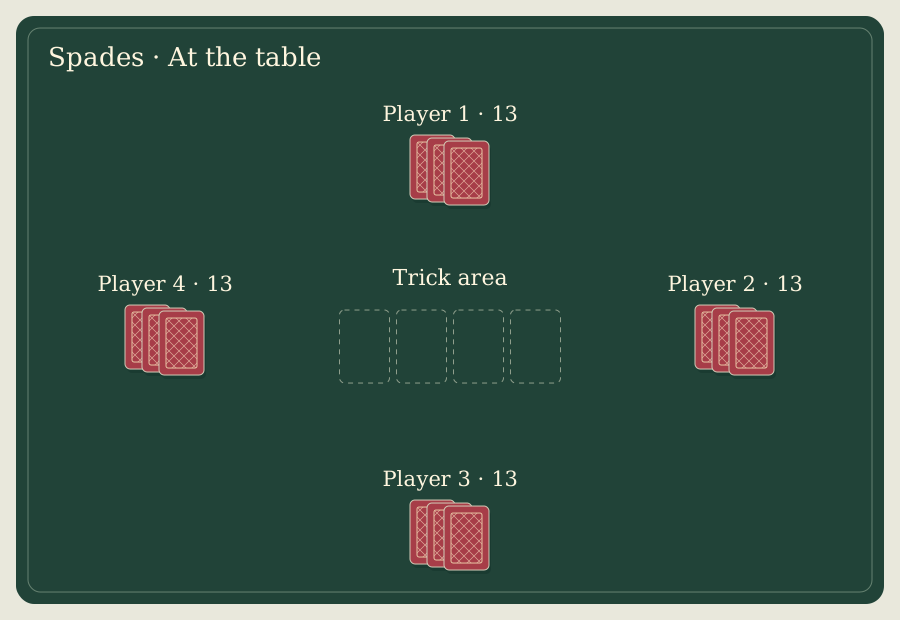
Setup and deal
A random dealer deals singly clockwise, 13 each; deal then rotates left. Starting left of dealer, everyone declares once from 0–13 expected tricks, without passing or changing the bid. Add partners’ positive bids for their team target. Zero, or nil, is a personal promise to take no tricks and is scored separately; there is no risk-free zero.
03 /
Playing a hand
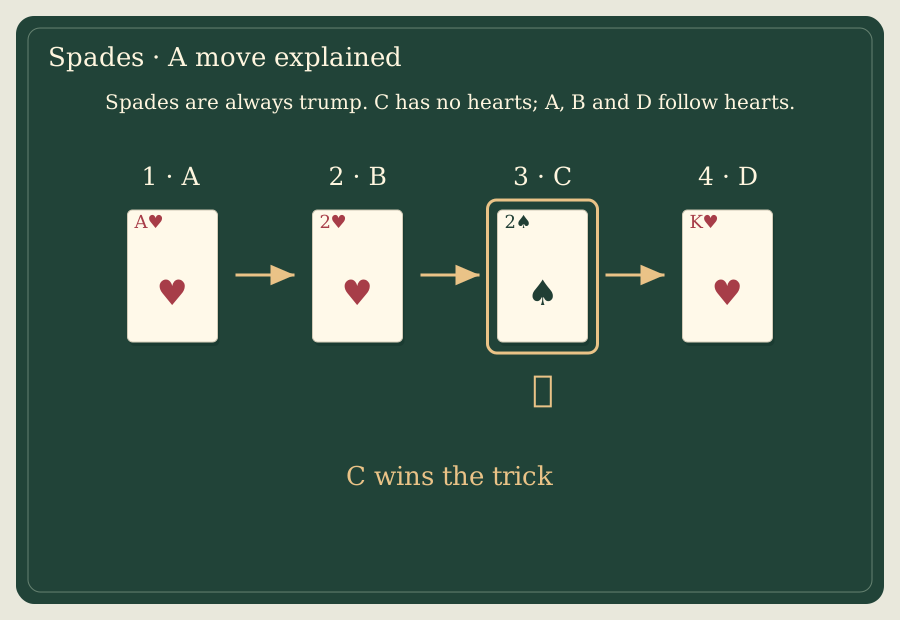
Dealer’s left leads a nonspade, unless holding only spades. Clockwise, follow suit if possible; otherwise play anything, without an obligation to trump or overtake. Highest spade wins, otherwise highest led-suit card; winner leads next. Do not lead spades until one has been played on another suit, unless only spades remain. Play all 13; track a nil bidder’s personal tricks as well as partnership tricks.
04 /
Complete scoring
A successful positive team target scores 10 × bid plus 1 for each overtrick; failure scores −10 × bid, with no trick credit. Overtricks are bags: every accumulated 10 subtracts 100; carry excess forward. Track bags separately.
Nil with no tricks gives the team +100; with a trick, −100. Score partner’s target independently. Failed nil tricks do not help partner’s target but each counts as a bag; we give no extra trick points for them. This is our explicit failed-nil accounting profile. If both bid nil, score each separately. After a complete deal, reaching 500 ends the game; if both reach it, higher total wins. Continue tied totals until different.
05 /
Worked example
A team bids 3 + 2 = 5 and takes 7: score 52 and 2 bags. With 9 old bags it now has 11: subtract 100 and retain 1 bag. In the pictured trick 2♠ beats A♥ only if its player genuinely lacked hearts.
← On a small screen, scroll the diagram horizontally. →
Common questions
Must I trump when void?+
No, any discard is allowed.