← On a small screen, scroll the diagram horizontally. →
01 /
History and selected rules
Bridge is a trick-taking card game. Contract bridge developed from whist, auction bridge and plafond; the EBU attributes the decisive scoring revision to Harold Vanderbilt in 1925. This guide selects rubber contract bridge: 4 players in fixed opposite partnerships. Bid a trick target and trump denomination, then fulfil the contract. Tournament matchpoints and IMP scoring are outside this rubber game.
02 /
Setup and deal
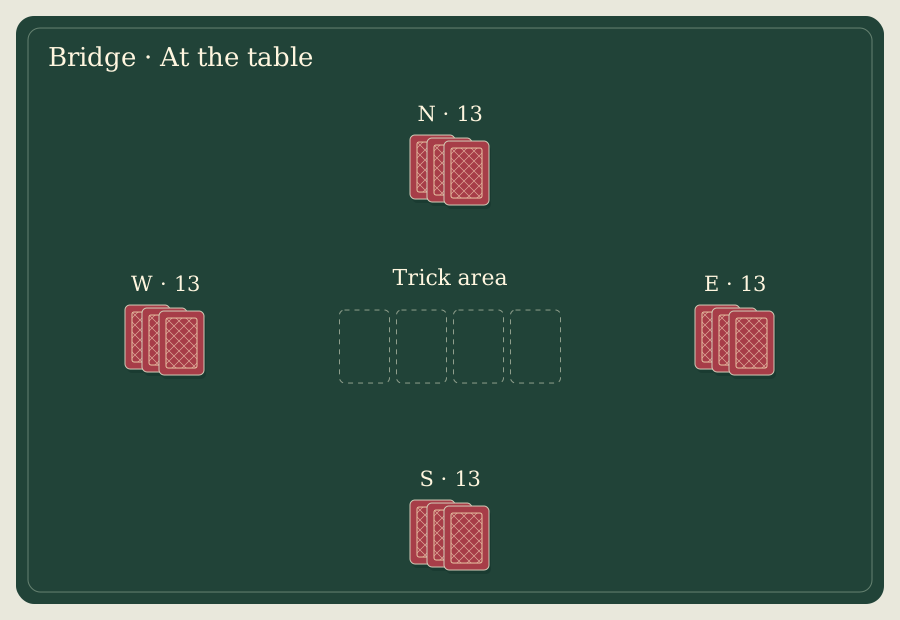
Use 52 cards without jokers, ranked A–K–Q–J–10–9–8–7–6–5–4–3–2. Suits have no play hierarchy except the chosen trump suit. Choose the first dealer randomly, shuffle, cut and deal singly clockwise, 13 cards each. Deal passes left after every deal, including a passed-out deal. Both partnerships start the rubber non-vulnerable.
03 /
Auction and partnership agreements
Dealer calls first, then clockwise. A bid names a level 1–7 and a suit or NT (no trumps), promising level + 6 tricks. Auction order is ♣ < ♦ < ♥ < ♠ < NT: raise the level, or name a higher denomination at the same level. Passing does not prevent bidding later. After a bid, double or redouble, 3 consecutive passes end the auction; 4 initial passes mean no score and a new deal.
Double only the last opposing bid, with nothing except passes intervening. Redouble only an opponent’s last double on the same condition. A new bid cancels any double or redouble. The last bid is the contract. Declarer is the winning partnership’s first player to have named the final denomination; partner becomes dummy.
For an introductory game agree an openly disclosed natural system: suit bids suggest playing that suit, NT suggests no trumps, doubles are for penalties, and there are no artificial conventions. A guide to strength is A=4, K=3, Q=2, J=1; consider opening from about 12 such points, 1NT with 15–17 and a balanced hand, otherwise your longest suit. These are recommendations and agreements, not legal requirements for a bid. Opponents may know every agreement; secret signals are forbidden.
04 /
Playing a hand
Declarer’s left-hand opponent leads. Dummy then exposes the whole hand in suit columns, trumps to dummy’s right. Declarer chooses plays from both hands, but only when the relevant hand is due to play. Dummy may not suggest a card; dummy may prevent a lead from the wrong hand and ask declarer about a possible failure to follow suit. Defenders control their own hands.
Each trick contains a card from every player, clockwise. Follow suit when possible; otherwise play anything, with no requirement to trump or overtake. Highest trump wins, or highest card of the led suit if no trump appears. The winning hand leads next: declarer cannot switch between hand and dummy at will. Normally play all 13 tricks and compare the partnership total with the contract. If an irregularity occurs, stop and apply the relevant ACBL law rather than inventing an automatic penalty.
A claim or concession can shorten play under ACBL Laws 68–69. After stating how many remaining tricks will be won or lost, declarer temporarily suspends play, exposes the hand and immediately explains a complete plan, including the order of the remaining cards. If both defenders agree, record the agreed result. If either disputes it, the regular rubber law requires play to continue with declarer’s hand exposed; declarer remains bound by the stated plan, with doubtful points resolved for the defenders. This is the selected regular rubber procedure; the alternative club laws provide for an arbiter’s decision.
05 /
Complete scoring
Draw partnership columns and a horizontal line. Below the line record only contracted tricks beyond 6 that were actually made: ♣/♦ 20 each, ♥/♠ 30 each; NT 40 for the first and 30 thereafter. Multiply this entry by 2 if doubled, by 4 if redoubled. A failed contract earns nothing below the line. All other scores go above.
Undoubled overtricks earn 20 in ♣/♦ and 30 in ♥/♠/NT. Doubled overtricks earn 100 non-vulnerable or 200 vulnerable; redoubled earn 200 or 400. Making a doubled contract adds 50, a redoubled contract 100. A bid-and-made small slam (level 6) adds 500 non-vulnerable or 750 vulnerable; a grand slam (level 7) adds 1000 or 1500. Slam bonuses combine with the other applicable awards.
Undertrick penalties go to defenders: undoubled, each missing trick costs 50 non-vulnerable or 100 vulnerable. Doubled non-vulnerable: first 100, second and third 200 each, fourth and every later 300. Doubled vulnerable: first 200, every later 300. Redoubling doubles those doubled penalties. The defeated declaring side receives no contract points.
Honours go to either side regardless of success: holding 4 of trump A–K–Q–J–10 in one hand earns 100; all 5 earns 150; at NT all 4 aces in one hand earns 150. Do not combine partners’ holdings. Claim before the next hand has been dealt or the rubber has been completed and scored, whichever comes first.
06 /
Ending and result
The first partnership to accumulate at least 100 below the line in one or more deals wins a game and stays vulnerable for the rest of the rubber. Draw a new line beneath both partnerships’ entries. Earlier partscores remain in the final total but no longer help win the next game: both sides begin its progress from zero.
The first side to win 2 games ends the rubber and receives 700 above the line if opponents won no game, otherwise 500. Add every entry above and below all lines for each side. The net result is the difference between totals; equal totals are a draw. Winning the rubber and winning the overall points need not belong to the same side. Money is optional. If stopping early, add 300 to the side that won the only completed game, and 100 to the side with the only partscore in the unfinished game. If both have partscores, neither receives that premium. Do not add a duplicate-style game bonus.
07 /
Worked example
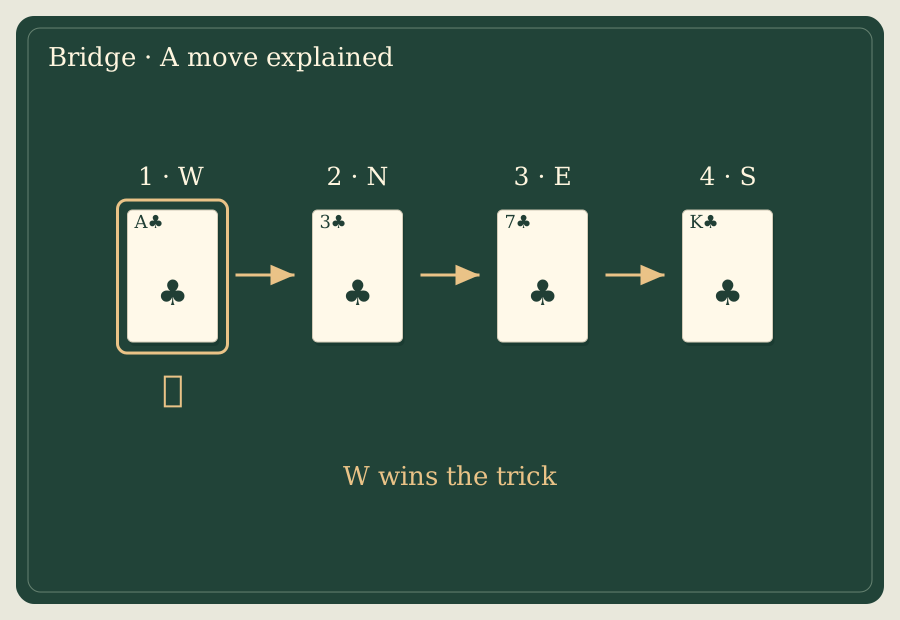
South opens 1♥, West passes, North bids 2♥, East passes, South bids 4♥; 3 passes follow. South declares because South first named hearts for that side. West leads A♣ and North exposes dummy. On A♣–3♣–7♣–K♣, West wins: K♣ does not outrank the ace.
South eventually takes 11 tricks: 120 below the line for 4♥ and 30 above for the overtrick. That wins a game and makes the pair vulnerable. Later, exactly making 3NT earns 100 below and a second game. If opponents won no game and there were no other scores, the pair totals 120 + 30 + 100 + 700 = 950. A doubled non-vulnerable contract down 3 instead gives defenders 100 + 200 + 200 = 500 above the line.
← On a small screen, scroll the diagram horizontally. →
Common questions
Does dummy choose a card?+
No. Declarer controls both hands in their proper turns; dummy does not advise.
Do overtricks count towards game?+
No. They go above the line. Only contracted and made trick points, including doubling, count towards game.
May I bid after passing?+
Yes, while the auction is still open.