← On a small screen, scroll the diagram horizontally. →
01 /
The contract and the deal
For 3–7 players use 52 cards; rank A K Q J 10 9 8 7 6 5 4 3 2. Choose dealer by lot. Shuffle, let the right neighbour cut, deal 5 each clockwise in packets of 3 then 2. With four players, 20 are dealt and 32 stay unused. No exchanges. Each deal creates one bidder against all others; defenders cooperate through legal play, without showing cards or giving instructions.
02 /
One chance to speak
Starting left of dealer, each player speaks once clockwise, dealer last. Pass or overcall the current bid. Order: Three < Four < Nap < Wellington. Three and Four promise at least 3 or 4 tricks; Nap and Wellington require all 5. Wellington is legal only after someone has bid Nap. Passing ends your chance; no second auction circuit. If all pass, collect cards and next dealer deals without payment.
03 /
The opening card sets trumps
Highest bidder leads any card: its suit becomes trump for the entire deal. Follow the led suit when able. Without it, play any card; you need not trump or overtrump. Highest trump wins, otherwise highest card of the led suit. Winner leads next. Cards have no point values. Resolve all 5 tricks for the teaching record, or stop when success or failure is certain and everyone agrees.
04 /
Pay the contract, not the overtricks
Use ledger units rather than money. Each opponent pays a successful bidder 3 for Three, 4 for Four, 5 for Nap, 10 for Wellington. If the contract fails, bidder pays that same amount to each opponent. Extra tricks do not increase the tariff. Complete a pre-agreed number of dealer rotations; highest net total wins, ties share. Start from zero and check that all balances sum to zero after each hand.
05 /
A complete four-player deal
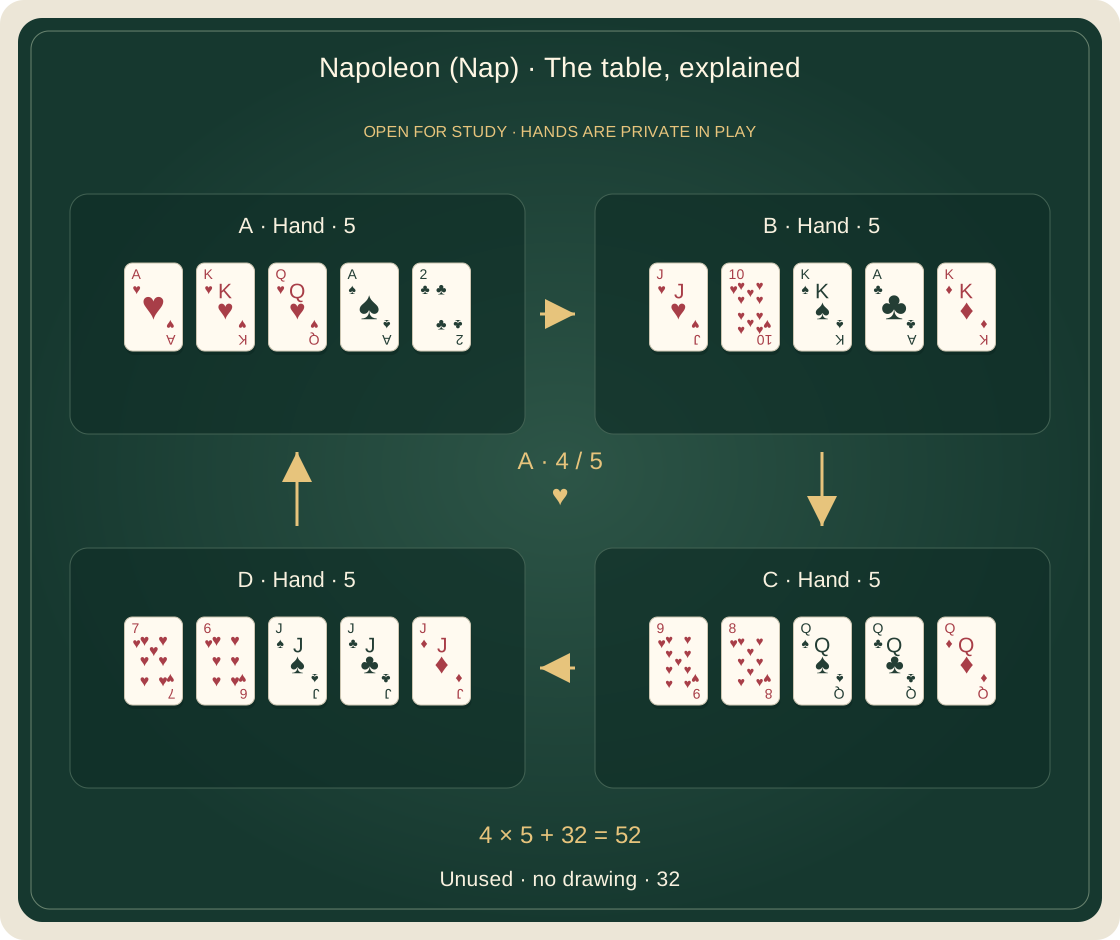
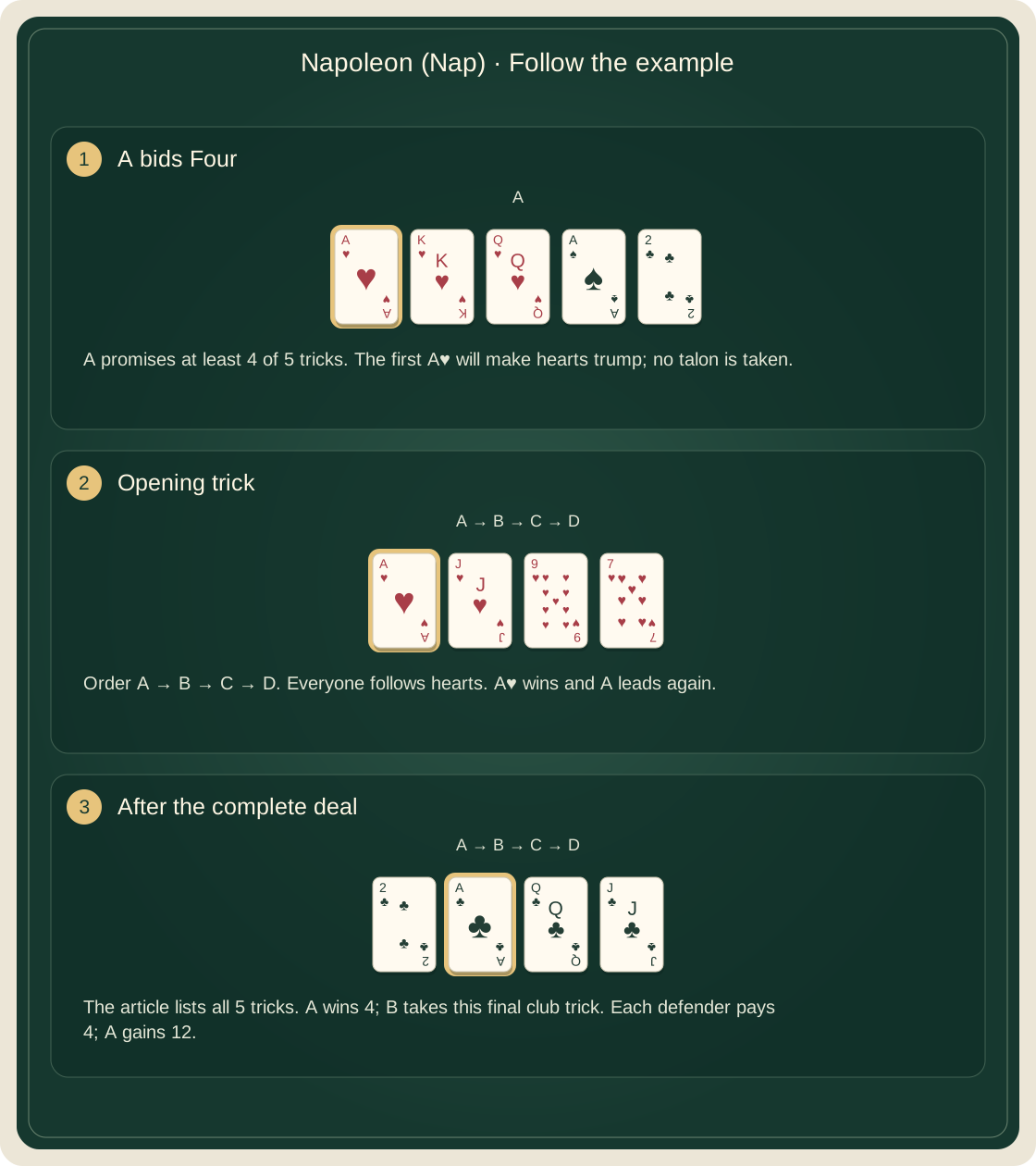
A bids Four; B, C and D pass. All hands are open only for study. The opening A♥ makes hearts trump. Every row below is played in A → B → C → D order.
A: A♥ K♥ Q♥ A♠ 2♣
B: J♥ 10♥ K♠ A♣ K♦
C: 9♥ 8♥ Q♠ Q♣ Q♦
D: 7♥ 6♥ J♠ J♣ J♦
| # | A | B | C | D | ✓ |
|---|---|---|---|---|---|
| 1 | A♥ | J♥ | 9♥ | 7♥ | A |
| 2 | K♥ | 10♥ | 8♥ | 6♥ | A |
| 3 | Q♥ | K♦ | Q♦ | J♦ | A |
| 4 | A♠ | K♠ | Q♠ | J♠ | A |
| 5 | 2♣ | A♣ | Q♣ | J♣ | B |
A takes 4 tricks, B takes 1. Each defender pays 4: A gains 12, the others lose 4 each; 12 − 4 − 4 − 4 = 0. If A had taken only 3, A would lose 12 instead. The undealt cards never enter play.
← On a small screen, scroll the diagram horizontally. →
06 /
The British game and its other tariffs
The historical account identifies H. E. Heather’s rules in an 1875 issue of The Bazaar; later descriptions add contracts and alternative payments. The name does not make this the unrelated Japanese Napoleon. Two, Misère, Blücher, floater exchanges and doubled Nap payments belong to other profiles. Agree any change before dealing: a table paying ten for a successful Nap cannot use this page’s base settlement unchanged.
Common questions
Must I trump when void?+
No. Following suit is compulsory; trumping is optional when void.
May I bid Wellington first?+
No. Another player must already have bid Nap.
Can the bidder take the unused cards?+
No. This profile has no talon or floater.