← On a small screen, scroll the diagram horizontally. →
01 /
A stops game despite the rummy name
Michigan Rummy is an ambiguous name. It can mean a multi-stage Three in One or Tripoli game, while many household guides use it for a single stops game with a payment layout. We select the latter: four pay-card spaces and a kitty, with no poker phase or rummy melds. Michigan belongs to the older stops tradition also associated with Boodle and Newmarket; branded boards do not all use the same rules. No single inventor of this selected household form is established.
02 /
A printed layout and a spare hand
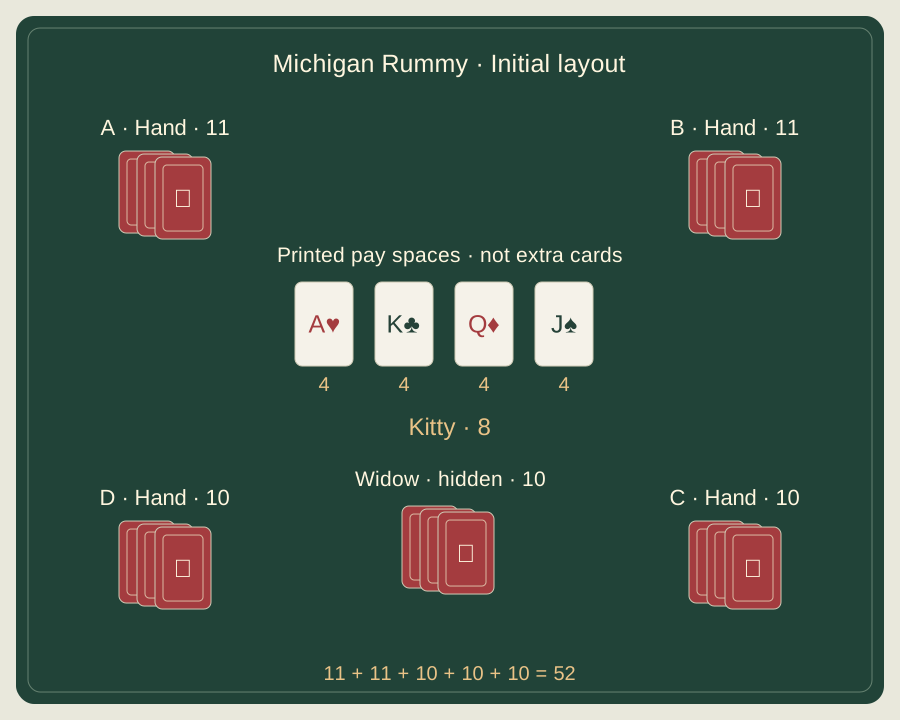
For 3–8 people use 52 cards, no jokers; ranks rise 2 3 4 5 6 7 8 9 10 J Q K A. Mark spaces A♥ K♣ Q♦ J♠ and Kitty on paper. They are labels, not cards removed from the pack. Use a points ledger or equal play-chip supplies. Before each deal everyone puts 1 on each card space and 2 into Kitty. With 4 players each card space gets 4, Kitty 8. Unclaimed previous balances remain and receive the new contributions.
03 /
Deal to the players plus a widow
Choose first dealer by high-card cut and rotate left. Shuffle, cut from the right, deal every card clockwise singly into one hand per player plus one spare widow, dealt last in each circuit. Unequal sizes are correct. With 4 players there are 5 hands: 11, 11, 10, 10, 10; the last is widow. Leave it hidden throughout the hand; no draw stock. This profile omits trading and auctioning the widow. Left of dealer starts. Do not open widow to identify a missing card during play.
04 /
The next card’s owner plays
Lead the lowest card you hold in any chosen suit. Whoever holds the immediately next higher card of that suit must play it, then the next owner, regardless of seating or the dealer order. A player can play consecutive cards if they hold them. Keep played cards visibly with their owners. Continue until ace, or until no player holds the next card because it is in widow or already played. That is a stop. You cannot jump a missing rank, change suit mid-sequence, or play a higher lead while keeping a lower card of the same suit.
05 /
Restart after a stop and collect pay cards
Last player to play at a stop starts again with their lowest card of a different suit if possible; if holding only the old suit, they may restart that suit from their lowest remaining card. This explicit fallback prevents a blocked table. Whenever you legally play A♥ K♣ Q♦ or J♠ collect the entire corresponding space immediately, not merely for holding it. Empty spaces refill only at the next deal. Cards in widow cannot win a payment. There is no reward merely for causing a stop and no special strength attached to a pay card.
06 /
First empty hand takes the kitty
As soon as anyone plays their last card, stop immediately. They collect Kitty and 1 chip per card still held by each opponent. No further sequence cards are played, even if available. Other unclaimed spaces carry into the next deal. For a finite session agree complete dealer rotations. At the agreed end our table convention shares residual layout balances equally, using fractional ledger points if needed; highest final balance wins, ties share. A wrong deal or irrecoverable illegal play is redealt by the same dealer after restoring the ledger, with no extra ante.
07 /
Owners jump around the table
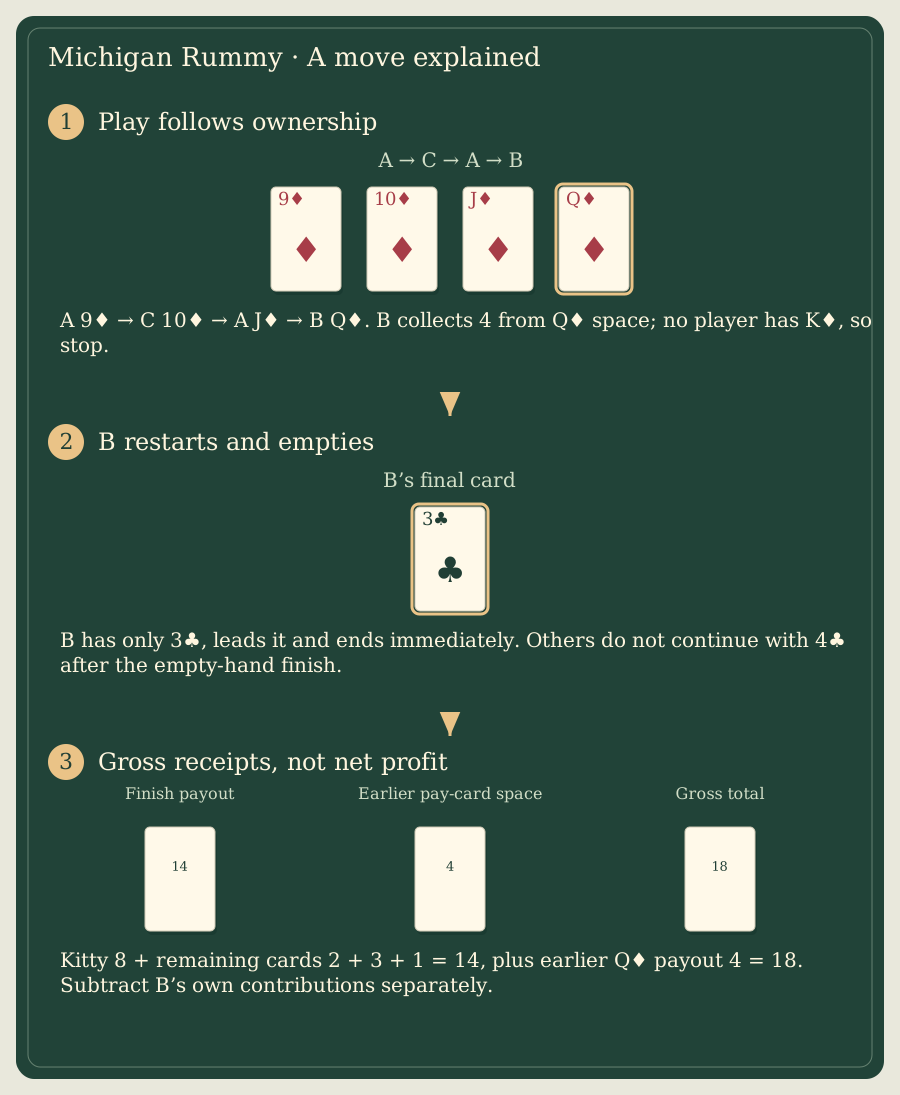
A leads 9♦, C owns and plays 10♦, A owns J♦ and plays again, B plays Q♦ and collects its space of 4. Nobody holds K♦: it is in widow, so Q♦ is a stop. B’s only remaining card is 3♣; B leads it and immediately finishes. Opponents have 2, 3 and 1 cards; Kitty is 8. B gains 8 + 2 + 3 + 1 = 14 at the finish, plus the earlier 4 = 18 gross receipts, before subtracting B’s contributions. The sequence is not restricted to A then B then C; do not skip 10♦ just because B lacks it.
← On a small screen, scroll the diagram horizontally. →
Common questions
Do players act clockwise?+
Dealing does; a sequence is played by whoever owns each next card.
Are the board cards removed?+
No, the board uses printed references; the full pack is dealt.
Must I play poker first?+
No. This guide selects the single-phase stops form.