← On a small screen, scroll the diagram horizontally. →
01 /
History and selected rules
The Chinese game “Fight the Landlord” is associated with Hubei; its exact invention date is not established. This is the usual 3-player form: landlord against a temporary farmer partnership, using 54 cards with distinguishable high and low jokers. Suits are equal. Ascending ranks: 3–4–5–6–7–8–9–10–J–Q–K–A–2–low joker–high joker.
02 /
Setup and deal
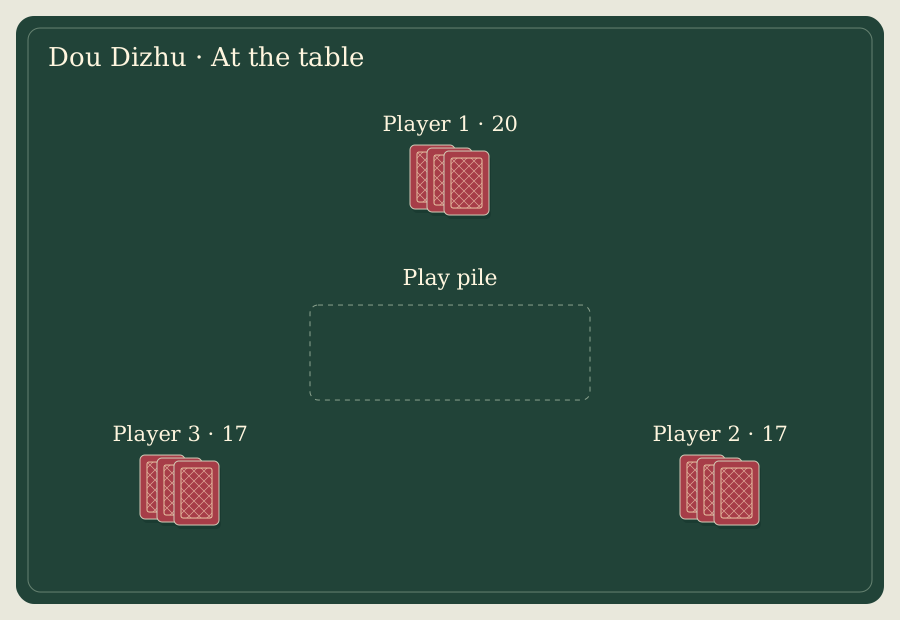
Choose a dealer randomly and mark a card face up within the shuffled pack. Draw cards anticlockwise until each has 17; leave the last 3 face down. The marked-card holder bids first. Pass or bid a higher 1, 2 or 3; after a bid, 2 consecutive passes or a bid of 3 end the auction. Redeal if all pass. Highest bidder becomes landlord, exposes and takes the remaining 3, holding 20. Exposing the reserve is our chosen agreement.
03 /
Playing a hand
Landlord leads any legal combination. Anticlockwise, pass or beat it with the same type and length. A pass does not bar a later play. After 2 consecutive passes clear the table; the last player to play leads afresh. Exceptions: a bomb (four equal ranks) beats any ordinary combination; only a higher bomb or the rocket of both jokers beats it. The rocket is unbeatable.
Ordinary plays are a single; pair; triple; triple plus a separate single or pair; at least 5 consecutive singles; at least 3 consecutive pairs; at least 2 consecutive triples. Sequences use only 3–A, never 2 or jokers. Compare the sequence’s highest rank or the principal triple, ignoring attachments.
A triple sequence may attach a single per triple or a separate pair per triple. Single attachments may match one another but not the triples; attached pairs have distinct ranks. Never mix singles and pairs. The jokers cannot both be attachments together. Also legal: four equal cards plus 2 different singles or 2 distinct pairs. This is an ordinary quadplex, ranked by its four, not a bomb. Attachments differ from the principal ranks; 2 is allowed. Equal principal ranks cannot beat each other.
04 /
Ending and result
The first empty hand immediately ends the deal. Either farmer finishing wins for both. Base value is the landlord’s bid; multiply by 2 for every bomb or rocket actually played. Double again for spring: landlord wins before either farmer plays, or farmers win with landlord having played only the opening combination. A winning landlord receives that value from each farmer; a losing landlord pays each. Keep points rather than money; changes sum to zero. Agree a deal count for a session; equal final totals tie.
05 /
Worked example
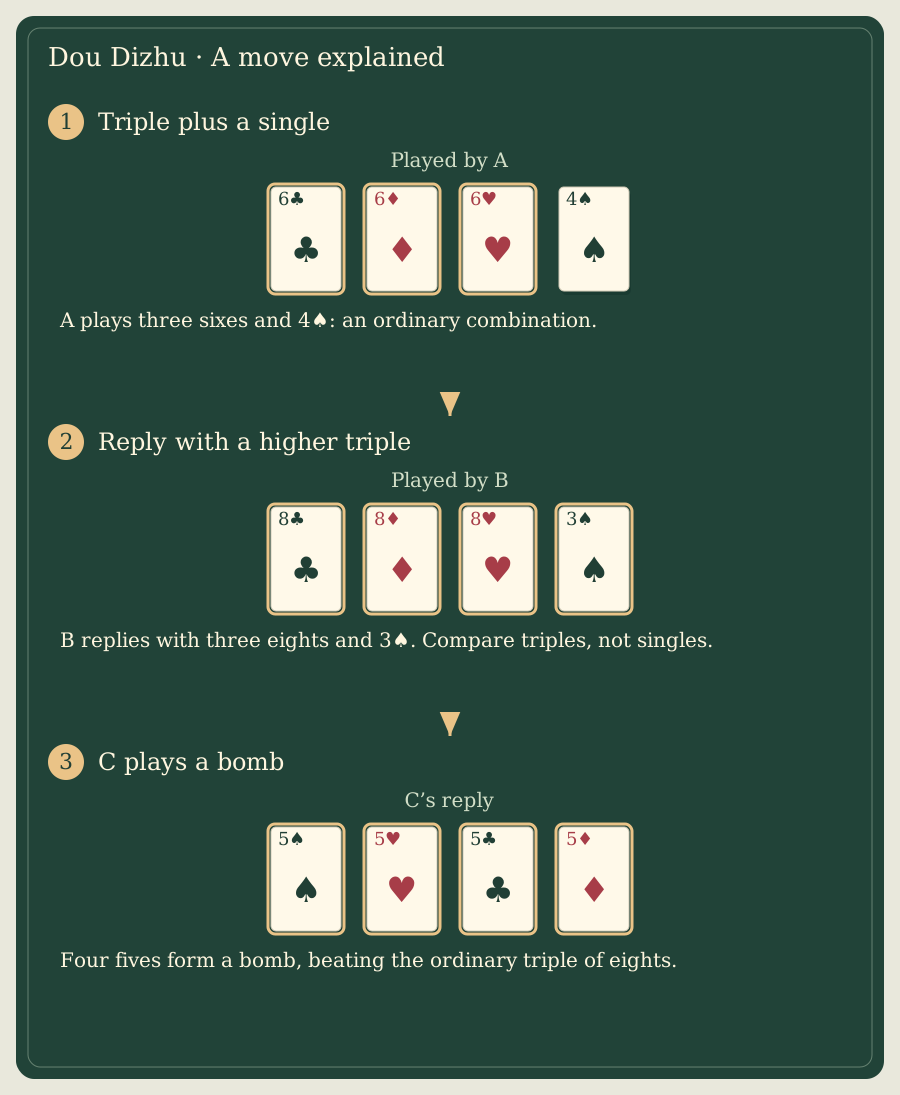
Against 6–6–6–4, play 8–8–8–3: the triple matters, not the attachment. An opponent can bomb with 5–5–5–5 despite its lower rank. With bid 2, that sole bomb and no spring, value is 4 per farmer: a winning landlord records +8 and the farmers −4 each.
← On a small screen, scroll the diagram horizontally. →
Common questions
May I beat my partner?+
Yes, but either farmer going out wins for both.
Is a quad with attachments a bomb?+
No. It is an ordinary combination of its own type.