← On a small screen, scroll the diagram horizontally. →
01 /
History and selected rules
Crazy Eights belongs to a widely varied family of suit-or-rank matching games; no precise inventor or date is established here. Select the simple Bicycle profile for 2–5 players: 52 cards, only eights special. There are no penalty twos, queen skips, reversals or required last-card call.
02 /
Setup and deal
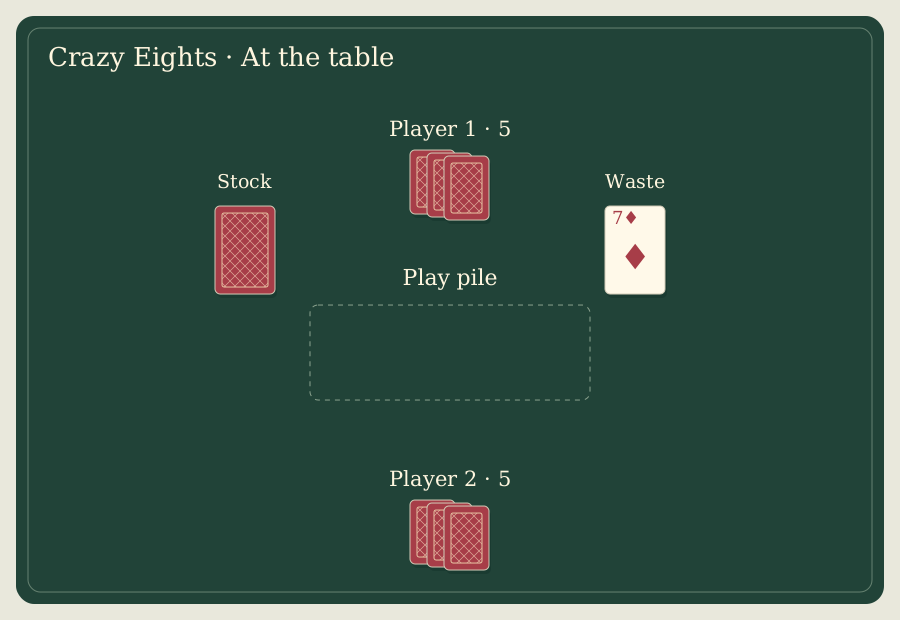
Choose the first dealer randomly, then rotate left. Deal 5 singly clockwise to each, keeping a closed stock. Expose the starter discard; bury an eight within stock and expose another. Dealer’s left begins, always proceeding clockwise.
03 /
Playing a hand
Play one card matching suit or rank. Any eight may cover anything: name a suit. After it, play that named suit or another eight; the previous printed rank no longer applies. You may finish on an eight.
Without a play, draw singly until able to play, then play. We allow choosing to draw one instead of an available play; thereafter the same rule applies. Do not recycle stock: when empty and unable to play, pass. Never take buried discards. A full circle of passes without changing the table blocks the hand.
04 /
Complete scoring
An empty hand wins immediately, earning the total opponents’ remaining values: 8=50, K/Q/J/10=10, A=1, others face value. Our blocked-hand agreement declares no winner and records each remaining value as a penalty. For a series, use remaining-hand penalties throughout instead, an empty winner scoring 0. Agree the deal count; lowest total wins, ties draw. Do not mix the two scoring methods within a session.
05 /
Worked example
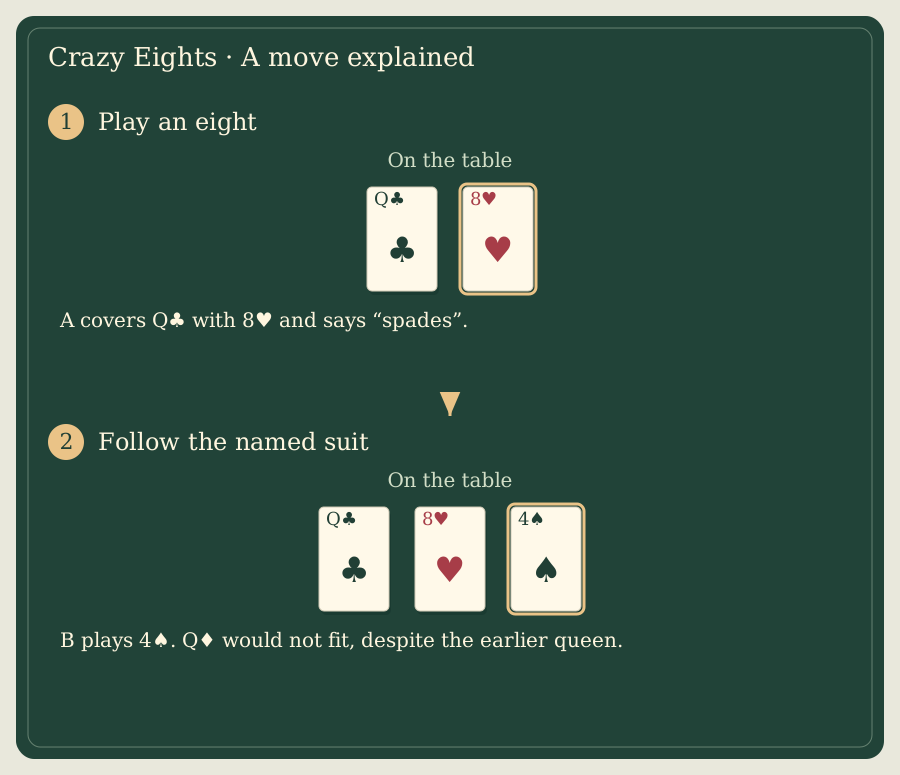
On Q♣, Q♦, 4♣ or 8♥ is legal. After 8♥ naming spades, Q♦ no longer fits: play a spade or an eight.
← On a small screen, scroll the diagram horizontally. →
Common questions
Does an eight force a draw?+
No. Here it only chooses a suit.