← On a small screen, scroll the diagram horizontally. →
01 /
History and selected rules
Big Two is played in China and Southeast Asia; its precise origin is uncertain. We select a Chinese-style 4-player individual game without monetary liability for helping a neighbour. Use 52 cards. Ascending ranks are 3–4–5–6–7–8–9–10–J–Q–K–A–2; suits ♦ < ♣ < ♥ < ♠. Do not import the different Pusoy Dos suit order.
02 /
Setup and deal
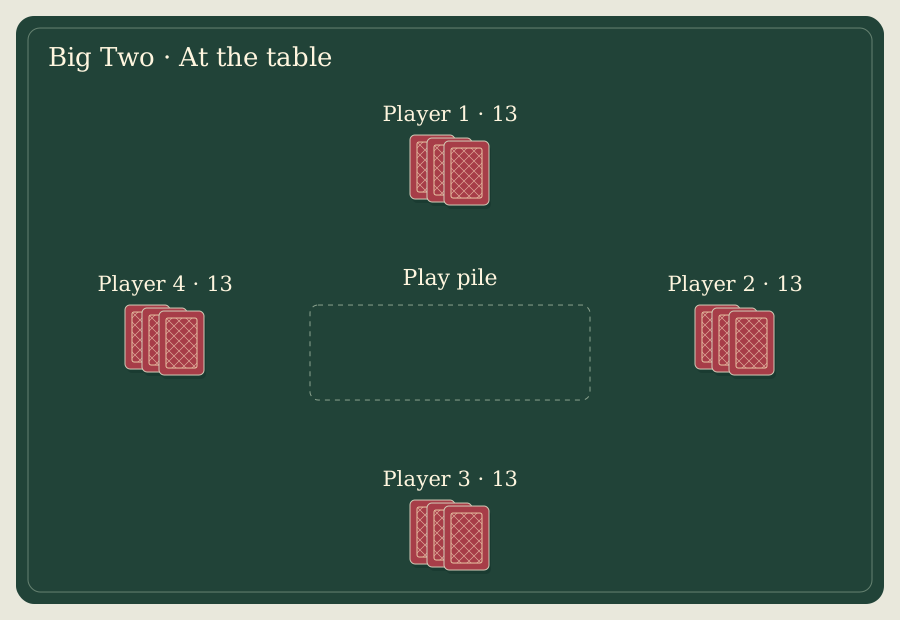
Choose the first dealer randomly; later the winner deals. Use the simpler deal beginning to dealer’s right, singly anticlockwise, 13 each. Holder of 3♦ opens with a combination containing it. Play anticlockwise. A later fresh lead may be any legal combination.
03 /
Playing a hand
Play a higher combination of the same length or pass, even when able to beat it. Passing does not bar re-entry. After 3 consecutive passes clear the table; the last player leads afresh. Answer remaining-card counts truthfully when asked.
Legal plays: single; equal-rank pair; triple; or a five-card group. Compare pairs by rank then highest suit; singles likewise, triples by rank. Five-card types ascend: straight, flush, full house, four of a kind plus a spare card, straight flush. A higher five-card category beats a lower one, never a pair or single. Bare quads and two-pair hands are illegal.
Straights contain 5 consecutive ranks: A–2–3–4–5 is lowest, then 2–3–4–5–6; 10–J–Q–K–A is highest. Never wrap K–A–2. Compare top rank, then its suit; likewise for straight flushes. Compare flushes by suit first, then cards descending; the latter is our explicit equal-top agreement. Full houses compare triples; quads compare their four. The 2 remains high in pairs, triples, quads and flush comparisons.
04 /
Ending and result
The first empty hand wins immediately; nobody beats the final play. Others receive penalties for remaining cards: up to 9 cards, 1 each; 10–12 cards, 2 each; all 13, 3 each, totalling 39. Winner scores zero. Agree the session’s deal count; lowest cumulative penalty wins, ties share victory.
05 /
Worked example
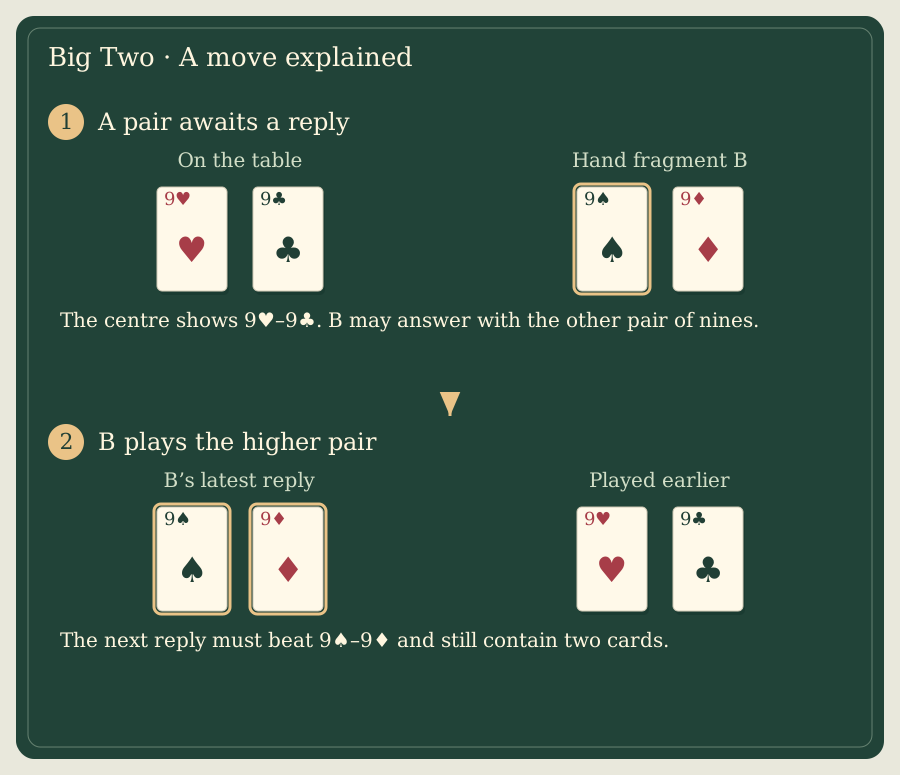
9♠–9♦ beats 9♥–9♣ because of spades. But that pair cannot answer a single 3♦: card counts must match. If you have 11 cards when someone wins, record 22 penalty points.
← On a small screen, scroll the diagram horizontally. →
Common questions
Is a two always highest?+
In ordinary groups yes, but not in this variant’s straights.