← On a small screen, scroll the diagram horizontally. →
01 /
Western India’s game of tens
Mendikot is a partnership trick game associated with Maharashtra and Gujarat. The name is explained by contributors through a word for zero referring to the ten’s printed zero; English spellings include Mendhi Coat. It is related to Dehla Pakad but does not require consecutive trick wins to collect cards. This guide selects the publicly chosen trump method, avoiding the different timing rules of closed hukum. A single invention date is not securely established. The aim is to capture tens, not to total face-card values.
02 /
Opposite partners, anticlockwise play
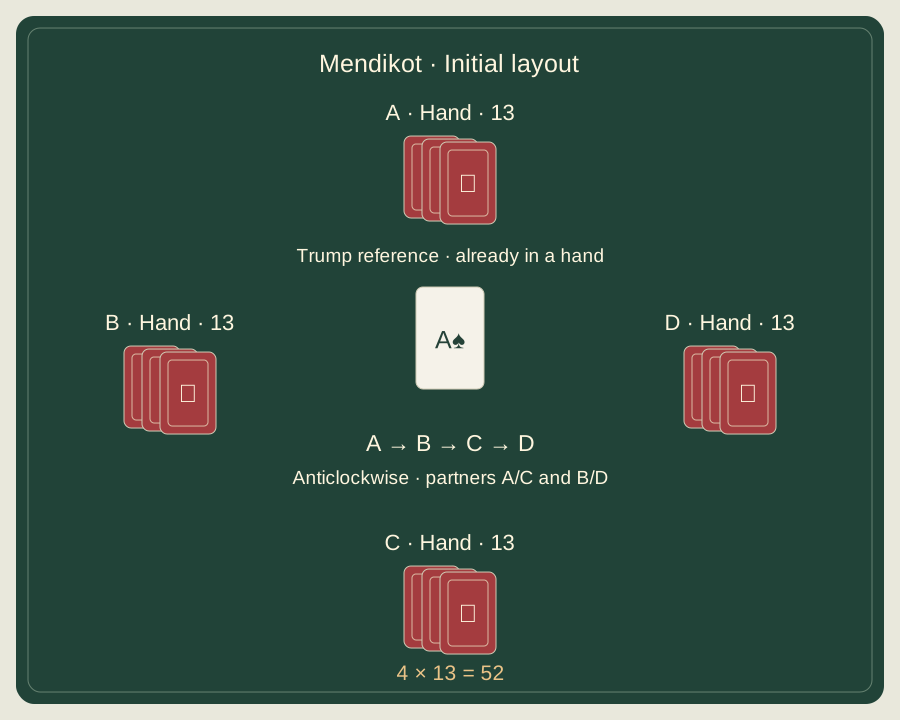
Exactly 4 players use 52 cards without jokers, partners opposite. Rank A K Q J 10 9 8 7 6 5 4 3 2 in each suit. Highest drawn card chooses first dealer; redraw ties. Dealer shuffles; player to the right randomly displays 1 card to establish trump and returns it to the pack. Shuffle again, cut from the left, deal anticlockwise in batches 5 + 4 + 4: 13 each, no stock or spare indicator. All know trump before play. The displayed card is included in a hand, not left outside the pack.
03 /
Follow suit; heading is optional
Player to dealer’s right leads any card. Each plays 1 anticlockwise. Follow the led suit whenever possible. If void, play any card: trumping is optional, as is overtrumping. You need not beat an opponent or your partner. Highest trump wins; without trump, highest card of the led suit wins. Winner takes all 4 into the team’s captured pile and leads next. No bids, drawing, melds or separate payments for aces or kings. Play all 13 tricks, keeping captured tens distinguishable for scoring without exposing private hands.
04 /
Tens decide before the trick count
A team taking 3 or 4 of the tens wins the deal, regardless of trick majority. At 2 tens each, the team with at least 7 tricks wins. All 4 tens is mendikot; all 13 tricks is a whitewash, also called a 52-card mendikot. Other cards have no numerical capture value. The tradition has no single universal session-point tariff. Our optional ledger records 1 win per deal, marks mendikot and whitewash as distinctions without multipliers, and stops after an agreed number of deals; most wins wins, equal totals share.
05 /
The losing side supplies the next dealer
If dealer’s team loses, the same dealer continues, except after losing all tricks: then dealer’s partner deals. If dealer’s team wins, deal passes to the right, a member of the losing side. This is not an automatic rotation around the table. Before the next deal return every captured card and reshuffle. A wrong hand size or exposed dealt card is corrected by redealing with the same dealer. For a discovered failure to follow, pause and restore the trick if possible; our learning agreement redeals an irrecoverable position without recording a win.
06 /
Closed and first-cut trumps stay separate
Other tables use cut hukum: no initial trump, and the first off-suit card establishes it. Closed hukum instead reserves a hidden card; its reveal can be automatic on a void or requested with a trumping obligation, depending on the agreed version. Those versions even differ on whether earlier cards of that suit count as trumps. Do not add either reveal rule to this public-trump game. For larger teams the pack and deal change; this article’s illustrated profile remains the fixed partnership game.
07 /
Capture a ten, then compare the whole deal
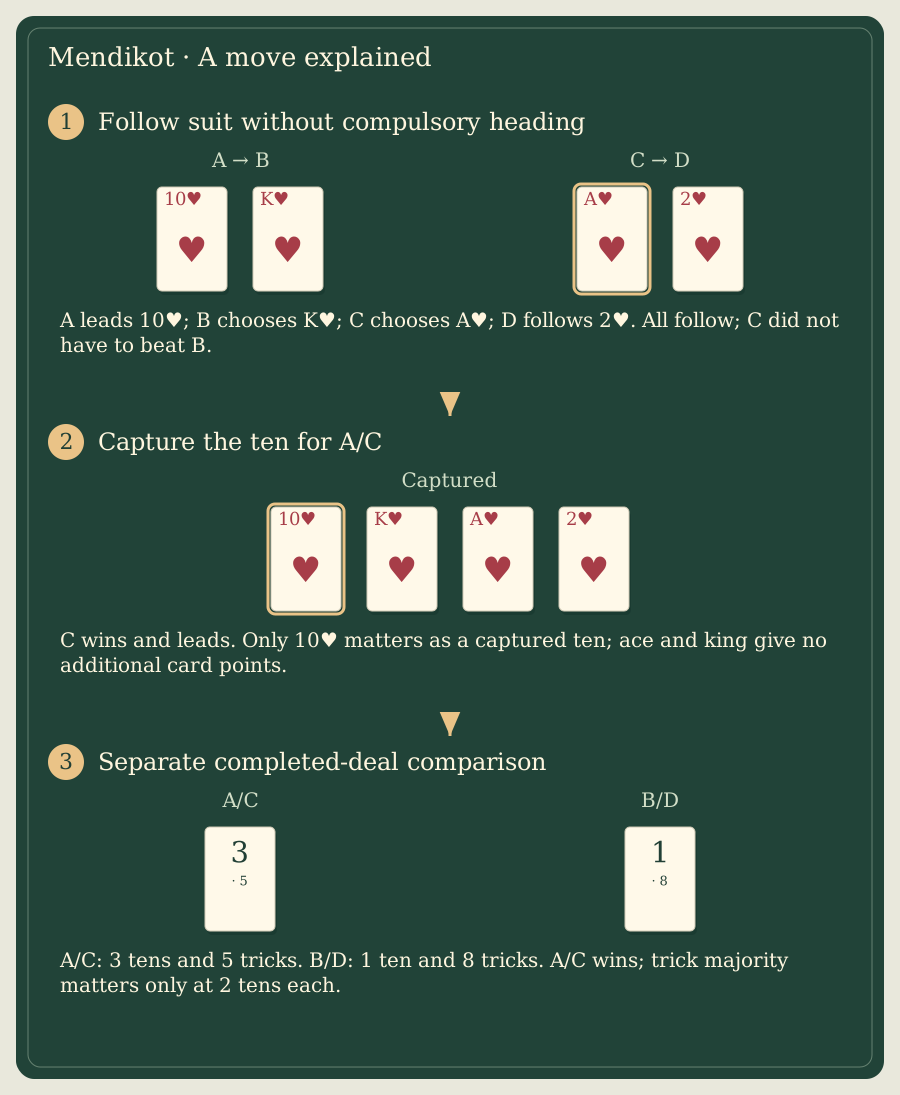
Spades trump; A and C partner, B and D partner, playing A → B → C → D anticlockwise. A leads 10♥, B chooses K♥, C chooses A♥, D follows 2♥. C captures the ten and leads next; C was not obliged to overtake K♥. In a completed deal A/C have only 5 tricks but 3 tens: they win against 8 tricks and 1 ten. In another deal with 2 tens each, the 7-trick side wins over 6. Do not award extra card points for the ace or king in the picture.
← On a small screen, scroll the diagram horizontally. →
Common questions
Must I beat the current winner?+
No. Follow suit if possible; heading and trumping are optional.
Do more tricks always win?+
Only when both teams captured equal numbers of tens.
Does dealer always rotate?+
No. The result chooses the next dealer from the losing side.