← On a small screen, scroll the diagram horizontally. →
01 /
A familiar name with local house rules
Mau Mau belongs to the matching-and-shedding family played widely in Germany and neighbouring countries. It shares a mechanism with Crazy Eights, but named cards and calls vary by household. Short Skat packs are traditional in some German regions; this guide uses the full international pack. There is no claim that every family uses this exact code. We select stackable sevens, skipping eights and wild jacks, with no ace or king powers and no reverse card. A precise inventor is not established.
02 /
Deal five and activate the starter
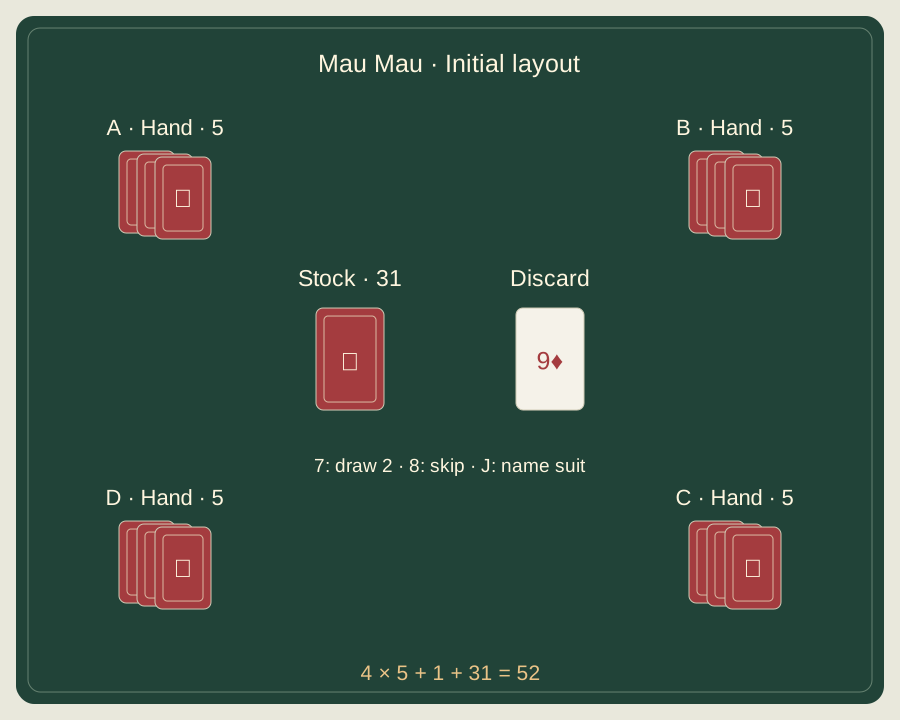
For 2–6 players use 52 cards without jokers. Choose dealer randomly and rotate clockwise. Deal 5 each singly, place remainder face down, turn 1 starter. With 4: 20 held, 1 discard and 31 stock. Start left of dealer, clockwise. A starter 7 begins a draw-2 obligation, an 8 skips first player, a J lets dealer name the starting suit. All other starters simply show suit and rank. Agree the scored-match target of 100 penalty points before beginning; the least total will win.
03 /
One match or one draw
Normally play 1 card matching the top discard’s rank or suit. If no legal play, draw 1; you may immediately play that drawn card if legal, otherwise keep it and end the turn. Do not play a different hand card after drawing. A J may be played on any normal top, including another J, and names any suit. After a J, play that named suit or another J; the jack’s printed suit is irrelevant. There is no obligation to beat a card, no trump and no trick capture.
04 /
Sevens accumulate, eights skip
A played 7 imposes 2 cards on the next player. They may play any 7 instead, adding 2 to the pending debt; otherwise draw the whole debt and lose the turn. A J or an 8 cannot cancel it, and penalty cards cannot be played immediately. Once paid, debt clears and the last seven supplies the ordinary suit and rank. An 8 skips the next seat; with 2 players you play again. Refill an empty stock by shuffling old discards while preserving the top and any named suit or pending debt.
05 /
Mau, Mau Mau and a fair finish
Say “Mau” after a play leaving 1 card and “Mau Mau” with the last. If another player notices a missing call before the next player completes a turn, draw 2 and continue instead of winning. A correctly called last card wins immediately, even a special card: this profile does not collect a final seven penalty after the finish. For disputes pause before moving more cards. If a required draw is impossible even after recycling, our explicit fallback stops the round and scores hands as held; no empty-hand winner is awarded.
06 /
Penalty totals, not card strength
Winner records 0. Others count every held card: A K Q J cost 10 each, numerals face value. Add round totals; after any player reaches 100, lowest cumulative total wins, ties share in this selected profile. The card that caused a penalty has no extra score multiplier. For example K♣ 7♦ 2♠ costs 10 + 7 + 2 = 19. A missed call adds cards to the hand rather than a fixed score deduction. A short casual game may stop after one round, agreed before dealing.
07 /
A chain adds two, never doubles
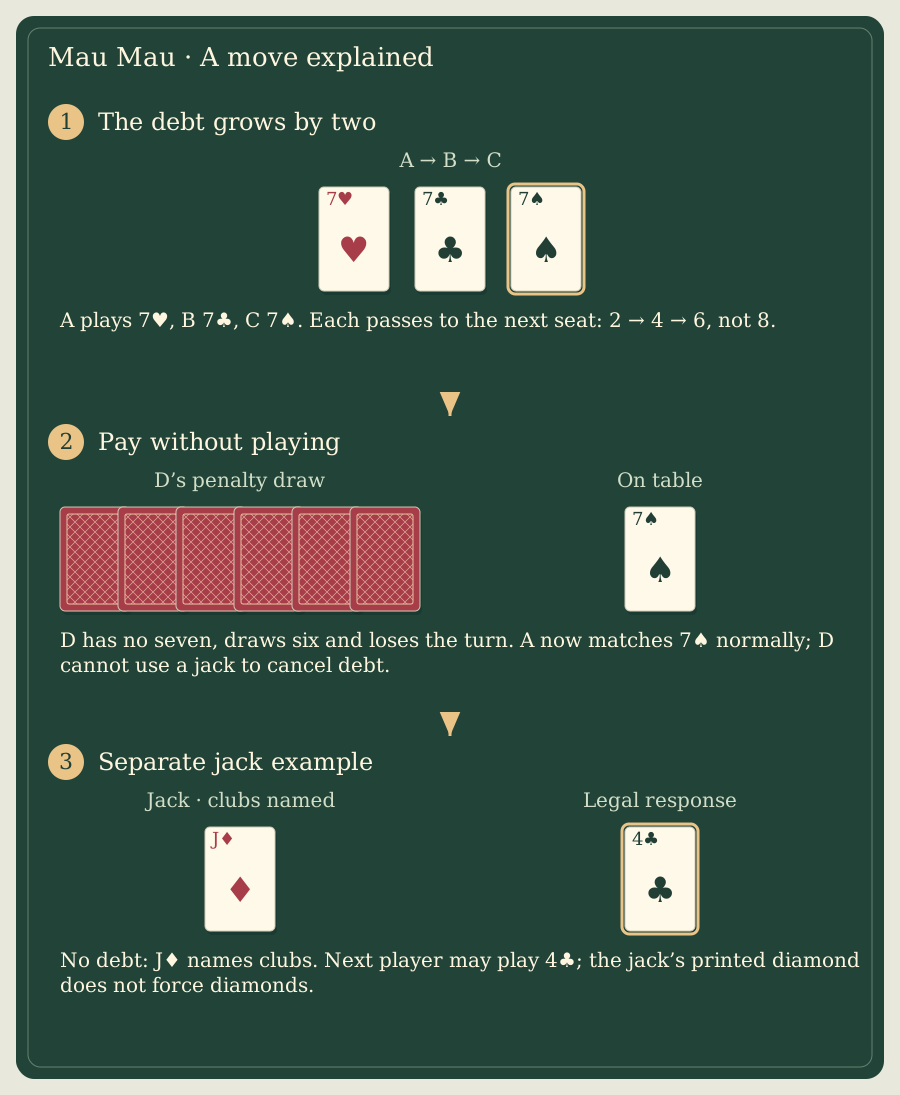
A plays 7♥. B responds 7♣, passing debt of 4. C plays 7♠, passing 6, not 8. D has no seven and draws 6 without playing, then A acts on 7♠ normally. These are individual turns; D cannot dodge the debt with J♦. In a separate position with no debt, A plays J♦ naming clubs; B must play a club or another jack, not any diamond. The diagrams show local examples rather than a full deal.
← On a small screen, scroll the diagram horizontally. →
Common questions
Does seven debt double?+
No, every additional seven adds the same draw penalty.
Can a jack cancel debt?+
No, respond with a seven or pay the debt and miss the turn.
Can I use a short pack?+
Yes as a separate agreed version, with a smaller starting stock.