← On a small screen, scroll the diagram horizontally. →
01 /
Lanterloo in a three-card form
Loo, shortened from Lanterlu, appears in English card manuals from the seventeenth century and later became known in America. Older books describe both five-card and three-card forms. We use limited three-card Loo: taking no trick costs a fixed penalty rather than the whole growing pool. Its changing simple-pool and double-pool procedures matter; treating every deal like ordinary whist misses much of the game.
02 /
A fixed penalty and a rotating dealer
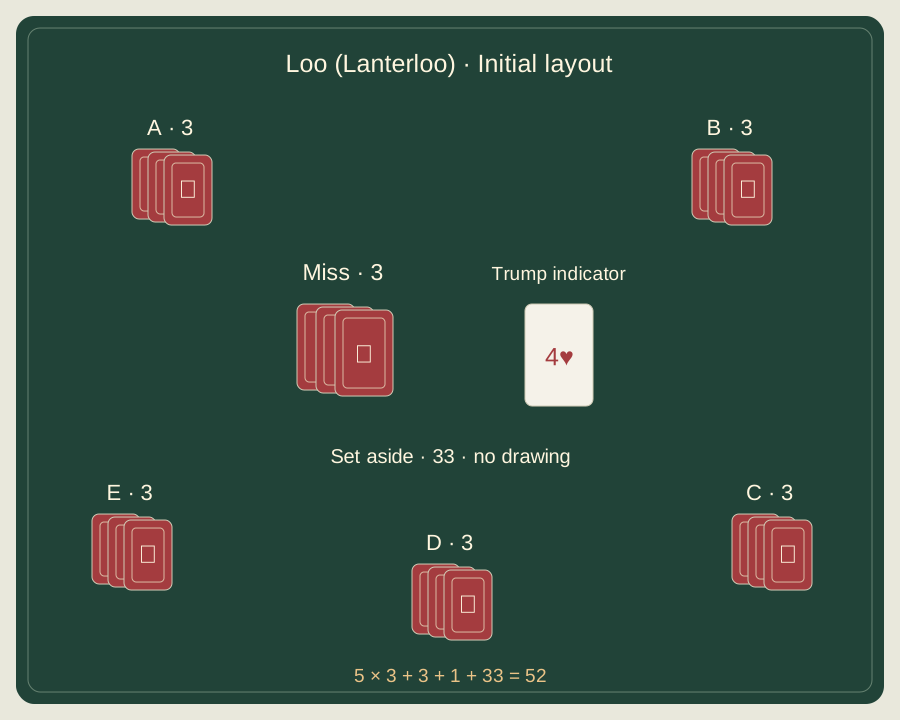
Use 52 cards without jokers, ranked A K Q J 10 down to 2. This profile seats 5–8 players, individually. Choose the first dealer randomly; shuffle, cut at the right, deal and play clockwise, rotate dealer left. We count in abstract units: dealer adds 3 to the pool before every deal, and being looed costs 3. A written ledger permits fractional shares. No money is required. An empty old pool makes a simple deal; any carried balance makes a double deal.
03 /
Simple pool: discover trump later
Deal 3 cards each, with no spare hand. Everyone must play: no passing or exchange. Initially there is no known trump. Dealer’s left leads freely; follow suit and, if possible within that obligation, beat the highest card. When someone cannot follow, they may play anything. After that whole trick is played, expose the next undealt card as trump and judge that trick using its suit. Before this first void, tricks are judged by led suit alone. The indicator stays outside all hands.
04 /
Double pool: stand, pass or take miss
Deal 3 to everyone plus an unseen 3-card miss immediately left of dealer; in each dealing circuit the miss receives the penultimate card. Expose the next card for trump. Starting left of dealer, each person looks at their hand only when it is their announcement turn. Stand with it, pass without penalty, or discard it unseen and take the miss. Only the first claimant gets that spare hand and must play it. No further draw or exchange is allowed.
05 /
When everyone else withdraws
If everyone before dealer passes, dealer collects the pool without play. If just one other player stands with their own hand, dealer must either play normally or defend using the miss. A defender receives no winnings and owes no loo penalty; shares for defended tricks remain in the pool. If instead the sole other player took the miss, dealer may stand or pass, giving that player the pool; defence is unavailable. These exceptions prevent a free, riskless take by a sole standing opponent.
06 /
Trump leads and compulsory heading
The first active player left of dealer leads. With known trumps, lead trump if you have one; in a double pool lead its ace if held, or its king when the ace is the exposed indicator. Followers must follow suit and, subject to that, head the trick if possible. If void, play a winning trump if possible; without a trump high enough to win, any discard is legal. Highest trump wins, otherwise highest led suit. The winner leads next. In a simple pool these trump obligations begin only after revelation.
07 /
A third of the pool per trick
Play all 3 tricks, keeping each person’s exposed cards in front of them for checking. Each normally played trick earns one third of the starting pool; defence shares stay there. Each active non-defender taking no tricks pays 3 into the next pool, regardless of its previous size. Passing players pay nothing. The next dealer adds another 3 before dealing. For a finite learning session, agree a deal count and split any final unawarded pool equally as an explicit session convention; compare net ledger balances.
08 /
A double pool and a forced ace
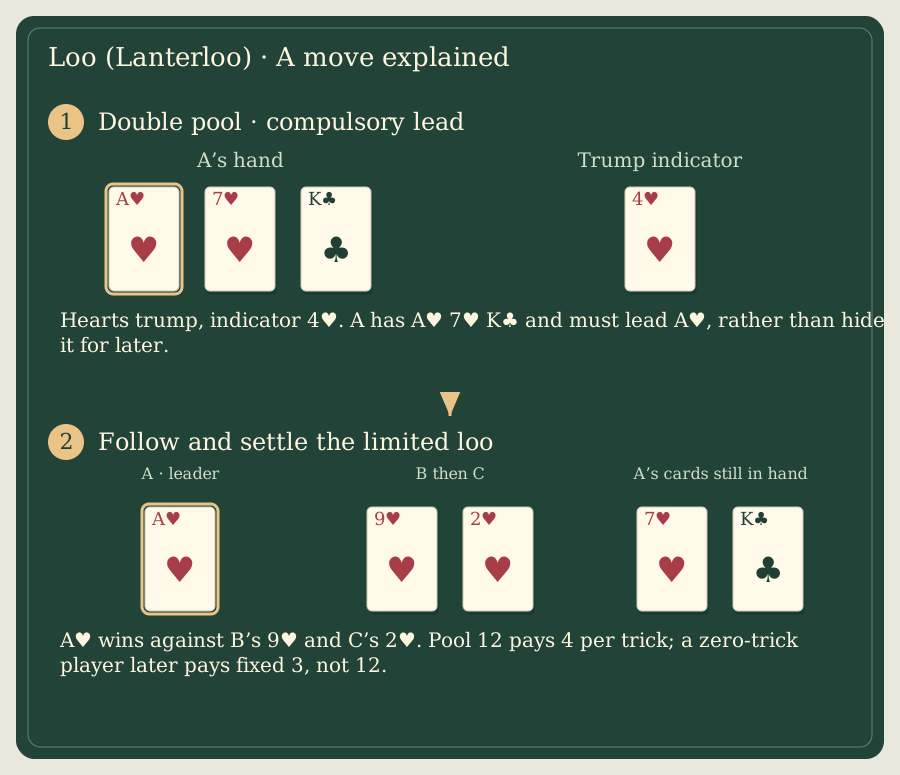
Pool 12, hearts trump, indicator 4♥. Leader A holds A♥ 7♥ K♣ and must lead A♥. B follows 9♥, C 2♥; A wins and is entitled to 4 of the pool. Suppose A takes 2 tricks, B 1, C none: payouts are 8, 4 and 0. C then pays the fixed loo penalty 3, not 12. The next dealer’s 3 makes the following pool 6. Players who passed this hand neither collect nor pay the loo penalty.
← On a small screen, scroll the diagram horizontally. →
Common questions
Can I pass a simple pool?+
No, everyone must play that deal.
May I reject the miss after seeing it?+
No, taking it commits you to play.
Does a zero-trick hand lose the whole pool?+
Not in limited Loo: the fixed penalty applies.