← On a small screen, scroll the diagram horizontally. →
01 /
An Austrian pot game with a force round
Kratzen is an Austrian member of the Rams family, traditionally a pot game with a special Weli trump. Its name refers to dropping out. Accounts differ sharply: the four-card description has a funding round with no payout, while some summaries substitute five cards and other penalties. We use the four-card structure with counters. To make a reproducible first game, our explicit teaching agreement omits dealer-changing cut rituals, alternative trump contracts and exchanges; these traditional extensions are described separately. A precise inventor or first date is not asserted.
02 /
Thirty-three cards, one permanent trump
For 3–6 players use a 33-card regional pack: A K Ober Unter 10 9 8 7 in each German suit plus bells 6, the Weli. Our French-suited substitute is A K Q J 10 9 8 7 in each suit plus 6♦ marked Weli. Q represents Ober, J Unter. Ordinary rank is that listed order. Weli is always trump, second only to the ace of the chosen trump suit; it is not an ordinary diamond when another suit is trump. Use a ledger with balances starting at 0, allowing negative counter payments, and keep the pot separately.
03 /
Deal four and take the upcard
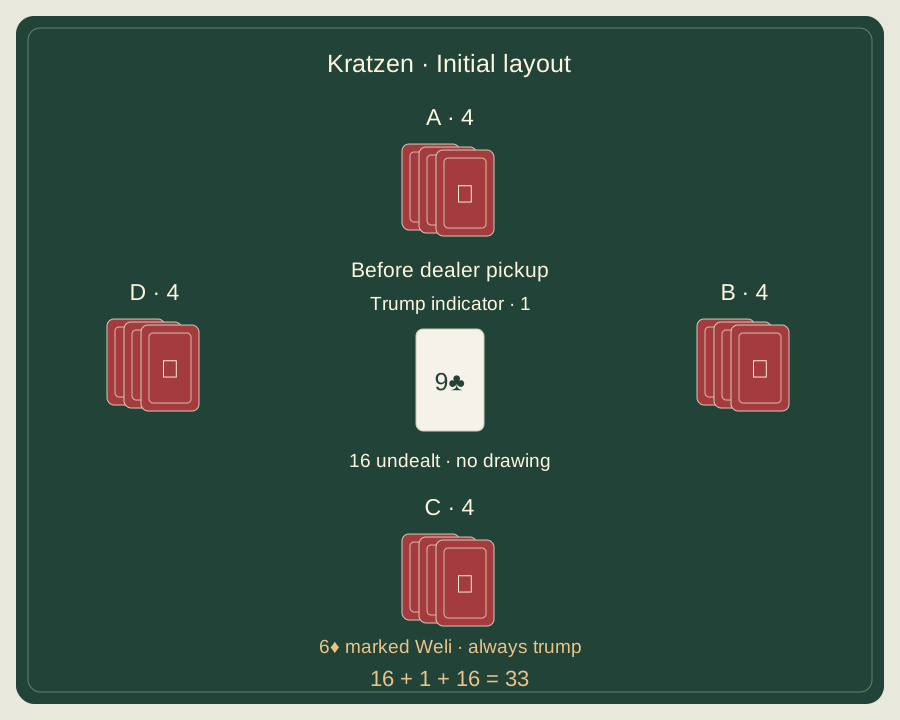
Choose dealer randomly, rotating left each deal. Cut normally without special payments. Deal 2 each clockwise from left, turn 1 card face up, then deal 2 each again. Upcard’s suit is trump. If it is Weli, turn another card for the suit. Dealer takes the exposed card or cards and discards privately back to 4; other cards are unused, with no drawing during tricks. The pictured opening before pickup has four hands of 4, 1 indicator and 16 undealt: 33. Dealer is the striker in this teaching profile and leads the first trick; later winners lead.
04 /
Muss funds, ordinary play distributes
With an empty pot, start a Muss: everyone pays 1 counter, dealer 2 instead, and everyone must play. No pot is paid out after these 4 tricks. Normally striker needs 2 tricks and each other participant 1. After this funding hand, play an ordinary hand with the existing pot: only the new dealer adds 1. Before play, others clockwise from dealer’s left choose join or fold; dealer must join. Folding adds no further penalty. If all others fold, striker receives the pot without play. A 7 as trump indicator instead forces Muss for that deal: all join, no payout, everyone’s requirement becomes only 1, including striker.
05 /
Follow, trump and head the trick
Play clockwise among active players, one card each per trick. First obey suit: if you hold the led suit, play it and beat the current winner if possible within that suit. If void, trump if held, overtrumping an existing trump if possible. Without led suit or trump, discard anything. Do not break suit just to beat a card with Weli. Highest trump wins; otherwise highest card of led suit. There are 4 tricks, no point values for captured ranks and no partnerships. Folded hands remain face down out of play. Winner leads next.
06 /
Freeze the pot before penalties
Let P be the pot just before play. In an ordinary played hand distribute P/4 per trick, including tricks won by a striker who missed the requirement. Then charge each failing ordinary participant P, and a failing striker 2P, into the next pot. Calculate every penalty from the same P, not from the growing balance. In Muss distribute nothing, but use the same failure penalties; unawarded P remains too. Keep fractions in the ledger. Empty pot means next hand is Muss, otherwise ordinary unless a trump 7 forces Muss. Our finite teaching session ends after one full dealer rotation: compare net balances, leave unawarded pot recorded, and share equal leaders.
07 /
What the fuller tavern game adds
Traditional tables can move the deal after special cut cards, bid Schlagen, Oder, Weiter-Oder or Weiter, and exchange cards before play. Some exchanges generate extra cards for exposed trumps, so they need their own stock and discard rules. These are not silently active in our fixed-dealer, no-exchange teaching profile. In particular, do not import a five-card payout divisor into four-card play, or treat every failed player as paying the same penalty. Agree a traditional regional ruleset as a whole before using those additions; their names alone do not settle the procedure.
08 /
The Weli can be overtaken
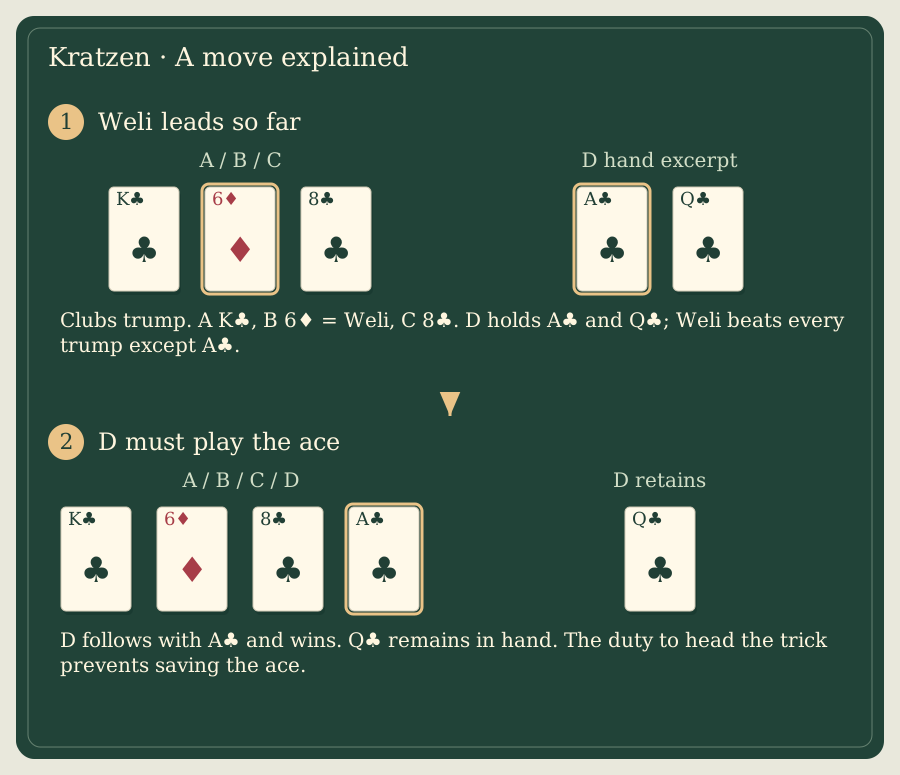
Clubs trump: A leads K♣, B plays 6♦ Weli, C follows 8♣. D holds A♣ and Q♣ and must play A♣ to beat Weli. D wins; Weli was not the highest trump. Separate ordinary settlement: P = 12, striker takes 1 trick, two others take 2 and 1, last takes 0. Payouts are 3, 6, 3, 0. Striker then pays 24 and last player 12; next pot is 36 before the next dealer’s ante. No penalty is recalculated after the first payment. A pot-game example can be learned entirely with a point ledger.
← On a small screen, scroll the diagram horizontally. →
Common questions
Is the illustrated game the five-card form?+
No. It is the declared four-card teaching profile, with traditional extensions identified separately.
Is Weli an ordinary diamond?+
No. The marked substitute is permanently trump, below only the trump ace.
Do penalties grow after each payer?+
No. Freeze the pre-play pot and calculate every failure from that same amount.