← On a small screen, scroll the diagram horizontally. →
01 /
Exact bidding with a remembered trump cycle
Kachuful is a South Asian member of the exact-bidding family also known through Oh Hell. Its Gujarati name is associated with remembering the recurring suit order. Local hand schedules and score formulas vary, so the name alone does not settle them. No precise individual inventor or initial Kachuful date is asserted here. The profile below uses a fixed suit cycle, descending then ascending hands and points only for exact predictions. Unlike a contract auction, each person makes one forecast and nobody buys the right to name trump.
02 /
Write the entire schedule first
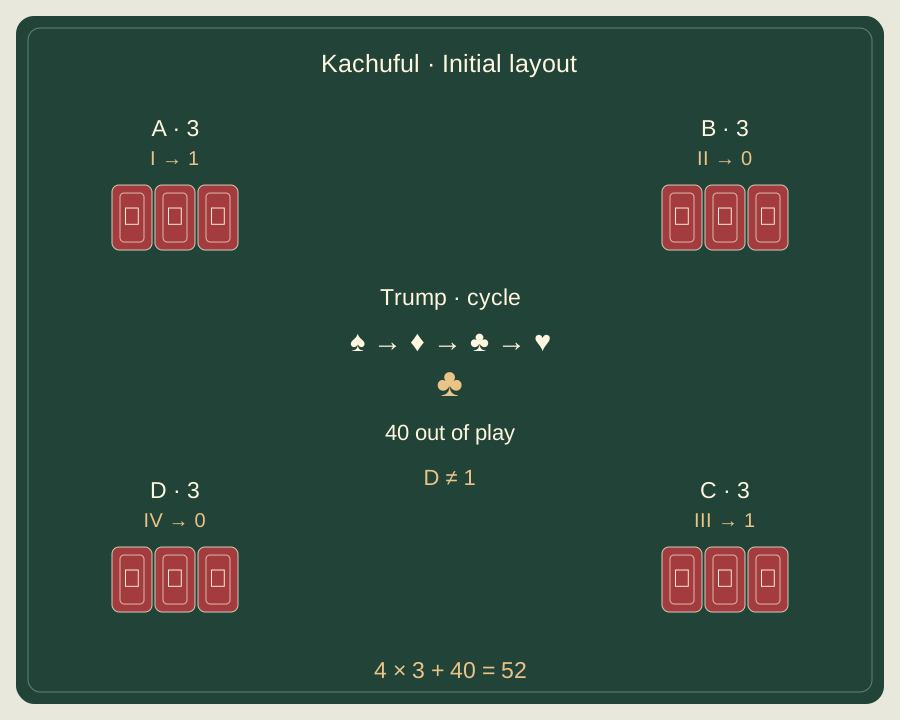
Use 52 cards, no jokers, for 3–7 players. Rank A K Q J 10 to 2. Maximum starting hand is floor(52 ÷ players): with 4 players, 13. Use H, H−1 down to 1, then 2 up to H; the one-card hand occurs once. At four players that makes 25 deals. Highest drawn card chooses first dealer; gather and shuffle again. Dealer gives the scheduled number singly clockwise from the left, setting unused cards aside. No stock drawing or trump indicator is used. Dealer rotates left every deal. Ties in the initial selection are redrawn by the tied players.
03 /
Cycle trump and constrain the dealer
Trump cycles by deal: ♠, ♦, ♣, ♥, then repeat, continuing through the one-card turning point without resetting. Everyone sees their hand and bids a whole number from 0 to the hand size, clockwise from dealer’s left; dealer bids last. No passes or later changes. The dealer cannot choose the number making all bids sum to available tricks. If that forbidden value lies outside the legal range, every legal bid is allowed. Write each bid before play. This hook guarantees at least one miss, not exactly one.
04 /
Follow suit, then count exact tricks
Player left of dealer leads any card, including trump. Play clockwise, 1 card per player per trick. Follow suit whenever possible; if void, play any card, with no compulsory trump or overtrump. Highest trump wins, otherwise highest of the led suit. Winner leads next. Continue until all dealt cards are played. Keep tricks individually: there are no partnerships. Taking extra tricks can be as damaging as falling short, so a high card is useful only if it fits your forecast.
05 /
Only exact predictions score
Exactly matching your bid scores 10 + bid; taking more or fewer scores 0. An exact zero earns 10. Do not add a point for each trick when a prediction fails: that is another family scoring system. Add after every completed deal and compare totals only after the whole descending-and-ascending schedule. Highest total wins, equal leaders share in this profile. Shorter schedules and negative miss scores are possible agreements for another session, not changes to introduce after seeing a result.
06 /
The forbidden bid and a costly ruff
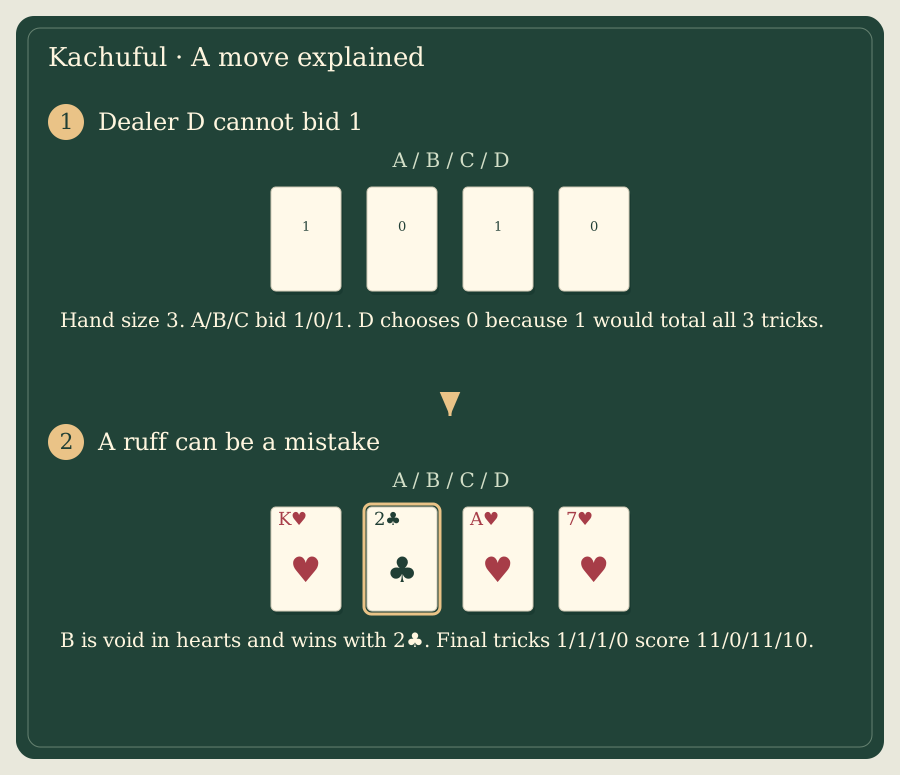
In a four-player 3-card hand, bids A 1, B 0, C 1 leave dealer D forbidden to bid 1, because that would total 3. D chooses 0. With clubs trump a trick goes A K♥, B 2♣ while void in hearts, C A♥, D 7♥. B wins despite bidding zero. Suppose final tricks A 1, B 1, C 1, D 0: awards are 11, 0, 11, 10. B’s extra trick is a miss, not a small positive score. This 3-card hand leaves 40 cards unused; they never enter play.
← On a small screen, scroll the diagram horizontally. →
Common questions
Is zero a legal bid?+
Yes unless it is the dealer’s forbidden total-completing bid. An exact zero scores 10.
Does a missed bid earn trick points?+
No. This exact-only profile scores zero for every miss, whether short or over.
What if the forbidden dealer value is impossible?+
Then every bid in the normal legal range is allowed; the total is already unable to match.