← On a small screen, scroll the diagram horizontally. →
01 /
A race driven by suits
Horse Race turns the four aces into moving horses. It belongs to social racing and banking games, with many local course lengths and payout agreements. A documented description appears in Scarne’s card literature, but that does not establish a single inventor or the earliest game. The profile below uses a visible seven-card course and crossing the finish, with score counters only. Hidden-track setbacks and Calcutta auctions are distinct alternatives; they change information and settlement rather than merely decoration.
02 /
Four horses, seven markers, forty-one race cards
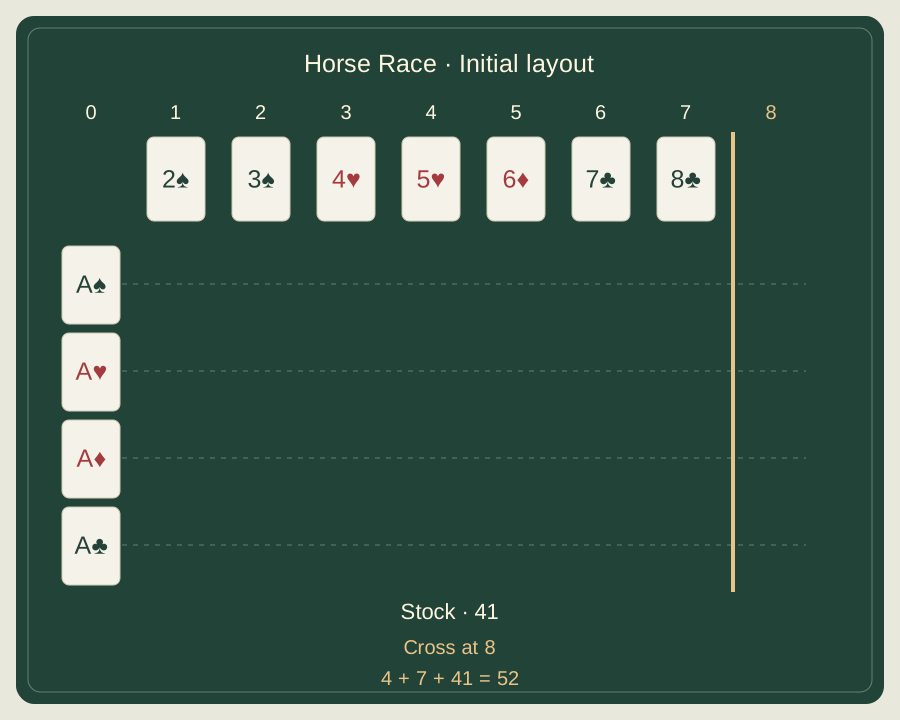
Use 52 ordinary cards without jokers for 3 or more people; the catalog suggests up to 10 for a comfortable table, not a rules maximum. One player runs the bank and reveals cards. Put A♠ A♥ A♦ A♣ vertically at position 0. Shuffle the other 48 and lay 7 face up across the top, marking positions 1–7; the remaining 41 form the race deck. If the course contains 5 or more of one suit, reshuffle those 48 and redeal: that horse would lack the 8 cards needed to finish. Course cards never move horses.
03 /
Agree counter stakes and net odds
Begin the session with equal counter balances. Before any race card is shown, post the bank’s payout table and maximum stake. For this teaching profile each non-banker chooses one horse and stakes 1 counter. Suggested net odds depend on that suit’s visible course count: 0 → 1:1, 1 → 2:1, 2 → 3:1, 3 → 5:1, 4 → 10:1. These are traditional proposed prices, not mathematically fair probabilities. Check that the bank has enough counters for every possible winning suit, then lock choices. No changing horse or adding stakes during the race. Counters are a scoring device here.
04 /
Advance by suit and cross the line
Banker turns the next race card face up into a separate revealed pile and advances its suit’s ace exactly 1 position. Rank does not matter: a king is not faster than a two. Course and revealed cards stay distinguishable. Position 7 is alongside the last marker, not a win. The first horse reaching position 8 crosses the line and wins immediately; no need to finish the deck or find a runner-up. Because only one horse moves per card, there is no simultaneous tie. The visible-course version has no backward move.
05 /
Settle and rotate the bank
Collect losing counters. Return a winner’s stake and add the posted net winnings; do not confuse net odds with total returned. Several players may back the same winner, each settled at their own locked stake. Record counter balances and rotate banker clockwise, gathering and shuffling the entire pack for a fresh race. For a finite teaching session give each person one turn as banker and compare final balances after all settlements; highest balance wins, ties share. The banker’s gains and losses count too, so the sum of balances is conserved.
06 /
The eighth diamond wins
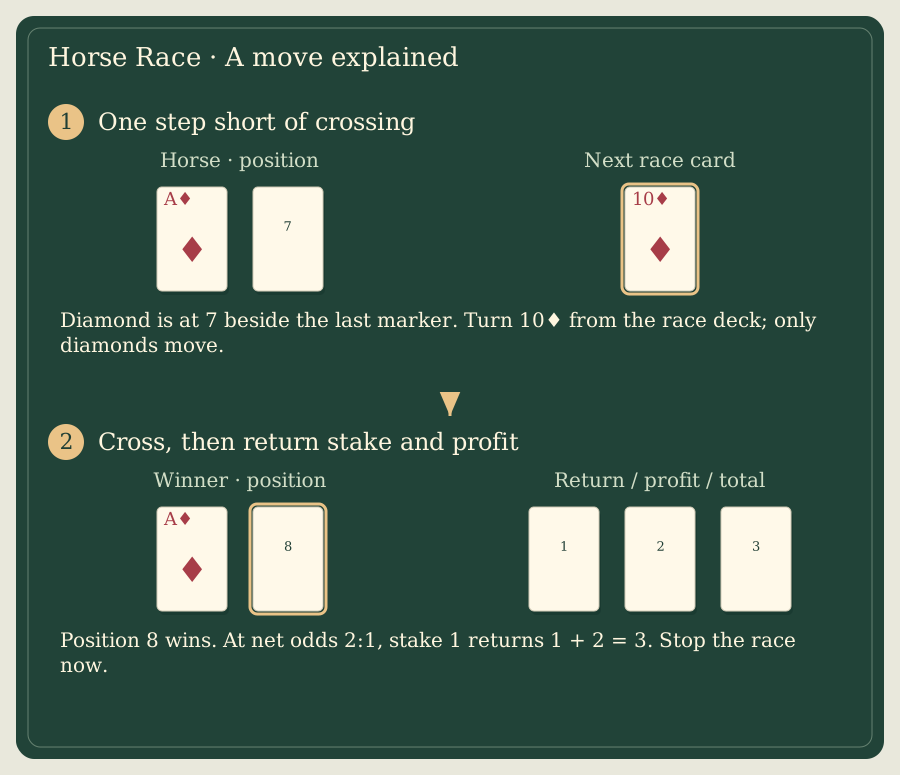
The course shows 2 spades, 2 hearts, 1 diamond and 2 clubs. Diamond therefore has 11 race cards available and posted net odds 2:1. All course counts are legal. Late in the race positions are ♠6, ♥5, ♦7, ♣4. Turning 10♦ moves diamonds to 8 and ends the race; its previous position 7 had not won. A player with a 1-counter diamond stake receives 1 returned plus 2 profit, total 3. A losing 1-counter stake goes to the bank. Cards of diamond already revealed are not put back into the race deck.
← On a small screen, scroll the diagram horizontally. →
Common questions
Does reaching the last marker win?+
No. This profile requires crossing beyond it; shorter reach-the-line versions are different.
Do high cards move a horse farther?+
No. Every race card moves its suit’s ace exactly one step; only the suit matters.
Why redeal a suit-heavy course?+
With 5 course cards of one suit, only 7 non-ace race cards of it remain, fewer than the required 8 advances.