← On a small screen, scroll the diagram horizontally. →
01 /
Context and preparation
British Pontoon derives its name and game tradition from French Vingt-et-un. It is not identical to casino Blackjack or games marketed under casino Pontoon rules. Use 52 cards without jokers; with eight players use two packs. Choose banker by highest cut, recutting ties. A=1 or 11, faces and 10=10, others face value. Each nonbanker chooses an initial unit stake from 1 to 5 after seeing the first card. Our eight-deal session uses unlimited accounting units with negative balances, not finite bankrolls; highest final balance wins, shared ties.
02 /
Two-card deal and ranking
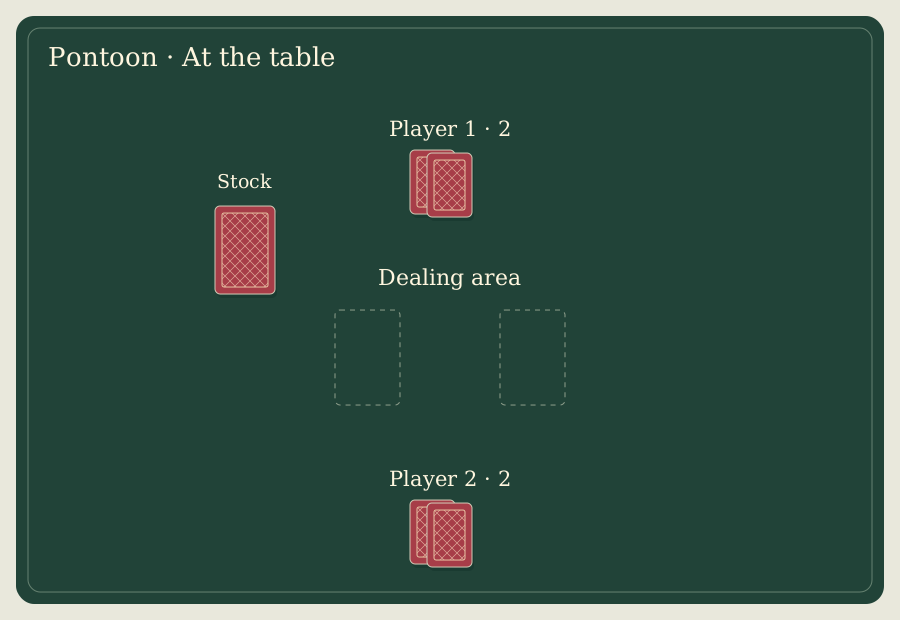
Banker deals clockwise from the left, one card face down to everyone including banker. Others inspect, but banker does not. Players place initial stakes; deal a second face-down card each, then all inspect. Banker’s two-card 21 is immediately exposed and collects DOUBLE every stake, even against another Pontoon; no one acts.
Best to worst: Pontoon(A plus ten-value card); five cards totalling 21 or less; ordinary 21; lower totals; bust above 21. Equal ordinary totals go to banker. A five-card trick beats ordinary 21 even with a lower total. Ordinary hands of two, three or four cards are otherwise compared solely by total.
03 /
Player actions
If banker has no Pontoon, players act clockwise, completing each split hand before the next. Declare a Pontoon by showing ace over the ten-value card. Split only equal RANKS, not merely equal values: add a stake equal to the original, receive one face-down card on each and play separately. Further equal-rank splits are allowed to at most four hands per original hand.
Below 21, buy a face-down card by adding between one and two times the ORIGINAL stake. A later purchase adds at least the original stake and at most the previous purchase addition. Alternatively twist: receive one face-up card without increasing the stake. After twisting, you may only twist, never buy. Stick only with at least 15. At 21 or a nonbust fifth card stop taking cards. Bust: expose, lose current stake immediately, and put those cards under the pack; later banker bust does not refund it.
04 /
Banker and settlement
After players finish, banker exposes and may draw face-up cards or stay at any total; no player 15 minimum applies to banker. Stop at five cards or bust. If banker busts, each surviving ordinary hand wins its current stake; Pontoons and five-card tricks win twice it.
If banker stays with at most four cards, better surviving player totals win their stake, equal or lower lose it; player Pontoon/five-card trick wins twice. If banker makes a five-card trick, only player Pontoons win, at double; EVERY other surviving hand loses double, including a player five-card trick. Transfers are net gains/losses; return the player’s own posted stake separately when won. Totals and categories have no suit tiebreak.
05 /
Worked purchase
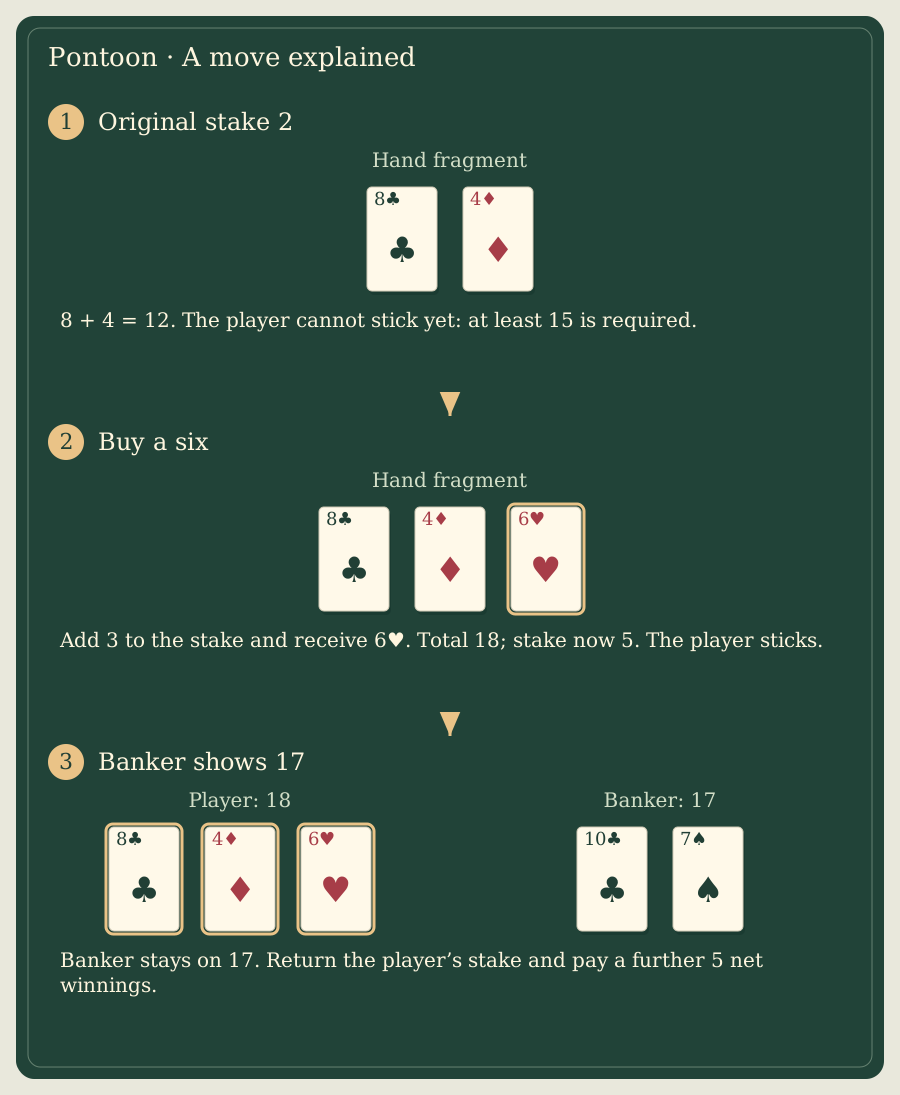
Initial stake 2, hand 8+4=12. Buy a card for an additional 3: stake 5; receive 6, total 18, and stick. Banker stays 17: win 5 net. If banker instead makes a five-card trick, this hand loses 10 net. A further purchase before sticking could add from 2 to 3, not up to twice the new total stake. The original 2 still controls the minimum.
← On a small screen, scroll the diagram horizontally. →
06 /
Bank change and next deal
An unsplit player Pontoon, when banker lacks one, transfers the bank next deal; with several, the nearest clockwise from banker wins priority. Otherwise banker remains. Split Pontoons pay normally but never transfer bank. If any Pontoon appeared, shuffle and cut; otherwise place used cards under the pack without shuffling. Our table cancels and reshuffles an insufficient-card deal with all transfers reversed; cancelled deals do not count toward eight. Selling the bank, burning hard hands, Royal Pontoon and casino house draw schedules are excluded.
Common questions
May I buy after twisting?+
No. All further cards must be twists.
Does a banker five-card trick merely push against mine?+
No. Your five-card trick loses double in this profile.