← On a small screen, scroll the diagram horizontally. →
01 /
Players and equipment
Use an ordinary 52-card deck without jokers. One person deals while others select a side. Two to eight participants makes a convenient teaching group, but this is a practical size rather than a mechanical limit; more people can observe the same deal. Neither suit strength nor card ranking decides the result. Only matching ranks matter.
02 /
Prepare a round
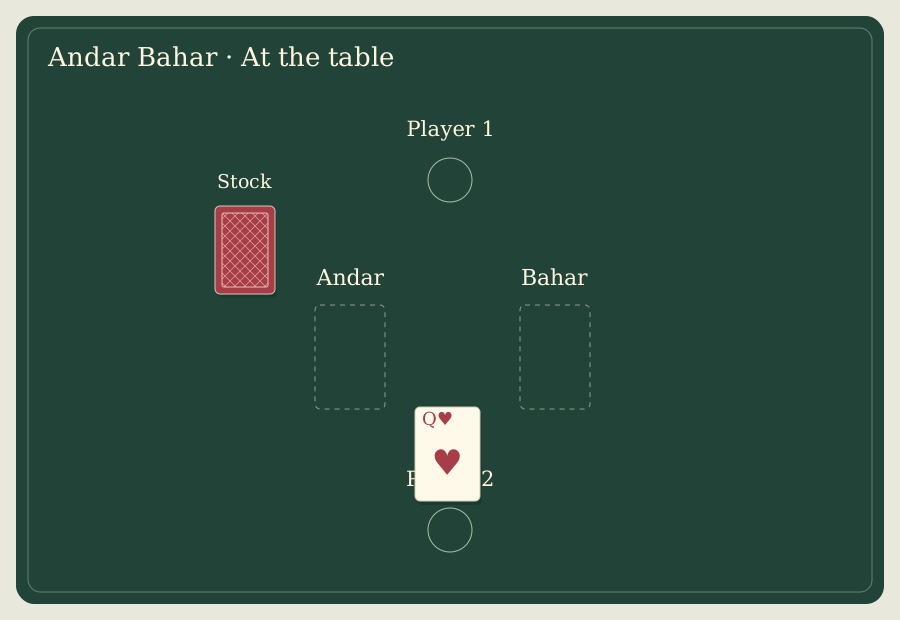
Mark two areas Andar, meaning inside, and Bahar, meaning outside. Shuffle, cut and expose one card in the middle. This middle card is not a wild joker or a trick-taking trump. If it is 8♦, any of the three remaining eights will match; a diamond is not required.
Each participant places a marker on one side before any more cards are exposed. Lock those choices now. This teaching version does not permit switching sides after seeing part of the deal.
03 /
Alternate until a match
Under the selected procedure, a black middle card sends the next card to Andar; a red middle card sends it to Bahar. Expose single cards alternately onto the two piles. Stop immediately when a card has the same rank as the middle card. Its destination is the winning side. Do not expose further cards to compare a second match.
A complete deck must eventually supply a match: removing the middle card still leaves three cards of its rank. A deal without a match indicates an incomplete or incorrectly handled pack, so check it and restart. That is a practical integrity check rather than a special ending condition.
04 /
A complete teaching match
Agree to play ten rounds. Award one point-counter for choosing the winning side and zero otherwise. Gather all 52 cards, reshuffle and rotate the dealer each round. Highest total after round ten wins; equal highest totals share the victory. This scoring framework is explicitly an instructional convention, not a claim about traditional banking payments. You may also play without keeping score and simply observe each result.
05 /
A sample round
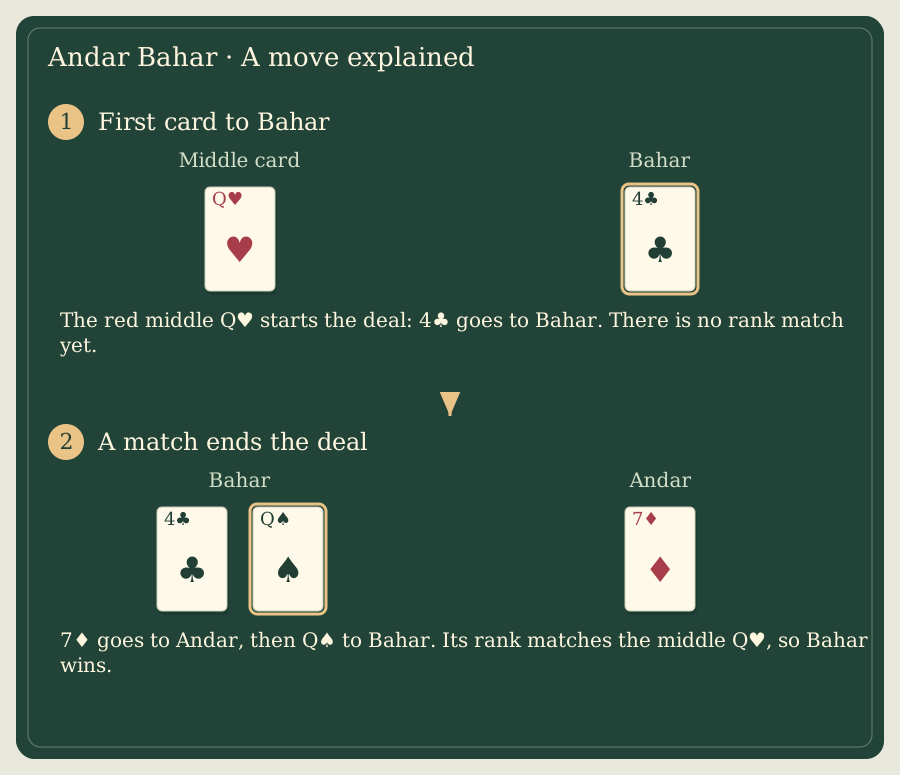
The middle card is Q♥, so Bahar receives the next card. Deal 4♣ to Bahar, 7♦ to Andar and Q♠ to Bahar. Stop: Bahar wins. The black queen matches the red queen because rank alone matters. Someone choosing Andar cannot move their marker after the first two cards appear.
← On a small screen, scroll the diagram horizontally. →
06 /
Specify the starting procedure
Some versions always start at Andar; others use the colour of the first subsequent card. These are different procedures, so identify yours in advance. Predictions about the number of cards or properties of the middle card are excluded here. A payment table from one operator does not apply universally, and the two sides should not automatically be described as equally likely.
07 /
Regional context and related names
Accounts associate the game with southern India, including Bengaluru, without establishing a precise invention story here. Related Tamil names include Ullae Veliyae and Mangatha; one version lets a player select a target number instead of exposing a middle card. Katti is sometimes mentioned alongside Andar Bahar, but uses a different mechanism and should not be silently merged with it.
Common questions
Must the suit match too?+
No. Only the middle card’s rank matters.
Is the middle card a real joker?+
No. It is an ordinary card identifying the rank to match.
Can we play without money?+
Yes. The teaching match here uses only points or counters without cash value.