← On a small screen, scroll the diagram horizontally. →
01 /
Selected version
Acey Deucey, or In Between, asks whether a third card lies strictly between two exposed posts. Banker and shared-pot versions differ. This guide selects Pagat’s shared-pot ante format, always-high aces and double loss on a post match. This is the card game, not the similarly named backgammon variant; no precise inventor is established.
02 /
Preparation
For 2–8 players use 52 cards without jokers. Ranks are 2–3–4–5–6–7–8–9–10–J–Q–K–A; suits do not matter. Use notional chips. Teaching session: 100 each, ante 1 before each round, at most 3 complete rounds; this is an explicit duration agreement. Choose a dealer, shuffle and have the right neighbour cut. Everyone, including dealer, antes.
03 /
Round and two posts
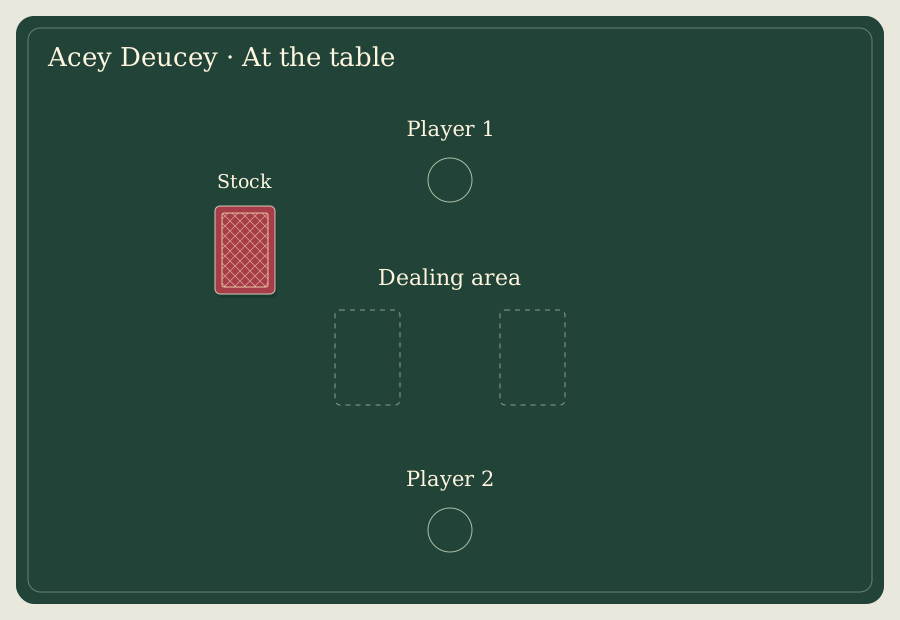
Deal one face-up card to everyone. Dealer’s left acts first: receive a second exposed card, then bet or pass. Continue clockwise, dealer last. Do not give everyone their second card in advance. The two cards are interval posts, not a poker hand. Ace is always above K; it cannot be declared low.
04 /
Bet and settlement
Passing costs nothing and no third card is dealt. Otherwise announce a whole-chip stake from 1 to the pot size, also limited to half your own chips so a double loss is covered. If no stake is affordable, pass. A third card strictly inside wins one stake from the pot; outside loses one stake; equal to either post loses two stakes. Keep the wager separate until settlement: its return is not an additional profit. Equal or adjacent posts may simply be passed; there is no automatic pair payout here.
05 /
Next round
Discard a finished player’s cards without touching first cards of players still waiting. Used cards do not return during the round. At most 8 players need no more than 24 cards per full round. After dealer’s turn collect the entire deck, pass the deal left and shuffle again. If continuing, everyone adds a fresh ante. Low aces, quadruple ace-post losses and higher/lower pair bets belong to other versions.
06 /
Session end
If a bet empties the pot, end immediately. Otherwise stop after 3 complete rounds. Divide any remaining pot equally; record fractional shares exactly rather than adding another deal. Highest final chip balance wins, with tied players sharing victory. The wager cap prevents debts. If anyone cannot pay the next ante, stop before new contributions and divide the remaining pot in the same way.
07 /
Inside is not on the post
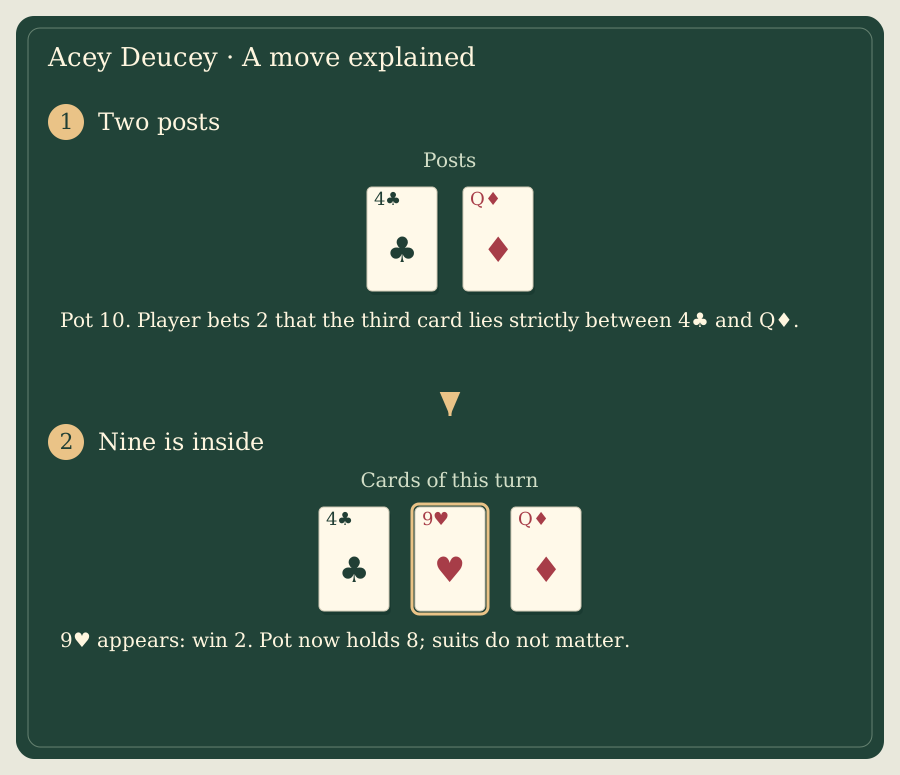
Posts are 4♣ and Q♦, stake 2, pot 10. Third card 9♥ lies strictly between: player gains 2 and pot falls to 8. If Q♠ had come instead, its rank hits a post: lose 4 and pot would become 14. Suits change neither result.
← On a small screen, scroll the diagram horizontally. →
Common questions
May an ace be called low?+
Not in this profile: ace is always high.
What does a post match cost?+
Two stakes, including an ace post.
Can I pass after the posts?+
Yes, without a stake or third card.