← On a small screen, scroll the diagram horizontally. →
01 /
Bridge adapted for two
Honeymoon Bridge names a family of attempts to play bridge when only two people are available. It is not one standardized tournament discipline. Some versions use dummy hands; others first play drawing tricks. Here we select Draw and Discard Bridge: build one concealed hand each from the stock, then bid and play without dummies. The name evokes a couple playing together, but an exact inventor or first date is not established. The drawing procedure below is different from drawing a replacement into an already dealt hand.
02 /
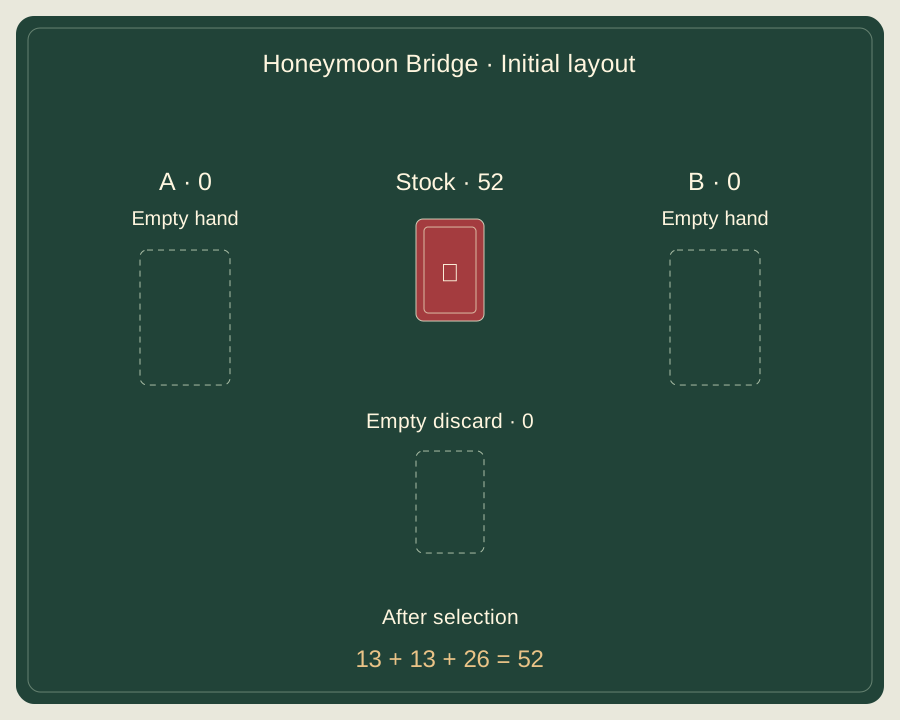
An empty hand and a full stock
Use 52 normal cards, no jokers, for exactly 2 players. Card rank is A K Q J 10 down to 2. Choose dealer randomly; dealer shuffles, opponent cuts, then put all 52 face down as stock. Nothing is dealt. Prepare a shared face-down discard and a score sheet with each player’s contract points below a line and bonuses or penalties above. Dealer alternates after every hand, including a passed-out auction. Both players start not vulnerable, with 0 games and 0 points.
03 /
Keep one, discard one
Non-dealer starts, then alternate. Look privately at the top stock card. Keep it, then look at and discard the next card face down; or reject the first face down and accept the next without a choice. Either way remove 2 stock cards, keep 1 and discard 1. The opponent cannot take a rejected card. Repeat 13 turns each: stock 0, hands 13 each and discard 26. You know your own rejected cards, but never expose or reuse the discard. Do not add the keep-and-replace procedure of another Honeymoon variant.
04 /
A two-person auction
Non-dealer calls first. Bid a level 1–7 and strain, ordered ♣ ♦ ♥ ♠ NT from low to high; a higher level beats any lower level. Level means tricks above 6: 1 promises 7, 4 promises 10, 7 promises 13. You may pass, bid higher, double the opponent’s current undoubled bid, or redouble your own doubled bid. A new bid cancels prior doubles. A pass after any bid, double or redouble ends the auction; if both pass before bidding, reshuffle for the next dealer. The last bidder declares. NT means no trump. No partner or dummy assists.
05 /
Thirteen two-card tricks
Defender leads first. Each trick has 2 cards, one from each player. Follow suit if possible; when void, play any card, without compulsory trumping. Highest trump wins, otherwise highest of the led suit wins; a discard in another non-trump suit cannot win. Winner leads next. No drawing or discarding now: the 26 rejected cards remain out of play. Count declarer’s tricks after all 13. Making the promised total or more succeeds; otherwise each missing trick is an undertrick. Defender does not need to bid a separate defensive contract.
06 /
Contract points, overtricks and slams
Only a made contract scores below the line: bid tricks above the book of 6, at 20 each for ♣/♦, 30 each for ♥/♠, NT 40 for the first and 30 thereafter. Double multiplies these points by 2, redouble by 4. Overtricks go above: undoubled 20 in minors or 30 in majors/NT; doubled 100 each not vulnerable or 200 vulnerable; redoubled twice those amounts. Made doubled contract adds 50 above, redoubled 100. A bid and made small slam adds 500 not vulnerable or 750 vulnerable; grand slam 1000 or 1500. Taking extra tricks without bidding slam earns no slam bonus.
07 /
Undertricks and vulnerability
If declarer fails, no contract or overtrick score is earned. Defender receives penalties above the line, using declarer’s vulnerability. Undoubled: 50 per missing trick not vulnerable, 100 vulnerable. Doubled not vulnerable: first 100, second and third 200 each, fourth and later 300 each. Doubled vulnerable: first 200, each later 300. Redoubled penalties are twice doubled penalties. These values are cumulative: doubled not vulnerable down 3 costs 100 + 200 + 200 = 500, not merely the last step. Winning a game makes that player vulnerable for the rest of this rubber.
08 /
Game lines and the rubber
Accumulate contract points until someone reaches 100 below the current line. That player wins a game; draw a fresh line and reset both players’ progress towards the next game to 0, retaining all old points in final totals. First to 2 games ends the rubber and receives 700 if opponent won no game, otherwise 500. Total everything above and below: higher points wins the score comparison, possibly different from the rubber winner. We omit honour bonuses by explicit agreement. Finish a complete rubber rather than using unfinished-rubber settlement. Keep vulnerability separate from the reset game counter.
09 /
From a rejected card to a made game
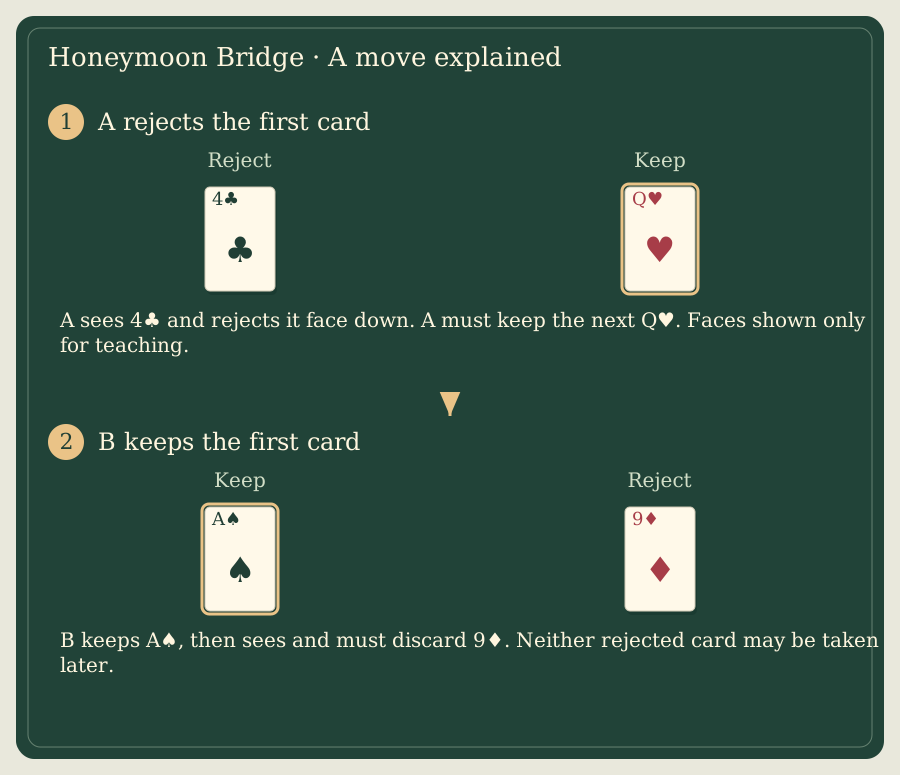
A rejects 4♣ and must keep the next Q♥. B keeps A♠ and must inspect and discard the next 9♦. There is no option to give 4♣ to B. Later A bids 3NT and B passes. B leads K♣; A holding A♣ must follow and wins. Suppose A finishes with 10 tricks: the contract required 9, giving 40 + 30 + 30 = 100 below and 30 above for the extra trick. A wins a game and becomes vulnerable; both game-progress counters restart at 0. No separate duplicate-bridge game bonus is added to rubber scoring.
← On a small screen, scroll the diagram horizontally. →
Common questions
Can the opponent take my rejected card?+
No. All rejected cards remain face down and out of play in this selected profile.
Where do the other cards go?+
After selection each has 13 and the face-down discard has 26. Those discards never join the thirteen scored tricks.
Is the rubber winner always the points winner?+
No. Ending the rubber earns a bonus, but compare all points above and below the lines for the final score result.