← On a small screen, scroll the diagram horizontally. →
01 /
An Aragonese partnership tradition
Guiñote is a Spanish partnership game especially associated with Aragon and neighbouring regions. Related names include guinyot and joc de cotos. Its family resemblance to other marriage games comes from trick points, a changing obligation after the stock ends, and declarations from a held royal pair. Regional rules and organised tournaments preserve different details; a single ancient inventor or exact founding date is not established. This guide explains an Aragonese-style four-player profile. In particular, the declaration is king plus sota, not king plus caballo, and the sota outranks the caballo. Those distinctions matter even when borrowing a French-suited pack.
02 /
Spanish ranks and the illustrated mapping
Use 40 Spanish cards in coins, cups, swords and clubs: A, 2, 3, 4, 5, 6, 7, sota, caballo, rey. Their printed court numbers are 10, 11 and 12, but winning order is A, 3, rey, sota, caballo, 7, 6, 5, 4, 2. Point values are A = 11, 3 = 10, rey = 4, sota = 3, caballo = 2; all others = 0. The pack totals 120 points. Our drawings use a declared French-card adaptation: remove 8, 9, 10; K means rey, J means sota, Q means caballo. Diamonds represent coins, hearts cups, spades swords and clubs bastos. Q is a substitute knight, not a Spanish queen.
03 /
Deal and trump indicator
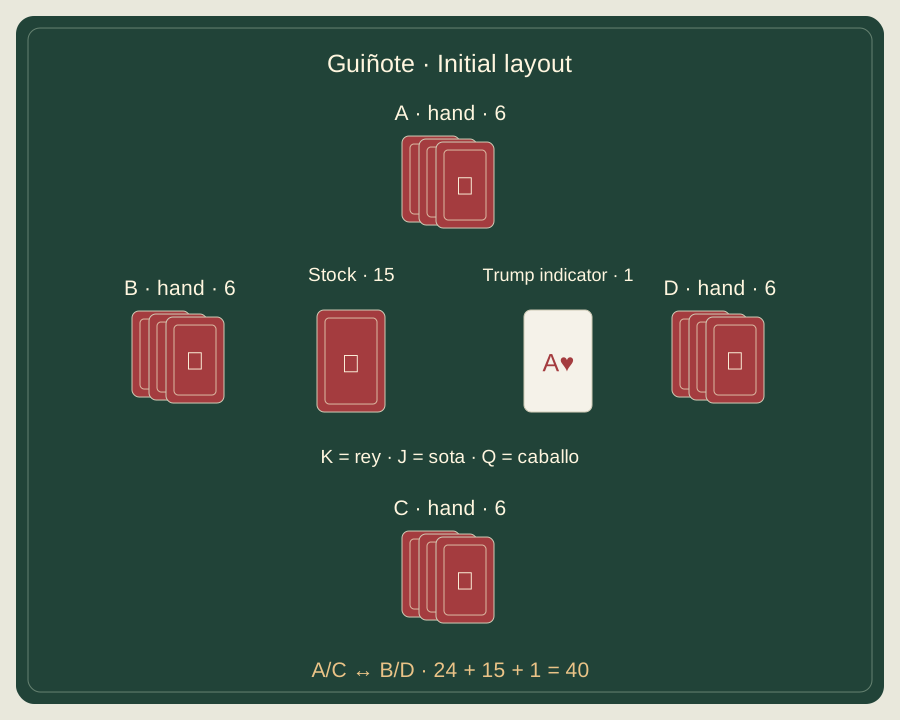
Play with 4 players in 2 fixed partnerships, sitting opposite. Randomly choose the opening dealer; the player on the left cuts. Deal counterclockwise in packets of 3 until everyone has 6. Put the next card face up under the remaining stock as the trump indicator. There are 24 cards in hands, 15 hidden stock cards and 1 visible indicator, totalling 40. The player right of the dealer leads; play continues counterclockwise. After each trick, its winner leads next. For later deals the previous last-trick winner deals. Never share hand information through words or private gestures.
04 /
The open phase with a stock
While stock remains, play any hand card: following suit, overtaking and trumping are not compulsory. The highest trump wins the trick; without trump, the highest card of the led suit wins. The winner draws the next stock card, then everyone else draws a card counterclockwise, restoring the hands. Repeat for 4 tricks with draws. In the final draw cycle, the last player takes the exposed indicator; it is part of the pack, not a bonus card. After that cycle there is no stock and each hand still has 6 cards. Do not keep drawing during the following strict phase.
05 /
Arrastre: obligations without stock
Play the final 6 tricks without draws. Always follow the led suit if you have it. If no trump has been played and an opponent is winning, beat the best led-suit card if able; otherwise follow with any card of that suit. You need not overtake your partner in this profile. If void in the led suit and an opponent is winning, play a trump that wins if you can; overtrump an opposing trump when possible. If you cannot overtrump, or your partner is winning, you may discard any card. Never use a trump instead of following a suit you hold. Stricter partner-overtaking agreements must be distinguished before play. If trump was led, overtake an opponent’s winning trump when able.
06 /
Cantes and exchanging the seven
After your partnership wins the latest trick, holding rey and sota of a suit in the same hand allows a cante: 40 for trump, 20 for another suit. In the diagrams that is K with J, never K with Q. Declare each suit only once per deal; cards stay in hand and can later be played normally. For a clear teaching window, declare and show both cards before the next lead; some tables permit later declarations before an opponent plays. While stock remains, a holder of trump 7 may exchange it for the exposed indicator after their partnership won the last trick, before the next lead. During the final draw cycle, exchange before your own draw, and not if the indicator would go to your partner. After the final draw it is too late.
07 /
Idas, vueltas and the match
Complete all 10 tricks of the first deal, the idas. Add captured card points and cantes; winning the last trick adds 10, so the base total is 130 before cantes. A partnership reaching 101 wins the partida. If both qualify, the last-trick side wins provided it has at least 30 trick points without cantes; otherwise the other qualifying side wins. If neither qualifies, keep the totals and redeal for vueltas. In vueltas, a team that has just won a trick may claim once its cumulative total reaches 101; do not claim merely for holding valuable cards. Points up to 50 are called malas; above that, subtract 50 and call the rest buenas: 101 is 51 buenas. Agree a coto as best of 5 partidas, first to 3 wins.
08 /
An arrastre trick and a declaration
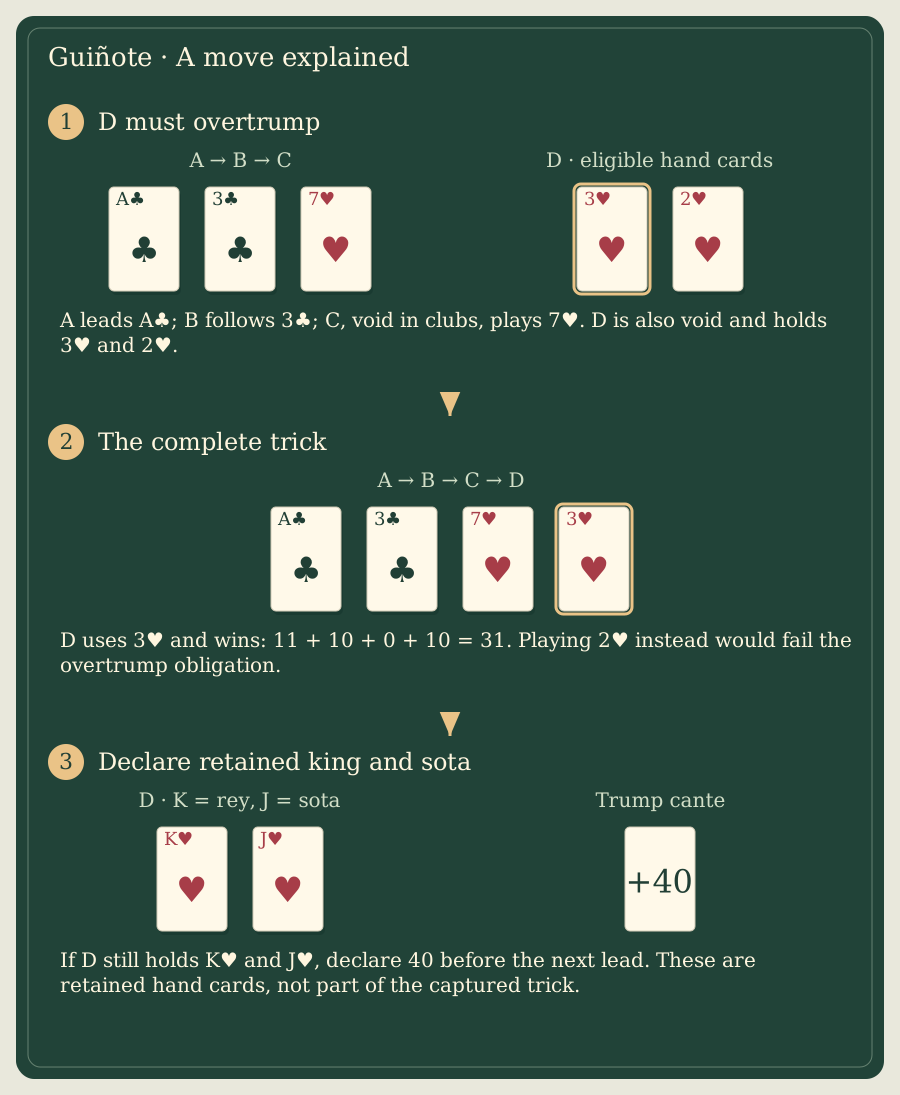
Hearts are trump and the stock is empty. A leads A♣, B follows 3♣, C has no clubs and trumps with 7♥. D has no clubs but holds 3♥ and 2♥. Because opponent C is winning, D must use 3♥ to overtrump; choosing 2♥ would be illegal. D wins 11 + 10 + 0 + 10 = 31 card points. If D still holds K♥ and J♥ after the trick, D may declare 40 for the trump cante before the next lead; Q♥ would not complete that pair. In a separate scoring example, 61 trick points plus a 40 cante make 101 and win the partida after idas.
← On a small screen, scroll the diagram horizontally. →
Common questions
Is the cante king and knight?+
In this Aragonese profile it is rey plus sota. With our French mapping that is K and J, not K and Q.
Must I follow suit while stock remains?+
No. The stock phase is free. Once the last draw is completed, arrastre requires following suit and the stated winning obligations.
Are 51 buenas different from 101 points?+
They are the same total. Buenas names the amount above the initial 50 points.