← On a small screen, scroll the diagram horizontally. →
01 /
From Jiangsu to partnership play
Guandan, 掼蛋, developed around Huai’an in China’s Jiangsu province and spread as a partnership climbing game. It combines shedding combinations with the level progression familiar from other Chinese card traditions. Its name is often rendered as throwing eggs; stories about the name should not be confused with a proven single inventor. Regional leisure games and competition codes differ. This guide selects the common promotion pattern and the entertainment-style tribute rules, not the alternative larger promotion for a sweep. There are no card-point tricks: finishing order, control of the lead and helping your partner decide the result.
02 /
Teams, deal and a shared level
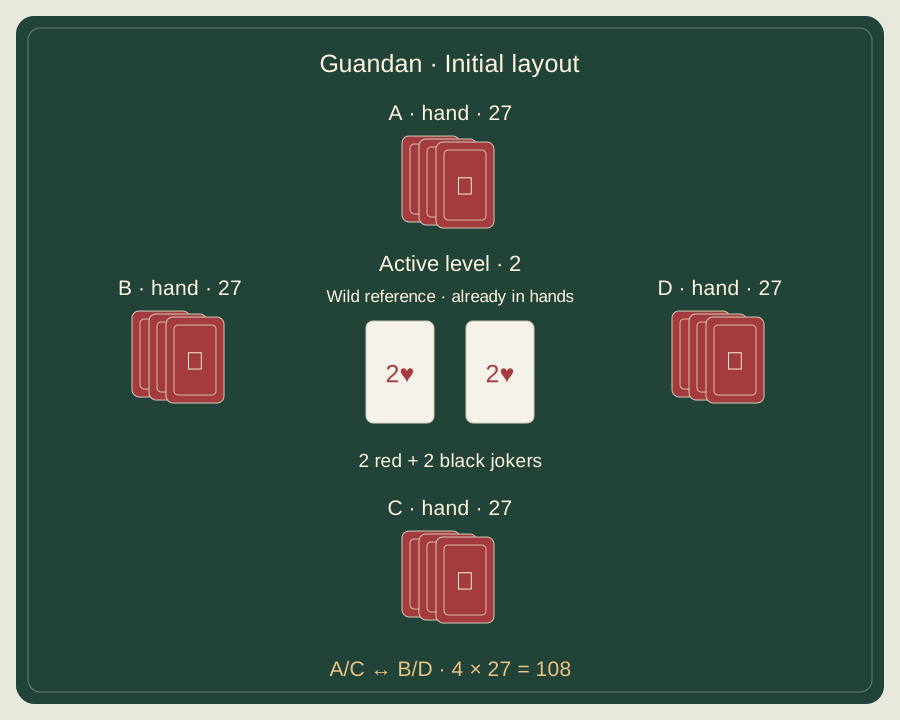
Seat 4 players in 2 fixed partnerships, partners opposite. Mix 2 standard packs with their jokers: 108 cards, including 2 red and 2 black jokers. Everyone receives 27, with no stock. Draw or deal counterclockwise. For the opening deal, randomly choose a shuffler, turn a card face up and bury it while cutting; whoever receives that marked card leads any legal play. Both teams start at level 2. Later the previous winning team’s level sets the single active level for everyone in the deal; teams do not use separate wild ranks simultaneously. Record both team levels and name the active level before tribute and play.
03 /
Level order and heart wild cards
For singles and equal-rank sets, red joker beats black joker, then active level rank, then A, K, Q, J, 10 down to 2 with the level rank removed from that ordinary position. Suits do not break ties. Both hearts of the active level are wild and can represent any non-joker needed in a combination, including a suit for a straight flush. Declare their meanings when playing. A wild played alone is just a level card, not a red joker; both wilds together can be a level pair. In sequences, every rank returns to natural order: a level 7 still fits between 6 and 8. Jokers never substitute into sequences.
04 /
Every ordinary combination
Ordinary shapes are a single, a pair, a triple, a full house of triple plus pair, a straight of exactly 5 consecutive ranks in mixed suits, a tube of exactly 3 consecutive pairs, and a plate of exactly 2 consecutive triples. Compare equal shapes only: rank sets use level order, full houses use the triple, and sequences use their highest natural rank. A higher pair cannot beat a single. Same-colour jokers can form a pair or the pair portion of a full house; mixed jokers cannot pair. Sequences can use A low or high but cannot wrap through K–A–2. Equal strength never beats a play.
05 /
The bomb ladder
A rank bomb has 4 or more equal ranks, using wild cards if declared. The bomb ladder, low to high, is 4 equal cards, 5 equal cards, a straight flush of exactly 5, then rank bombs of 6, 7, 8, 9 and 10 cards, then all 4 jokers together. Compare size before rank; equal-sized rank bombs use level order. Straight flushes use their highest natural rank, not suit. Wilds cannot replace jokers. A bomb may beat any ordinary shape regardless of card count, but a bomb can only be answered by a stronger bomb. Bombs are played on your turn, never as an out-of-turn interruption.
06 /
Beat, pass and regain the lead
Play counterclockwise. A leader starts with any legal shape. Others may beat it correctly or pass, even if able to beat it. A pass does not lock you out: you may play on a later turn in the same contest. After 3 consecutive passes, counting empty hands as automatic passes, clear the played cards permanently. The last unbeaten player leads again; if already out, their partner receives the lead. Mark finishers as they empty their hands. Stop when a partnership has both players out, or when only the last player remains. At 10 or fewer cards, state the exact remaining count when asked. Do not disclose your partner’s hand or arrange private signals.
07 /
Promotion and winning at Ace
The team of the first finisher wins the deal. If the partner finishes second, advance 3 levels; third gives 2 levels; fourth gives 1 level. Advance the winning team from its own recorded level; the other team stays where it was. Levels run 2, 3, 4, 5, 6, 7, 8, 9, 10, J, Q, K, A, stopping at A rather than jumping over it. To win the match, be the declaring team in a deal actually played at your Ace level and finish first with your partner second or third. A first-and-fourth win at Ace is insufficient. We use no automatic Ace-failure reset; limited-attempt resets are a separate regional option.
08 /
Tribute, return and next lead
After later deals are distributed, previous last place gives previous first place their highest single except a heart-level wild, even if they are partners. The recipient returns a different card of natural rank 10 or lower that is not an active level card. After a first–second sweep, both opponents pay; the larger tribute goes to first place. For equal tributes, first place takes from their right-hand opponent and the partner takes the other. Each recipient returns to their own payer. The single payer, or the payer to first place after double tribute, leads. Cancel all tribute if the liable player, or both liable opponents together, hold both red jokers; previous first place then leads. Show these exchanges publicly before play.
09 /
A heart wild becomes a bomb
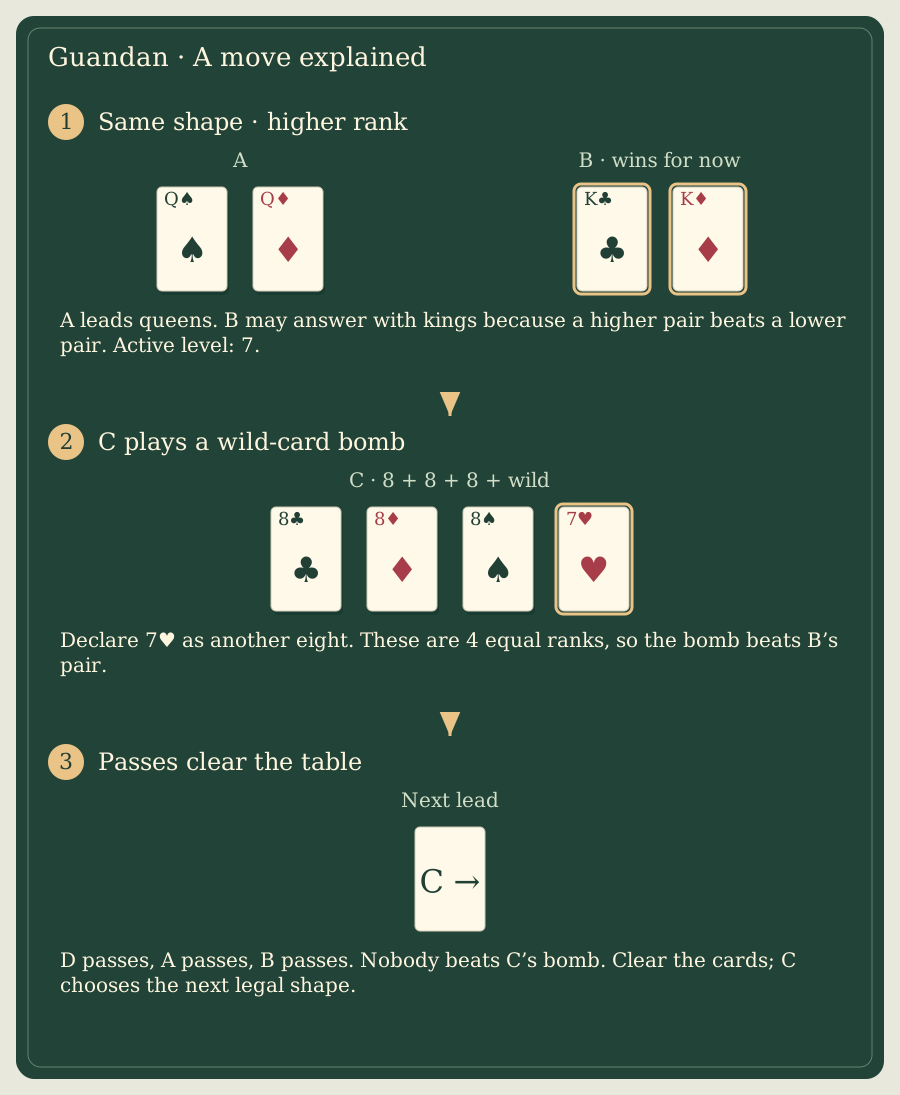
At active level 7, A leads Q♠ Q♦. B responds K♣ K♦, a higher pair. C, A’s partner, plays 8♣ 8♦ 8♠ 7♥, declaring the heart as another eight. That makes a 4-card rank bomb and beats the kings even though eights are lower than kings. If D, A and B all pass, C clears and leads again. The two eights already in different suits are physical cards, not a suit-following obligation. In a separate level example, a team on 6 finishing first and third advances to 8, not to the other team’s level. Spending a wild this way is useful only if the regained lead helps the partnership finish.
← On a small screen, scroll the diagram horizontally. →
Common questions
Does each team have its own wild rank?+
No. The declaring team sets one active level for the deal; both hearts of that rank are wild for everyone.
May I bomb out of turn?+
No. A bomb changes which shapes you can beat, but it does not change the turn order.
Is reaching Ace already a match win?+
No. Win while declaring Ace with your partner second or third. Winning at the opponent’s active level only earns the next Ace declaration.