← On a small screen, scroll the diagram horizontally. →
01 /
A reconstructed historical game
Gleek was played in England before whist became dominant. The name appears in earlier literature, but names alone do not prove that those early games had these rules. Our guide follows David Parlett’s reconstruction from Cotgrave (1662), Willughby (1660–1670) and Cotton (1674). Their accounts differ, particularly over betting and low-trump payments. Here the stock auction rises by 2 counters, and the buyer must retain trump honours when discarding: these are explicit teaching agreements that avoid odd payments and keep the final point total intact. Play with counters as score markers.
02 /
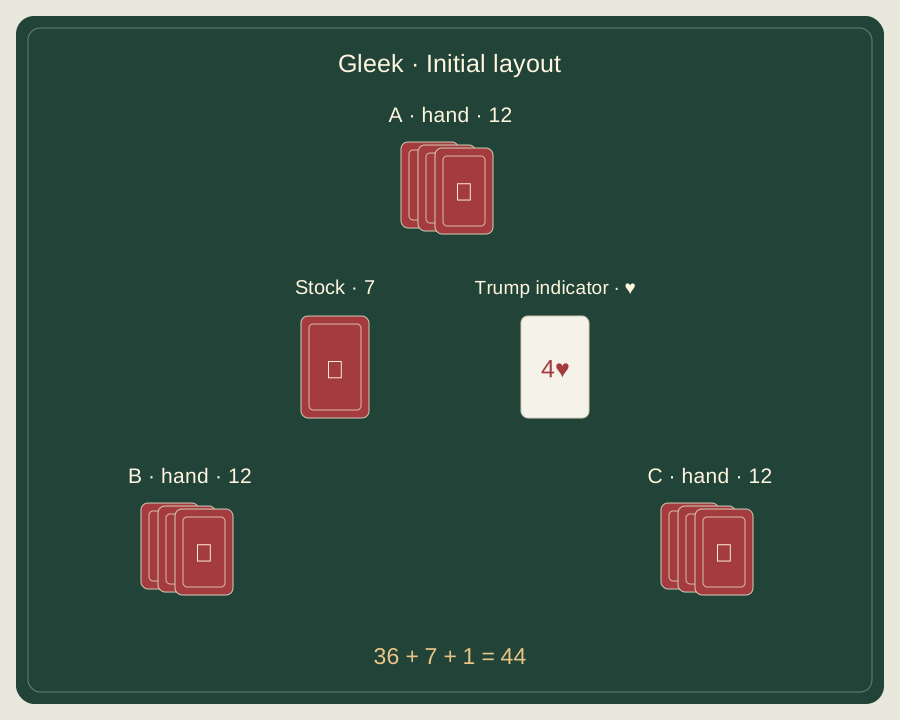
The pack and the deal
Exactly 3 players use 44 cards: remove all 2s and 3s from an ordinary pack. Rank each suit A, K, Q, J, 10, 9, 8, 7, 6, 5, 4. Lowest cut deals first; deal and play clockwise, rotating the dealer each hand. Deal 12 cards to each in batches of 4. Of the remaining 8, expose 1 as trump indicator and leave 7 hidden for the auction. The indicator stays out of the hands and belongs to the dealer for scoring. If it is the trump 4 (Tiddy), each opponent pays the dealer 4 counters immediately. There is no purchase of the indicator.
03 /
Buying the stock
The dealer’s left neighbour, eldest hand, must open at 12. Thereafter each player passes out of this auction or bids higher; our agreed increase is 2. After both opponents pass, the winner pays half the final bid to each: a bid of 14 costs 7 to each opponent. Before looking at the stock, discard exactly 7 cards face down, then take the 7 closed stock cards. Everyone still has 12 cards. Our teaching agreement forbids discarding A, K, Q or J of trumps. The indicator is never part of this exchange. Passing here does not exclude a player from later phases. No other player exchanges cards.
04 /
Vying the ruff
A ruff is your highest total within a single suit: A counts 11, K/Q/J count 10 each, and other ranks count face value. All 4 aces beat every ordinary ruff. Starting with eldest, each has a chance to open the contest at 2 counters; declining to open is a check, not a permanent withdrawal. If nobody opens, skip this phase and double its opening stake next deal; reset to 2 after a settled contest.
After an opening, go clockwise. A player may fold, match the current stake, or raise it by 2. A fold fixes that player’s liability at the stake then current. In this teaching procedure, compare the remaining hands once all remaining players have matched without a further raise; if only one remains, that player wins unseen. The best ruff wins, equal totals favouring the earlier seat from the dealer’s left. Each loser pays the winner their fixed or final stake, rather than paying that amount again on every turn. Reveal enough cards to verify a contested claim. Historical betting procedures vary: this explicit procedure is used for the whole match.
05 /
Gleeks and mournivals
Before trick play, everyone may declare sets in their current hand. A gleek is 3 of a rank; a mournival is 4. Only A, K, Q and J qualify. Each opponent pays 4 for a gleek of aces, 3 for kings, 2 for queens or 1 for jacks; a mournival doubles the corresponding payment to 8, 6, 4 or 2. A mournival is not also a separate gleek. Everyone scores every valid set, not just the strongest set at the table. Record and verify declarations; these are direct counter transfers, not trick points. Cards remain in hand for the play.
06 /
Playing the tricks
Eldest leads to the first of 12 tricks. Each player contributes 1 card clockwise. Follow the led suit if possible; otherwise play any card. Neither overtaking nor trumping is compulsory. The highest trump wins, or the highest card of the led suit if there is no trump; the winner leads next. Trump never changes during the hand. Announce A/K/Q/J of trumps when you play them and credit their honour value to yourself, even if someone else wins that trick. Holding trump 4 gives a separate payment of 2 counters from each opponent, claimed before play or when playing it, but never twice. Payments for trump 5 and 6 and the compulsory-highest-card variant are excluded here.
07 /
Settlement and winning the session
For the final phase, count 3 points per trick won. Add your own played trump honours: A=15, K=3, Q=3, J=9. An honour turned up belongs to the dealer for this count; do not award it to the stock buyer. The 12 tricks supply 36 points and honours 30, for 66 in total under our no-honour-discard agreement. Compare your total with 22: pay the deficit into the pot or collect the excess. Players owing counters pay before winners collect. Auction, ruff, sets and Tiddy transfers stay separate from these points; ordinary captured cards add nothing. Agree on a session of 3 deals or another multiple of 3 so everyone deals equally. The highest counter balance wins; equal balances share victory.
08 /
Examples: honours and the final balance
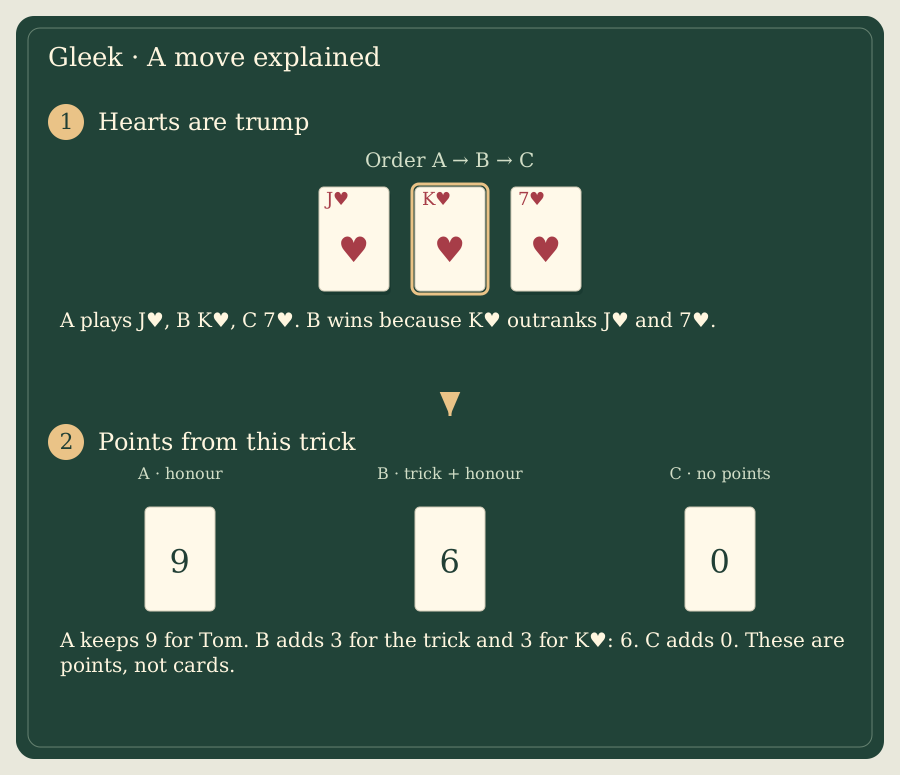
Hearts are trump. A leads J♥, B follows K♥ and C follows 7♥. B wins the trick and earns 3 for it, plus 3 for playing K♥: 6. A earns 9 for playing Tom despite losing the trick; C adds nothing. Those honour points do not move with the captured cards.
For a separate complete-hand calculation, A wins 5 tricks and plays A♥, K♥, Q♥: 15 + 15 + 3 + 3 = 36. B wins 4 tricks and plays J♥: 12 + 9 = 21. C wins 3 tricks: 9. The total is 66. Relative to 22, A collects 14, B pays 1 and C pays 13: the transfers sum to zero. Keep earlier phase payments in separate columns so the same honour is not counted again.
← On a small screen, scroll the diagram horizontally. →
Common questions
Who gets the points for a captured honour?+
In this reconstruction, its player keeps the honour points. The trick winner receives only the trick points and their own played honours.
Does the buyer take the trump indicator?+
No. Only the seven closed stock cards are exchanged; the indicator remains outside the hands.
Are historical variants interchangeable?+
Agree on one profile first. Highest-card obligations, extra low-trump payments and different ruff procedures change play and settlement.