← On a small screen, scroll the diagram horizontally. →
01 /
What this version means
Give Away is an ambiguous name, so identify the layout before playing. This guide covers the turn-based shared-foundation game: everyone owns a personal packet, while the centre accepts ascending ranks without regard to suit. It is a race to clear cards, not a trick-taking game. Its exact inventor and first publication have not been established for this profile; a confident origin story would be misleading. Simultaneous races and games also called Getaway use different procedures.
02 /
Pack, players and deal
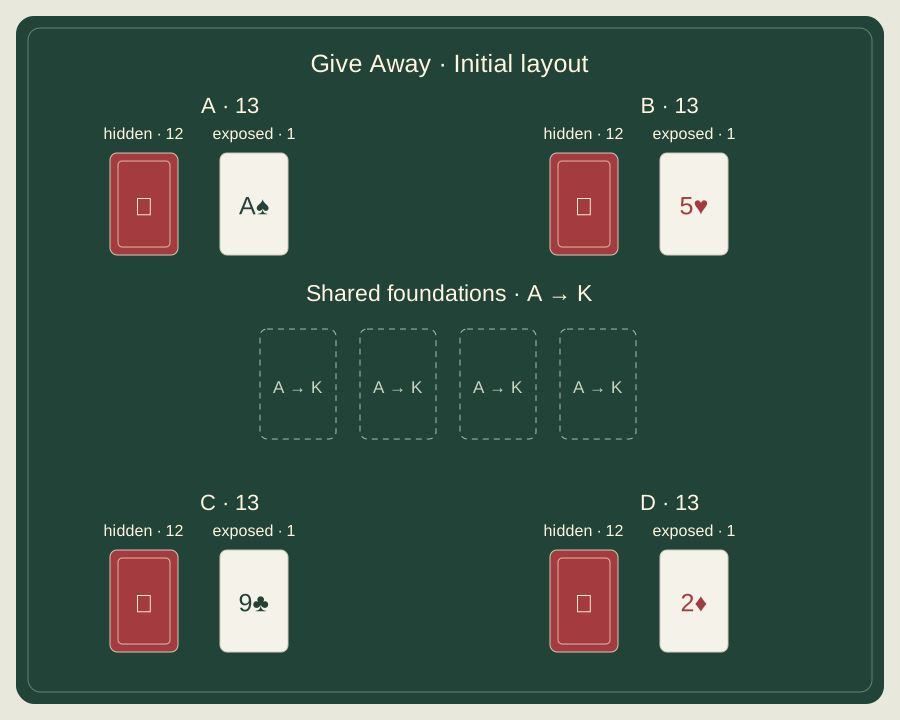
Use 52 ordinary cards without jokers for 2–6 players. Shuffle and deal every card face down clockwise, starting left of the dealer; uneven packets differ by at most 1 card. Nobody inspects their packet. In the illustrated 4-player deal, each receives 13 cards: expose the top card beside the remaining 12. Each player always has at most 1 exposed personal card. Leave 4 empty foundation spaces in the centre. There is no shared draw pile, reserve or personal waste pile. Rotate the dealer between rounds to distribute any extra cards fairly.
03 /
A complete turn
The player left of the dealer begins; turns move clockwise. An ace starts an empty foundation. Otherwise play only the rank immediately above a foundation’s exposed top: 2 on A, 3 on 2, continuing through 10, J, Q, K. Suit and colour never restrict the move. A king finishes that pile; do not wrap from K to A. You may use only your own exposed card. If it is legal, you must play it, expose your next card and check again. Continue for as long as legal plays remain. If several piles accept it, choose any one. When stuck, leave the card exposed and end your turn. Never bury it, draw an alternative or play on a neighbour’s packet.
04 /
When nobody can play
A block occurs after every active player passes once in succession without any card moving. Stop immediately: the next circuit cannot uncover a different card. This can happen on the very first circuit if no ace is exposed. Do not reshuffle packets or turn extra cards. Count each player’s remaining face-down cards plus their exposed card. The lowest count wins this blocked round. For an equal lowest count, this teaching profile records a draw and awards no round win; agree on that tie convention before dealing. This stopping rule makes a blocked position a defined result rather than an endless loop.
05 /
Winning a round and a match
Playing your final exposed card wins immediately, provided your personal packet is also empty. An empty face-down packet alone is not enough. The round ends at that moment; do not require the winner to wait for the next turn. A single round needs no points. For a short match, first to 3 round wins takes the match; draws do not advance anyone. Keep the same block and tie conventions throughout. Simultaneous play, downward building and extra exposed cards are separate variants; do not quietly introduce them halfway through a match.
06 /
Example: a run of compulsory plays
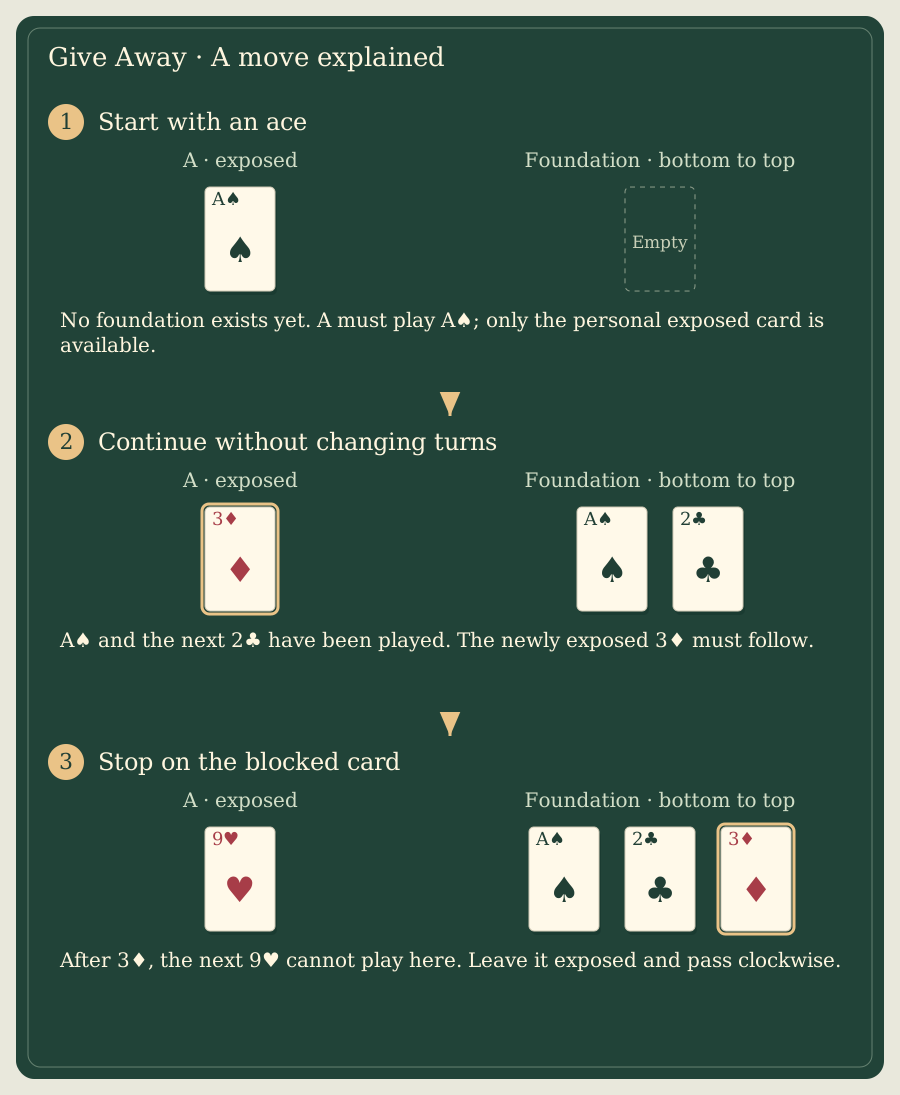
All foundations are empty. A exposes A♠ and must start a foundation. The next personal card is 2♣, which must go on A♠ despite the different suit. Next comes 3♦: it must go on 2♣. The next card is 9♥, so A stops with 9♥ exposed; it cannot jump from 3♦ to 9♥. Later, if a foundation reaches 8♠ before A’s next turn, 9♥ becomes playable there. Another player cannot take A’s exposed card to play it. The diagram follows one packet, not several cards held simultaneously.
← On a small screen, scroll the diagram horizontally. →
Common questions
Can I keep a playable card?+
No. Play it and expose the next card; passing is allowed only when your exposed card has no legal destination.
Must the foundation keep the same suit?+
No. Only the next higher rank matters; colours and suits are ignored.
What if no ace is exposed at the start?+
After a complete circuit of passes, apply the blocked-round count. Do not reveal extra cards to rescue the deal.