← On a small screen, scroll the diagram horizontally. →
01 /
Players and cards
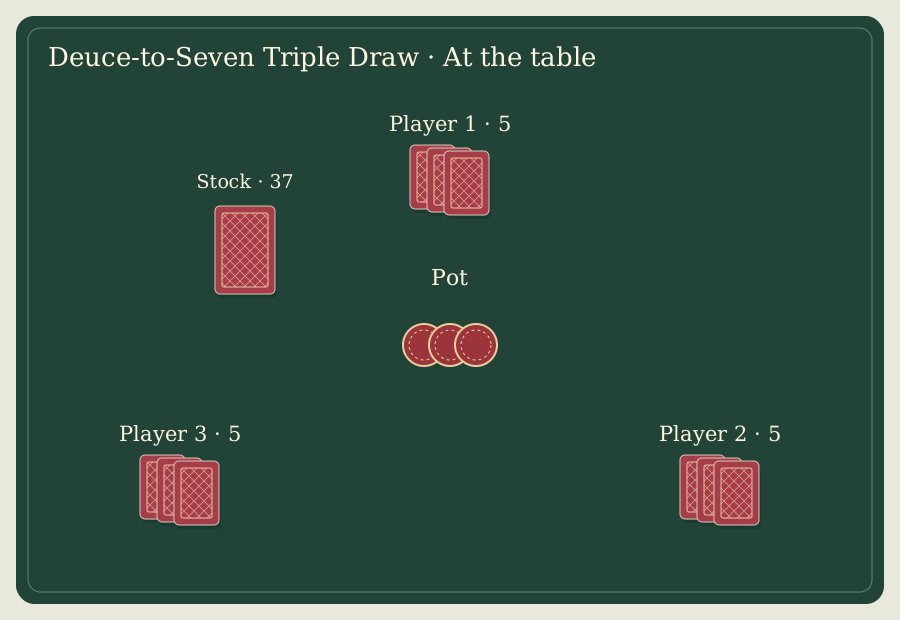
For 2–6 players use an ordinary 52-card pack without jokers. Each receives 5 private cards and no community cards. Select fixed-limit 2/4 notional chips, blinds 1/2, no ante or rake. Everyone starts with 100; no chips may be added during a hand. This is specifically 2–7 lowball: A is always high and straights and flushes hurt. The seven in the name is not a maximum qualifying rank.
02 /
Comparing low hands
From best category to worst: unpaired, one pair, two pair, trips, straight, flush, full house, quads, straight flush. For unpaired hands sort all 5 ranks descending and compare in order: the lower first differing rank wins. Best is mixed-suit 7–5–4–3–2; 7–6–4–3–2 loses on 6 against 5. Only all cards sharing a suit makes a flush; a repeated suit alone does not. A–5–4–3–2 is not a straight but is A-high; an ordinary unpaired K-high beats it.
Within a category compare repeated ranks first: a lower pair, triple or quad is better. With two pair compare the higher pair, lower pair, then kicker; with full houses compare triple then pair. Compare remaining cards descending, lower being better. Straights and straight flushes compare their top; flushes compare all ranks descending. Suits never break ties.
03 /
Deal and opening
Choose the first button by lot; after each hand move it left to the next player with chips. The left neighbour posts small blind 1, the next big blind 2. Deal 5 hidden cards each, singly clockwise. First betting starts left of the big blind. Blinds count towards the wager; the big blind retains the option to raise after mere calls. Heads-up, the button posts the small blind and acts first before drawing; the other posts big blind. Draws and later betting start with the active player left of the button, the big blind heads-up.
04 /
Four betting rounds
The sequence is bet, draw, bet, draw, bet, draw, final bet and showdown. Bets and each raise are 2 in the first two rounds and 4 in the last two. This limit profile caps a round at one bet and 3 full raises; the big blind counts as the first bet. If action becomes heads-up before the cap, raises are unlimited. A cap already reached is not undone by a later fold.
With no wager, check to remain without adding chips or bet. Facing a wager, fold to abandon all claim, call by adding the difference, or raise by calling and adding the fixed increment. Check-raising is allowed. A round ends when everyone still holding chips has responded and matched, or everyone checks. If only one player has not folded, that player takes the pot immediately without showing.
05 /
Three draws and a short pack
On each draw the remaining players, including all-ins, announce clockwise from the button’s left how many cards they discard, from 0 to 5. Zero means stand pat, keeping everything; it does not prevent drawing later. Keep discards hidden and separate. Burn 1 hidden card before replacements, even when everyone stands pat. Give each player all replacements consecutively, restoring a hand of 5.
For this live table agree the following shortage procedure: shuffle the stub with previous discards and folded hands; current discards of already served players may join, but exclude those of the current recipient and players still waiting. Never touch live hands. Burn cards stay out. Repeat if necessary. A card discarded on an earlier personal draw may return after reshuffling; this expressly differs from PokerStars’ electronic protection.
06 /
All-in and reopening
Insufficient chips do not force a fold: put the remainder all-in and continue drawing. But you cannot shove a large stack beyond the fixed limit. An incomplete all-in raise smaller than half the fixed increment does not reopen raising for players already acted; half or more does. After a bet of 4, all-in to 6 adds 2 and reopens action: the next full raise adds 4, to 10. An incomplete increase of 1 would not reopen it. A player yet to act retains legal raising rights; a less-than-half increase may be completed to the full level.
07 /
Scoring
Return any uncalled excess to its owner. Separate main and side pots by contribution levels: an all-in player may win only covered levels; folded contributions remain but their owners cannot win. Contributions of 6, 10, 10 create a main pot of 18 for all and a side pot of 8 for the latter two. Compare each pot separately using the complete 5-card hand. There is no “seven or better” qualifier: if everyone has pairs, the best of those hands wins.
08 /
Ending the game
After final betting show all hands claiming a pot: the last aggressor shows first, or without a final bet the first active player left of the button. Equal ranks split the relevant pot equally; this home agreement gives an indivisible chip to the first tied player left of the button. When all-in ends betting, remaining draws still occur. For a session play 10 hands or until only one player holds chips; skip eliminated players. Most chips at the end wins, ties share place. Shuffle the full pack before every new hand.
09 /
History and selected variant
2–7 is a low-poker ranking system also called Kansas City lowball. Triple Draw supplies three exchange opportunities and four betting rounds; it is not four-card, different-suit Badugi. Sources document modern tournament and online play but do not establish a sole inventor reliably. This describes a live table with expressly selected recycling, raise-cap and session-end procedures; operator versions may differ.
10 /
Worked example
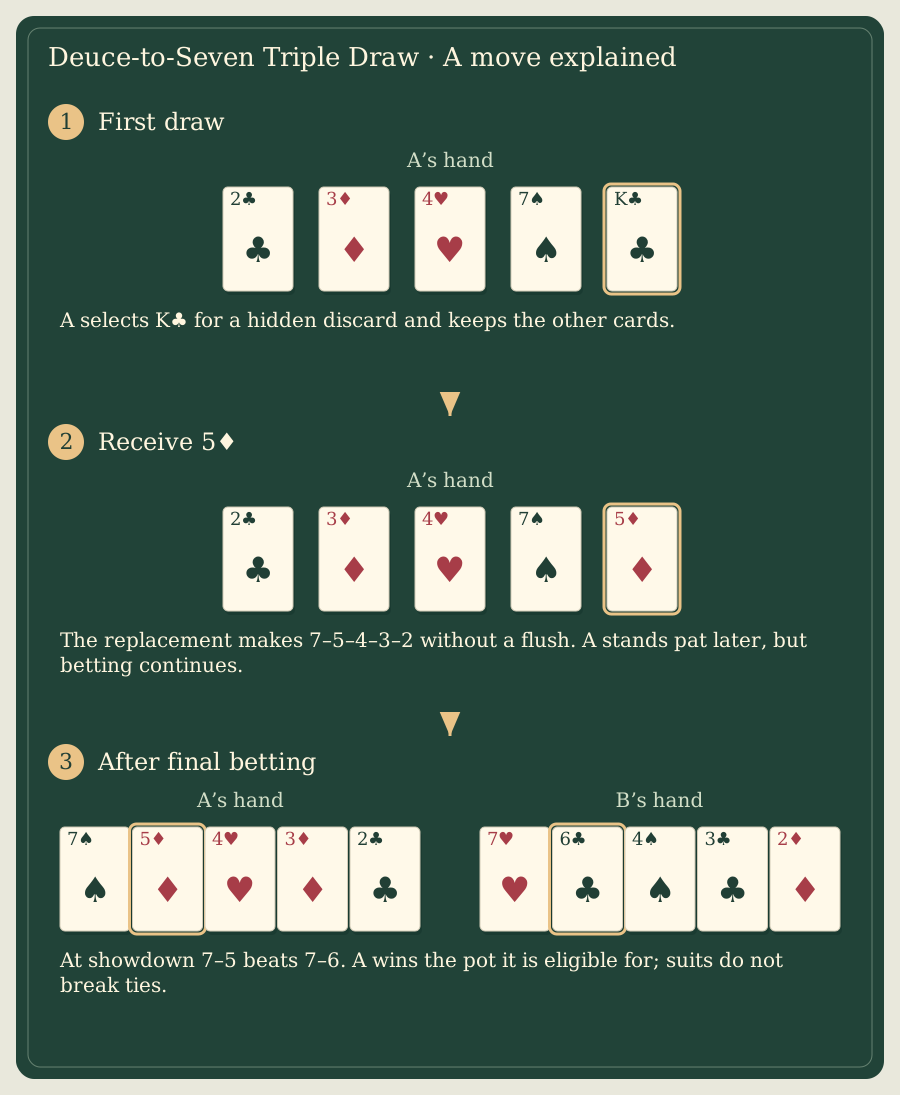
A holds 2♣ 3♦ 4♥ 7♠ K♣. On the first draw discard K♣ and receive 5♦, making the best 7–5–4–3–2 without a flush. A stands pat on later draws but still participates in betting. B shows 7♥ 6♣ 4♠ 3♣ 2♦ and loses on 5 against 6. In a separate side-pot example A contributed 6, B and C 10 each: A’s best hand wins only 18; the better hand between B and C wins 8.
← On a small screen, scroll the diagram horizontally. →
Common questions
Is A–2–3–4–5 best?+
No, A is high: it is ace-high, not a wheel.
Does standing pat forbid later draws?+
No, decide anew on each draw.
Does all-in stop drawing?+
No, the hand remains live and receives the remaining draws.