← On a small screen, scroll the diagram horizontally. →
01 /
Context and preparation
Brag is a longstanding British vying game documented in Hoyle-era accounts before modern poker. Three-card Brag is closely related to Teen Patti but has its own ranking and showdown procedures. This profile includes traditional blind play, not poker blinds. Use nonredeemable accounting units with negative balances permitted, so finite-bankroll and side-pot rules are unnecessary. Our session ends after eight resolved pots; carry-forward deals do not count as resolutions. Highest net balance wins, shared exact ties.
02 /
Complete hand ranking
Use 52 cards without jokers, A K Q J 10 9 8 7 6 5 4 3 2. High to low: prial, running flush, run, flush, pair, high card. A prial is three equal ranks; triple threes is highest, then triple aces, kings down to fours, then twos. For runs, suited or mixed, A–2–3 is highest, A–K–Q second, then K–Q–J downward to 4–3–2; K–A–2 is invalid. Any running flush beats any mixed run.
Compare ordinary flushes and high-card hands lexicographically from highest card downward, ace high. Compare pairs by pair rank, then kicker. Suits never break ties. A mixed run beats every ordinary flush: do not apply poker’s order.
03 /
Ante and deal
Choose first dealer randomly and rotate clockwise left. Shuffle before the first deal, then only after a showdown won by a prial. Put folded and completed hands under the pack without shuffling; retained blind hands stay out. Everyone posts ante 1 for each fresh deal, including a carried-pot deal. Deal three singly from the left. Players may privately look or leave their hand untouched to play blind. No draw or exchange.
04 /
Repeated betting
At every turn pay a fresh full amount, not a difference from earlier contributions. Express the betting level in SEEN-equivalent units. Opening level is from 1 to 5; each raise increases that level by at most 5. A seen player pays the level, a blind player half it; record fractions exactly. For example a seen bet 4 and blind bet 2 are equivalent, so the next seen player needs 4, not 2. No free check. Fold ends participation and forfeits contributions. A lone SEEN survivor takes the pot without showing.
Only two remaining players may see. Seen against seen: pay twice the current level. Seen against blind: you CANNOT see the blind player; continue betting or fold. Blind against seen: pay the current seen level, twice your normal blind payment. Blind against blind: also pay twice the blind rate, which equals the seen level. Opponent exposes first; caller wins only with a strictly better hand, otherwise opponent wins. For two blind players turn cards alternately, opponent first. Ordinary matched payments never end betting automatically.
05 /
Playing blind and changing status
Leave blind cards untouched and do not inspect them out of turn. At your own betting turn you may look before deciding; from that instant you are seen and pay the seen rate. You cannot become blind again with that same inspected hand. Blind discounts and see restrictions are status rules, not separate pots.
If all opponents fold while you remain blind, you do NOT collect. Carry the whole pot into the next deal and you may retain that unseen hand. Everyone posts the next ante and receives a new hand, so the retaining player temporarily has two. Choose to look at one old or new hand, or neither. If you look at one, you must immediately keep it and discard the other unseen, or discard the inspected one and retain the other blind. Only after discarding the first may you inspect the remaining one. Never inspect both then choose the better.
If you keep both blind, you pay one player’s blind rate, not two independent bets. Before a showdown our table requires selecting a single hand through the same inspect/keep-or-discard process before seeing the opponent’s revealed cards; this operational timing is explicit clarification. If everyone folds again while both remain unseen, retain only ONE unseen hand for the next deal; never accumulate three.
06 /
Worked pot
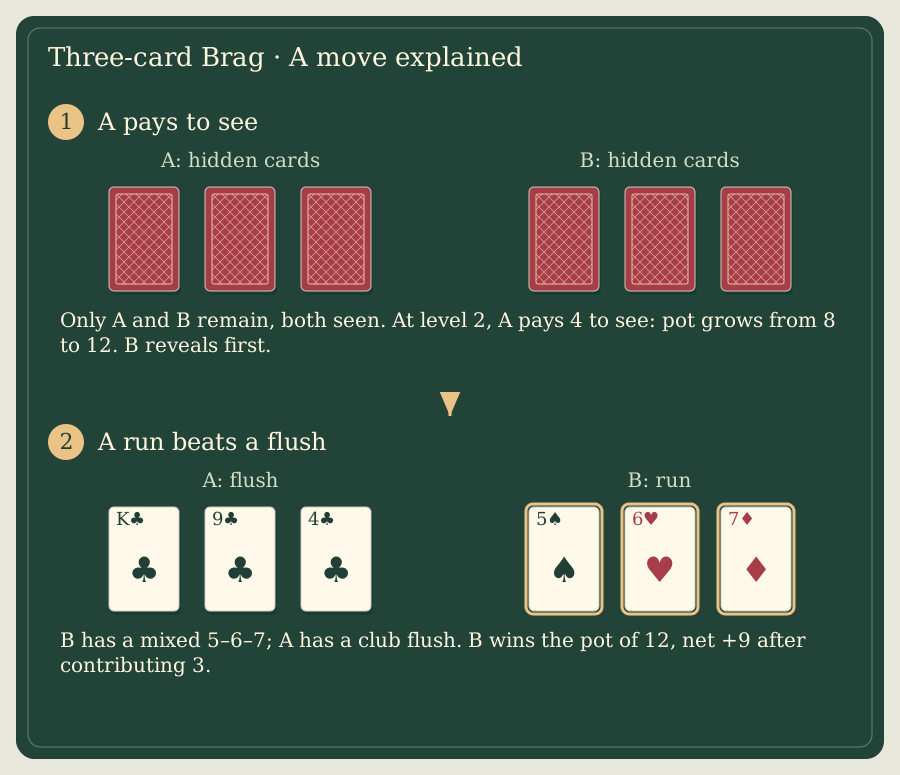
Everyone has looked at their cards; all players are seen. Four ante 1 each: pot 4. A pays 2, B pays 2, C folds, D folds: pot 8. A pays 4 to see B: pot 12. A holds K♣–9♣–4♣, a flush; B has 5♠–6♥–7♦, a run. B wins because run beats flush and records+9 net after contributing 3; A loses 7, C and D lose 1 each. Check 9−7−1−1=0. If the hands had equal strength, A as caller would still lose.
← On a small screen, scroll the diagram horizontally. →
07 /
Practice and other variants
Seen-only teaching exercise: everyone looks immediately, so all payments use the seen rate and sees cost twice it. This is an optional practice simplification, not the full profile above. Wild cards, draw-Brag and finite-bankroll covering rules require separate agreements.
Common questions
Does matching the previous bet make a showdown?+
No. Betting repeats; a see costs double and is available only heads-up.
How is an exact hand tie settled?+
The player who paid to see loses. Suits do not decide.