← On a small screen, scroll the diagram horizontally. →
01 /
History and selected rules
Hold’em is community-card poker associated with Texas; a precise inventor and date are not established here. Select ordinary no-limit for 2–10 players without money. Start with 200 counters each, blinds 1/2 and no ante. Table stakes apply: no adding chips during a hand or wagering outside property. For this home session agree no rebuys; a player losing every chip is eliminated, and the last with chips wins. Blinds stay fixed; if stopping at an agreed time, most chips wins and equal stacks tie.
02 /
Setup and deal
Use 52 cards without jokers. Randomly place the dealer button. Left of it posts small blind 1, next big blind 2, both live first-round contributions. Deal 2 private cards each, singly clockwise from left of the button. Burn a card face down before each community release: flop 3, turn 1, river 1. Heads-up, the button posts the small blind, the opponent the big blind; deal the button last. Button acts first preflop and last postflop. When changing to heads-up, adjust the button if needed so nobody posts the big blind twice consecutively.
After every hand move the button and blinds clockwise. Preserve big-blind rotation when players bust: the next remaining player left of the previous big blind posts it; a small blind may be absent and the button may occupy an empty seat (dead button). Do not simply jump to occupied-seat positions and make someone miss their big blind. A short blind posts its whole remaining stack; others still face at least the full big blind 2. Reshuffle the collected deck before the next deal. To claim a pot at showdown, expose both private cards even when playing only the board.
03 /
Playing a hand
Bet preflop and after flop, turn and river. Preflop begin after the big blind; later begin with the first active player left of the button, always clockwise. Fold abandons the hand; check passes when nothing is owed; bet opens wagering; call matches your contribution; raise increases it. The big blind may raise after calls. Check-raising is allowed. A round ends when every nonfolded, non-all-in player had the opportunity to act and matched, or all checked. If all but one fold, the survivor immediately wins without showing.
The minimum opening bet is 2. A raise must add at least the last full bet or raise increment on that round, up to your whole stack; raises are uncapped. Announce the action and total amount before moving chips. A single oversized chip without a raise declaration facing a bet is a call with change. An incomplete bet or raise is allowed only when all-in. Calling with insufficient chips keeps the hand live for the covered portion. Return any unmatched excess.
A short all-in does not reopen raising for someone already acting until the increase since that player’s previous contribution reaches the last full increment. An unacted player may raise. Multiple short all-ins can cumulatively reopen action; the minimum increment remains the last full raise. Example: bet 10, call 10, all-in 15 lets those previous players only call or fold, but a new player may raise to at least 25. If another all-in reaches 20, the previous caller may raise to at least 30.
Separate pots by contribution levels, including folded players’ chips: an all-in is eligible only for levels covered. At each level the best remaining eligible hand wins. When no further betting is possible, expose all live hands and deal the remaining board with normal burns; folded players cannot win.
04 /
Complete scoring
At showdown choose the best 5 of the available 7 cards, using 0, 1 or 2 private cards. Order: straight flush, four of a kind, full house, flush, straight, three of a kind, two pair, one pair, high card. A straight is consecutive ranks; a flush shares a suit; a full house is a triple plus a pair. Ace is high, except A–2–3–4–5 is the lowest straight; K–A–2 cannot wrap.
Compare the defining ranks (triple first in a full house; higher pair first in two pair), then remaining cards descending until different. Straights compare top cards. Suits are equal. Identical best hands split the pot; our odd counter goes to the first winner left of the button. Last river bettor or raiser shows first, or first left of the button if none.
05 /
Worked example
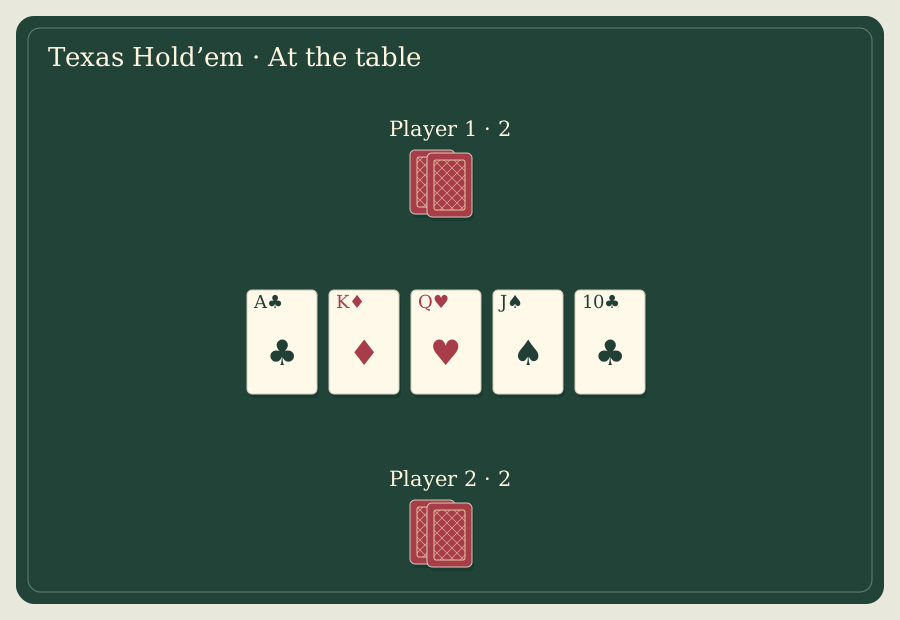
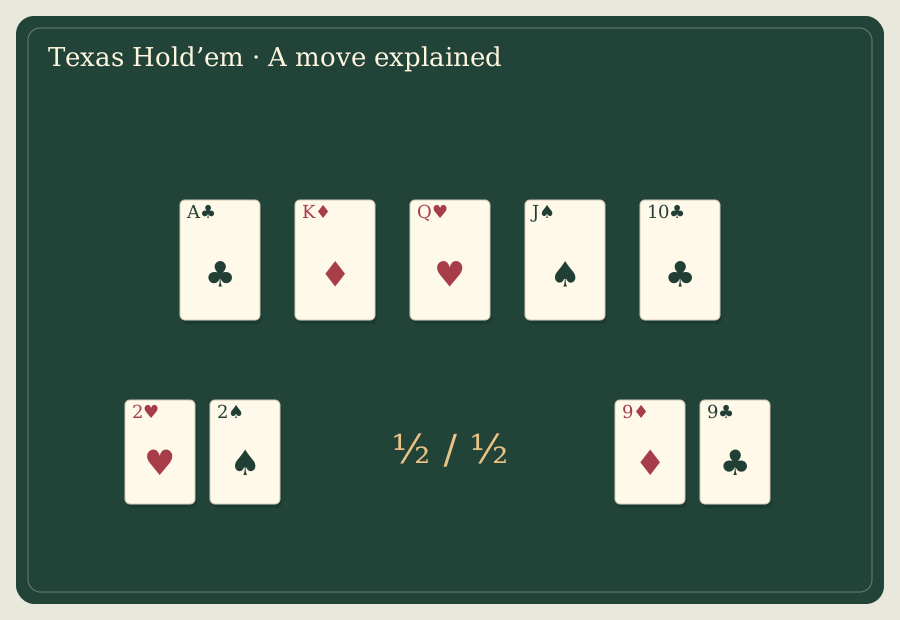
The board is A♣–K♦–Q♥–J♠–10♣. You hold 2♥–2♠ and an opponent 9♦–9♣. Both play the board’s ace-high straight and split equally, even though the opponent’s pocket pair is higher. Compare the best complete hand, not the private pair.
Example side pots: A contributes 20 all-in, B 50 all-in, C 80. Return C’s unmatched 30. All contest the main pot of 60; only B and C contest the side pot of 60. If A has the best hand and C the next best, A wins the main pot and C the side. Tied hands split each pot separately.
← On a small screen, scroll the diagram horizontally. →
Common questions
Must I use a private card?+
No. Playing the entire board is legal.
May an all-in win an uncovered side pot?+
No. It is eligible only for covered contribution levels.