← On a small screen, scroll the diagram horizontally. →
01 /
Table and agreed limits
This open-hand version is for 2–8 players using 52 cards and play chips, without jokers. Each player antes 1. Card prices are 2–5: 2 chips; 6–K: 1 chip; ace: 4 chips. Purchases enter the pot but are not bets that other players must match.
Our teaching table uses a fixed bet of 1 and a maximum of three raises per betting round. Require at least 41 chips to enter a fresh deal: that covers the ante, five maximum-price purchases and all five capped betting rounds. This convention avoids an all-in procedure.
02 /
Five purchasing rounds
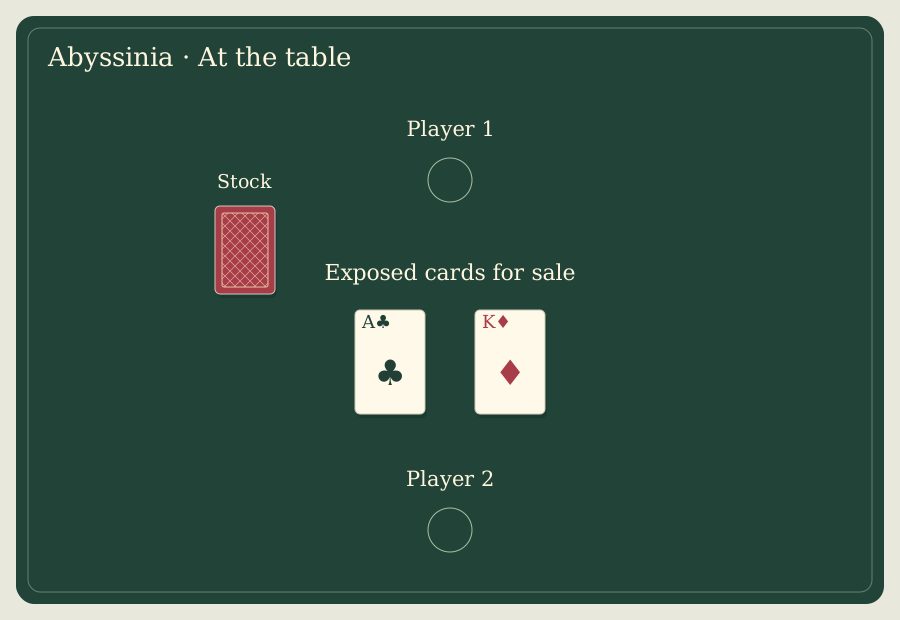
Start with no hand. Expose two cards, one on either side of the face-down pack. Beginning to the dealer’s left and proceeding clockwise, each active player buys one exposed card or the unknown top card of the pack. Reveal a blind purchase before charging for its rank; the buyer cannot return an expensive surprise.
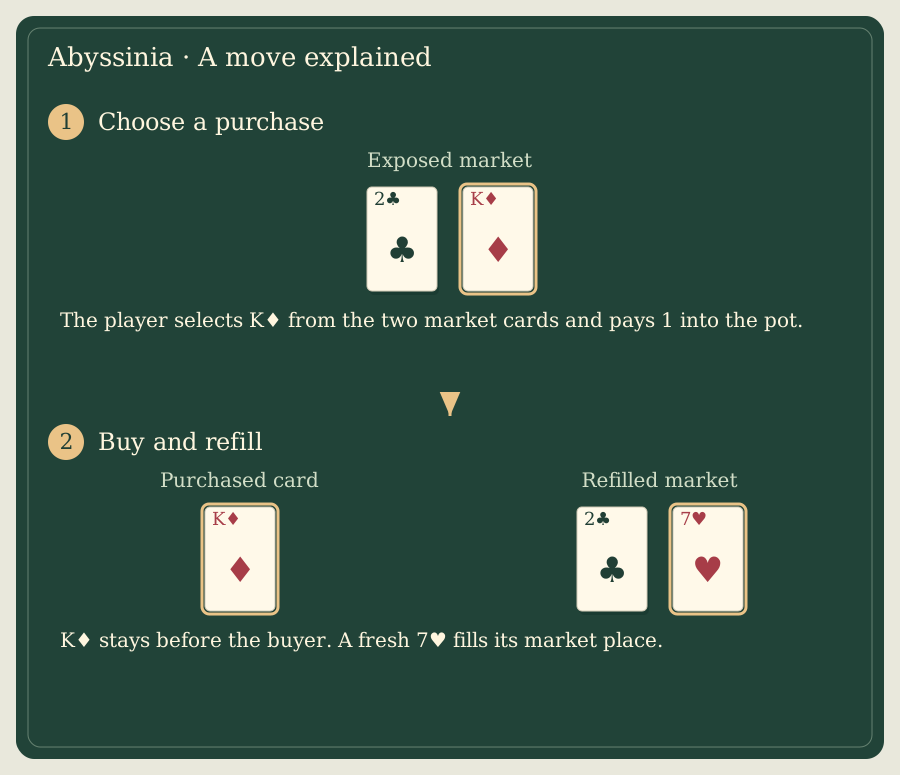
Immediately replace a purchased market card with the next card from the pack. Keep purchased cards face up in front of their owners. After everyone has bought a card, hold a betting round. Repeat four more times so surviving players have five cards. Individual cards cannot be exchanged or discarded.
03 /
Betting and folding
The first active player to the dealer’s left starts each round, and action proceeds clockwise. With no outstanding bet, check or bet 1. Facing a bet, call the outstanding amount, raise by 1 or fold. Check-raising is permitted here. A round ends after everyone remaining has answered the final raise, or everyone checks.
A folded player makes no further purchases and cannot win. If only one player remains, award the pot immediately. Purchase payments are part of that pot, just like antes and betting chips. Turn the dealer position clockwise for the next deal.
04 /
Awarding high and low
After the fifth betting round, divide the pot into high and low halves. High uses normal poker ranking: straight flush, quads, full house, flush, straight, trips, two pair, one pair, high card. Compare the main group first, then remaining kickers from highest down; compare the higher pair first in two-pair hands and the triplet first in full houses.
Low uses ace-to-five: ace is low, straights and flushes are ignored, and duplicates count against you. There is no eight-or-better qualifier. Reverse the duplicate categories and favour lower ranks and then lower kickers. For unpaired lows compare the highest card first, then descend to the first difference. Equal hands share their half; suits do not break ties. One player may win both halves without a declaration. Give an odd pot chip to high; allocate an indivisible chip within a tied half to its first winner clockwise after the dealer.
05 /
An original purchasing and showdown example
The market shows 2♣ and K♦. The king costs 1; the deuce costs 2. Buying blind instead might reveal A♠, costing 4. The uncertainty concerns both the card and its price.
At showdown Anna has 9♠ 9♥ 9♦ K♣ 2♣; Ben has 8♠ 5♦ 4♣ 3♥ A♦. Anna’s trip nines take high. Ben’s unpaired eight takes low against Anna’s triplet. A pot of 32 therefore returns 16 to each. These are gross awards: subtract a player’s ante, purchase costs and bets to calculate their net result.
← On a small screen, scroll the diagram horizontally. →
06 /
Context and variations
Pagat records Abyssinia among home stud games with purchased cards. The consulted sources do not establish an inventor or invention date. Its name does not establish an Ethiopian origin.
Other tables may change prices or allow purchased cards to be held concealed, creating a memory element. Declaring high, low or both is a separate variation. The fixed limits, chip reserve and odd-chip allocation above are explicit table conventions rather than claims of a universal rulebook.
Common questions
Can I refuse a blind purchase once I see its price?+
No. Reveal the card and pay its rank-based price.
Must opponents match my purchase payment?+
No. A purchase is a separate pot contribution, not a bet.
Is an Ethiopian origin established?+
No such origin is established by the consulted sources.