← On a small screen, scroll the diagram horizontally. →
01 /
History and selected version
Collector Matt Probert identifies former professional cricketer Don Arnold as the original designer and illustrates a Norfolk House Enterprises edition dated 1983. Catalogues also give other dates; this guide does not assert an exact first-publication year.
CricketWeb identifies Rob LeGrand III’s DOS program as an adaptation of the card game. Its README explains the mechanism and recommends that beginners disable extras and reduce the batting side to about four. This guide follows that recommendation, avoiding the additional restrictions applied to lower-order batters.
02 /
Equipment
Use two identical 55-card decks, each containing five suits with eleven values. Suits: BAT, BALL, STUMPS, GLOVES and PADS. Values: 1 through 11. Total: 110 cards. A standard 52-card pack is not a substitute.
For practice, make plain text cards on identical paper with identical backs. Write a suit and number; no commercial artwork is needed. You also need a coin, a score sheet and a delivery marker.
03 /
Deal and objective
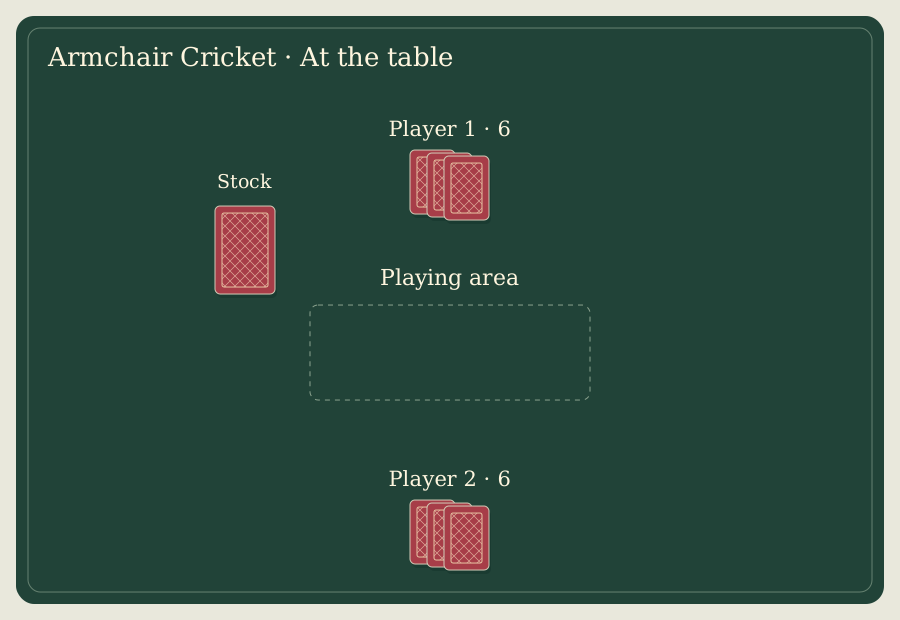
Shuffle both decks together and deal seven cards each. After inspecting their hands, toss a coin: the winner chooses who bats first. Bowler discards one unwanted card, then batter does likewise. Both now hold six; the remainder is the pickup pile.
Teaching lineup: four notional batters per side, so an innings ends at three wickets. Each side has two innings, in A–B–A–B order, with A batting first. Record runs, wickets and deliveries separately for each innings. Extras, two-card shots and other advanced rules are disabled.
04 /
One delivery
Bowler plays one card face up to the discard pile and immediately replaces it from stock. Batter answers with one card and replaces it too. A played card cannot be changed.
| Batter’s response | Outcome |
|---|---|
| Same suit, higher number | Runs from the difference table |
| Same suit, equal or lower | No runs; safe |
| Different suit, equal or higher | No runs; safe |
| Different suit, lower | Wicket |
| Difference | 1–3 | 4–5 | 6 | 7–9 | 10 |
|---|---|---|---|---|---|
| Runs | 1 | 2 | 3 | 4 | 6 |
Each pair of plays counts as one delivery; six make an over. With extras disabled, there are no replacement deliveries. Following a wicket, if the innings continues, batter may change up to two cards. Teaching exchange procedure: discard chosen cards first, then draw the same number.
05 /
Recycling and changing innings
When stock runs out, retain the top discard and shuffle everything beneath it into a new stock. Increase the pack-use counter by one; the initial stock is pack 1.
At three wickets, or when the batting player declares the innings closed, swap roles. Do not redeal: keep current hands and stock. Reset the new innings’ delivery count. This teaching version records team totals only; individual statistics and strike rotation are unnecessary.
06 /
Winning, ties and draws
If A completes its second innings with a combined two-innings total below B’s first-innings score, B wins without batting again. Otherwise B starts its second innings: as soon as B’s combined total exceeds A’s combined total, B wins immediately. If both sides complete two innings, compare their combined totals; equal totals produce a tie.
The DOS version also supplies a match-length limit: when pack 27 is exhausted, finish the current over. If a normal result has not been reached, record a draw: the match ran out of time. This differs from a tie, where completed innings finish level.
A declaration closes that innings permanently. Unused wickets cannot be carried into a later innings.
07 /
Choosing a response
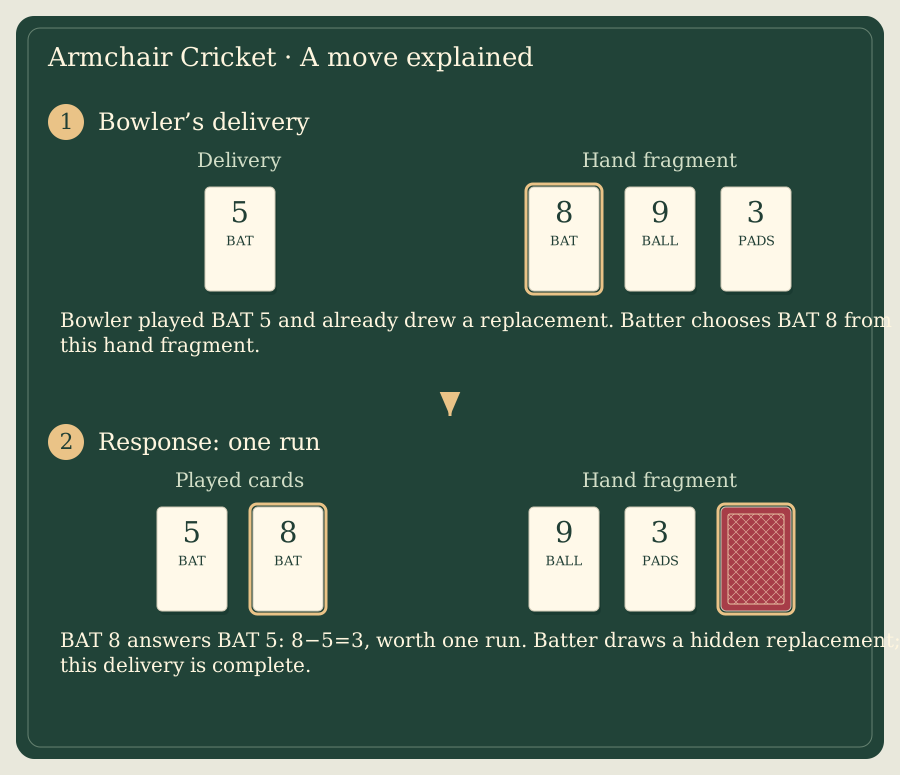
Bowler plays BAT 5. Batter holds BAT 8, BALL 9 and PADS 3. BAT 8 earns one run: its advantage is three. BALL 9 is safe but scores nothing. PADS 3 loses a wicket because it is lower and in a different suit.
Now suppose the fourth-innings target is two runs away. A safe scoring response earns only one, and the batter worries about the next delivery. The choice between taking the immediate run and preserving a card depends on the target and wickets remaining, not just on the numbers.
For a complete result example, A scores 23 and 18, totalling 41. B makes 29 in its first innings and reaches 13 in its second. B now has 42 and wins at once. There is no need to wait for a third wicket or the end of the over.
← On a small screen, scroll the diagram horizontally. →
08 /
Adding rules later
The README separately describes no-balls, wides and byes. They alter both runs and delivery counting, so introduce them only with their full instructions. An eleven-player lineup also needs the lower-order batting restrictions. Those extensions are outside this selected teaching version.
Common questions
Can I use ordinary playing cards?+
No. The game uses 110 custom cards; plain homemade text cards work for this teaching version.
Why only three wickets?+
The README recommends about four batters for beginners; three dismissals complete that lineup’s innings.
Are these official boxed-game rules?+
No. This is an expressly labelled teaching adaptation of the DOS version’s published account.
Can a lower card defend safely?+
Yes, in the same suit. A lower card in a different suit loses a wicket.