← On a small screen, scroll the diagram horizontally. →
01 /
A party-game name, many local rules
Kings, King’s Cup and Ring of Fire name a family of social drawing games, not a single international code. Cards trigger actions rather than capture tricks or form poker hands. Its spread through informal groups makes a precise inventor and first date difficult to establish. Some tables use a shared cup, others do not, and several ranks have competing meanings. This page gives a complete agreed rank chart, then an explicitly alcohol-free counter adaptation for the diagrams. It is unrelated to the trick-taking compendium called King.
02 /
Agree the chart before drawing
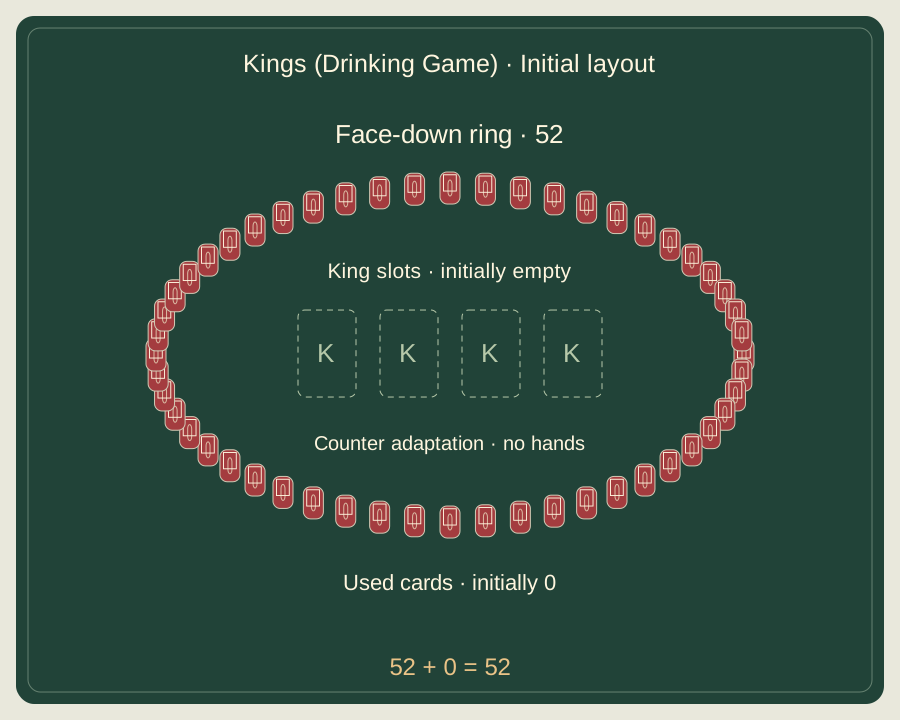
For 3–10 people, shuffle 52 ordinary cards without jokers into a face-down ring. No cards are dealt to hands. Choose first player randomly, then go clockwise: expose 1 card, resolve its action, leave it face up in the used area and pass the turn. Suits have no effect. Track drawn kings separately. Traditional play substitutes a drinking action for each penalty and often uses a central cup for kings. Our diagrams use 1 penalty counter per ordinary penalty and no shared drink. Nobody is required to perform an unwanted action; passing receives no additional penalty in this agreed adaptation.
03 /
Ace through six
A — Waterfall: traditionally players begin together and may stop in clockwise order after the drawer; in counter play everyone simply takes 1 counter. 2 — You: choose another player to receive the penalty. 3 — Me: drawer receives it. 4 — Floor: last to touch the floor receives it; agree an accessible table-touch substitute if needed. 5 — Thumb Master: drawer holds this role until the next 5; when they silently put a thumb on the table, last to copy receives a penalty, at most once per intervening turn here. 6 — Social: everyone receives a penalty. The meanings of 5 and 6 are chosen house variants, replacing gender-based versions.
04 /
Seven through queen
7 — Heaven: last to raise a hand receives a penalty. 8 — Mate: choose another person; until the next 8, whenever the drawer receives an ordinary penalty the mate receives one too, not in reverse. Use only this current link, with no recursive penalties or extra links. 9 — Rhyme: drawer starts a word; clockwise, supply new rhymes until someone repeats or cannot answer. 10 — Categories: same process with unique members of a named category. Allow 5 seconds per answer in these word rounds here. J — Rule Maker: create one simple agreed rule, replacing the previous J rule; breaking it brings an ordinary penalty. Q — Question Master until next Q: answering their question directly brings a penalty; replying with a question does not.
05 /
Kings determine the ending
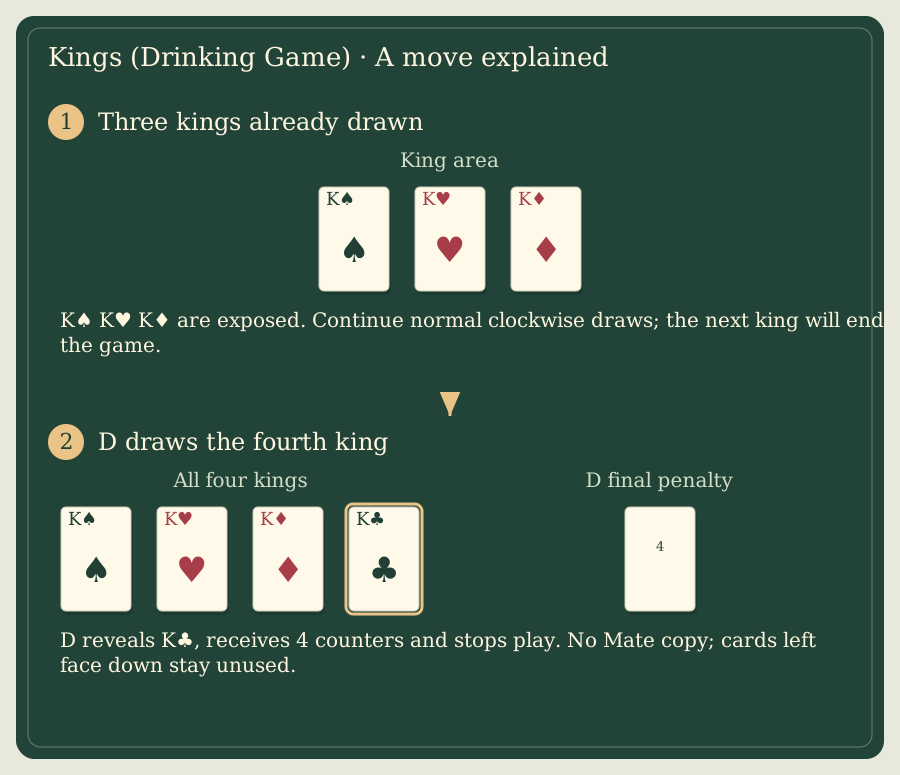
K — set the king aside visibly. In the common cup version, the first 3 kings add to the shared cup and the fourth triggers its final action and ends play. In our counter adaptation, place the first 3 kings in the central slots; drawer of the fourth receives 4 counters and the game ends immediately. This final penalty does not trigger Mate. Cards still in the ring stay unused. The party form has no required overall points winner; if you want a counter result, agree beforehand that fewest counters wins, with tied leaders sharing. Breaking the ring carries no penalty in this profile; some groups add one as a separate rule.
06 /
A category, a mate and the last king
A draws 8♠ and chooses C as Mate. Later B draws 10♦ and names fruit: B apple, C pear, D plum, A repeats apple. A receives 1 counter and C receives 1 through Mate; this copied penalty does not propagate again. Suppose 3 kings are already exposed and D now draws K♣: D receives 4 counters and play ends. In that separate final event the other kings are K♠ K♥ K♦. The diagram leaves the unknown ring as a counted packet rather than suggesting the entire pack was dealt to players. Agree your rank chart openly, since a remembered rule from another group may differ.
← On a small screen, scroll the diagram horizontally. →
Common questions
Does Kings have one official chart?+
No single universal authority fixes it. Agree the chart and persistent-role duration before drawing.
Do the diagrams require alcohol?+
No. They show the explicitly described counter adaptation; no drink is needed.
Must every card be drawn?+
No. Stop at the fourth king; cards still face down are unused.