← On a small screen, scroll the diagram horizontally. →
← On a small screen, scroll the diagram horizontally. →
01 /
Set up the table
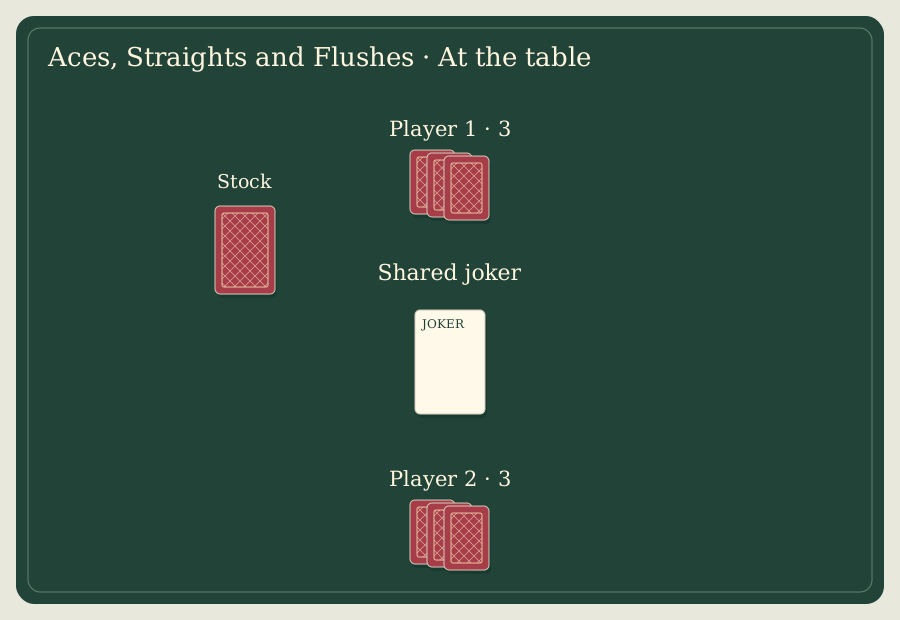
Our selected version is for 2–7 players. Use a standard 52-card pack plus one joker. Keep the joker out of the shuffled pack and expose it in the centre as everyone’s shared seventh card. Each player antes 1. Bets and raises are 1 on the first two rounds and 2 on the final two, capped at one bet plus three raises per round.
Require a 25-chip starting reserve for a new deal: the ante plus maximum contributions of 4 + 4 + 8 + 8. This teaching convention avoids all-ins. Seven players need 42 ordinary dealt cards; this version does not burn cards.
02 /
Six personal cards, four betting rounds
Deal singly clockwise from the dealer’s left. Give everyone two cards down and one up, then bet. Deal a fourth personal card face up and bet. Deal a fifth face up and bet again. Finally deal a sixth personal card face down and hold the last betting round.
Each surviving player now has three downcards, three upcards and access to the shared joker. There is no flop and no exchange. In this version the highest exposed hand starts each betting round. Pairs and trips count; unfinished straights and flushes do not. Break an exposed-hand tie by clockwise position after the dealer. There is no compulsory bring-in.
03 /
Betting actions
With no outstanding wager, check or bet. Facing a wager, fold, call or raise by that round’s fixed increment. Check-raising is allowed. Action proceeds clockwise until all remaining players have answered the final raise, or everyone checks. Folded players receive no more cards and cannot win. If just one player remains, award the pot without a showdown.
04 /
What the shared joker can represent
Choose your best five cards from your six personal cards plus the joker. The joker is a limited wild card, or bug: it can be an ace or the missing card needed to complete a straight, flush or straight flush. It cannot make paired kings, trip sevens or turn two pairs into a full house. In a flush it represents the highest missing card of the suit, not a duplicate suited ace.
Four natural aces plus the joker make five aces, beating a straight flush. Below that, the order is straight flush, quads, full house, flush, straight, trips, two pair, one pair, high card. Each player may independently use the same shared joker for a different purpose.
05 /
Comparisons and an original example
Only the best five-card hand counts. Within a category compare the main group first and then kickers from highest down. For two pair, compare the higher pair first; for a full house, compare the triplet first. Straights compare their top card: A–2–3–4–5 is five-high, while K–A–2–3–4 is invalid. Suits do not decide the pot. Equal five-card hands share it; give an indivisible chip to the first tied winner clockwise after the dealer.
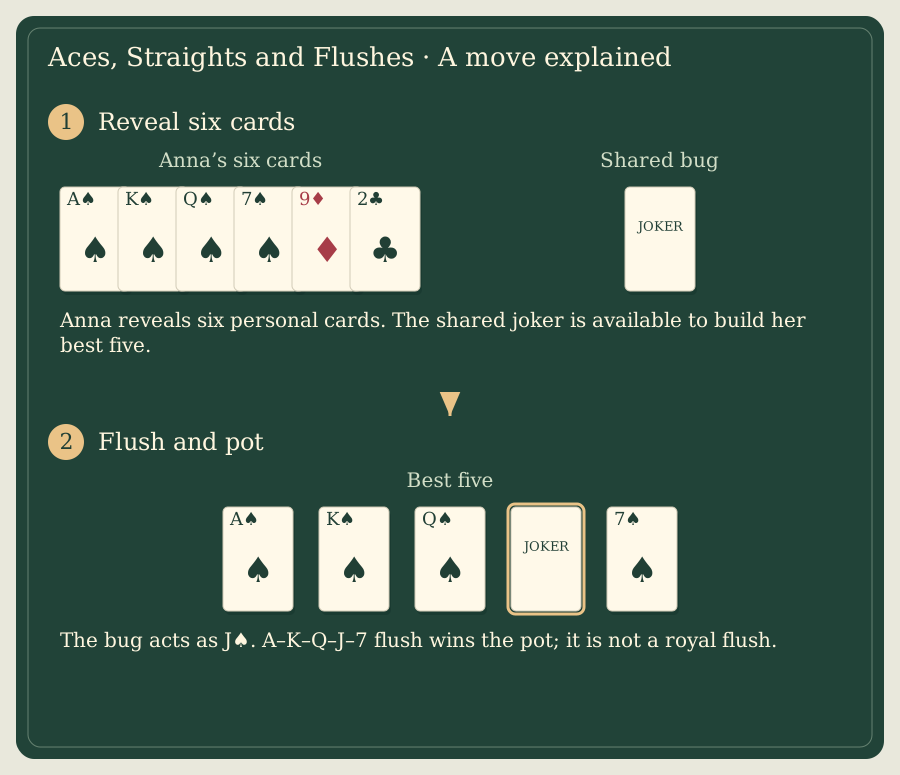
Anna has A♠ K♠ Q♠ 7♠ 9♦ 2♣. The joker supplies J♠, making an A–K–Q–J–7 flush. She cannot claim a royal flush: both J♠ and 10♠ are missing, and one bug cannot replace two cards. Ben has 9♣ 9♥ 5♣ 5♦ K♦ 3♥. His bug is an ace, leaving two pair with an ace kicker, not a full house. Anna wins.
06 /
Context and relation to stud
Pagat attributes its description of this home variant to Brian Johnson. That credits a rules contribution, not necessarily the invention; the source supplies no reliable invention date.
The name lists the joker’s permitted jobs. Compared with regular seven-card stud, players receive one fewer personal card and know the shared card from the start. The 1/2 limits, positional tie-break for opening action and absence of a bring-in are explicit teaching-table conventions. Replacing the bug with a fully wild joker would produce a different game.
Common questions
Can the joker turn two pairs into a full house?+
No. It is an ace unless it completes a straight or flush.
Can two players both use the joker?+
Yes. Each independently uses it in their own best five-card hand.
Is a seventh personal card dealt?+
No. The shared joker is the seventh available card.