← On a small screen, scroll the diagram horizontally. →
01 /
Context and chosen form
Classic Whist grew from Ruff and Honours and was widely played in the eighteenth and nineteenth centuries. Later bidding games, including Bridge, developed different systems. Here four players form two fixed partnerships with partners opposite. We select short Whist to five points without honours; this is not Solo Whist or an exact-bidding game.
02 /
Pack and deal
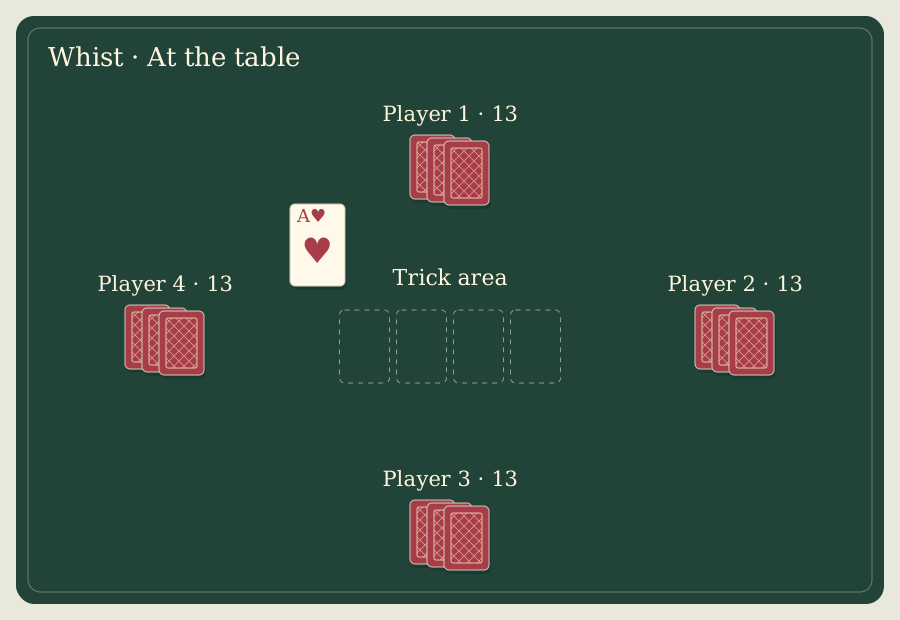
Use 52 cards without jokers, ranked A K Q J 10 9 8 7 6 5 4 3 2 in every suit. Choose the first dealer randomly; deal rotates clockwise after each hand. Dealer’s left shuffles, right cuts. Deal all cards singly clockwise from dealer’s left: 13 each. Turn dealer’s final card face up to determine trumps. It belongs to dealer and stays visible until dealer plays to the first trick.
03 /
Playing the tricks
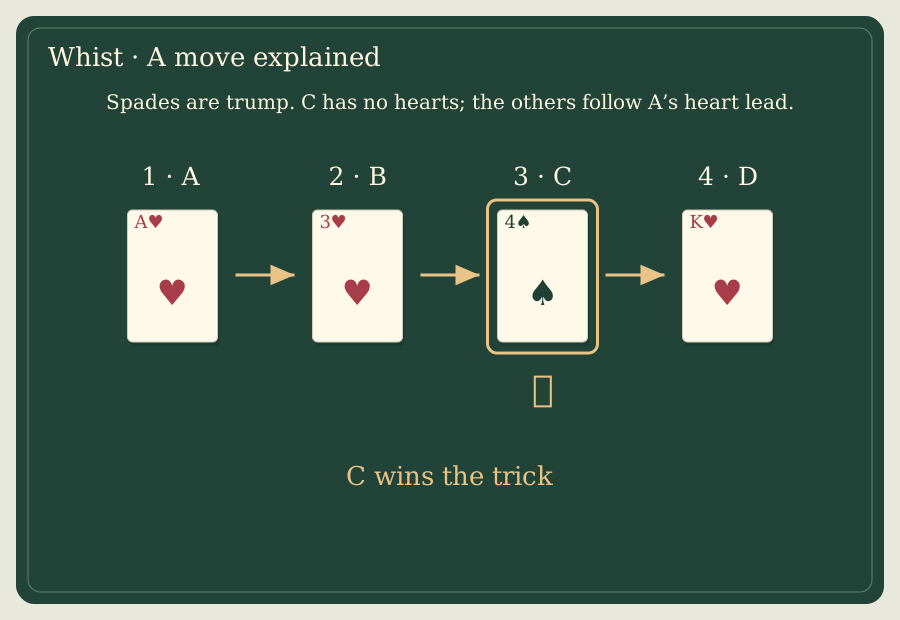
Dealer’s left leads any card, including a trump. Others play clockwise and must follow suit if able. If void, play anything: there is no duty to trump or overtrump. Highest trump wins, or highest led-suit card if no trump appears. The winner leads next. No bidding, draw, exchange or declarations occur. Partners count their tricks together; play all 13 tricks. A card’s rank affects winning, not an individual point value.
04 /
Score and finish
Only the side taking more than six tricks scores: one point per trick above six. The other side scores zero. Add the result to the team’s running total. First to reach at least five after a hand wins; exact arrival is unnecessary. Since only one side scores per deal, there is no final tie. If neither has won, shuffle all cards and move the deal left.
05 /
Worked score
A partnership wins nine tricks and its opponents four. Nine minus six gives 3 points. If the team previously had 2, its new total is 2+3=5 and it wins. The losing four tricks do not create negative points.
← On a small screen, scroll the diagram horizontally. →
06 /
Honours and other targets
Traditional honours award bonuses for holding the top trumps; our profile omits them entirely. Seven- or ten-point targets, rubbers, fixed trump rotations and whist-drive movement are other agreements, not rules to introduce mid-game.
Common questions
Must I trump when unable to follow suit?+
No. You may discard any card.
Does taking six tricks score anything?+
No. Scoring begins with the seventh trick.