← On a small screen, scroll the diagram horizontally. →
01 /
Partners, rank and deal
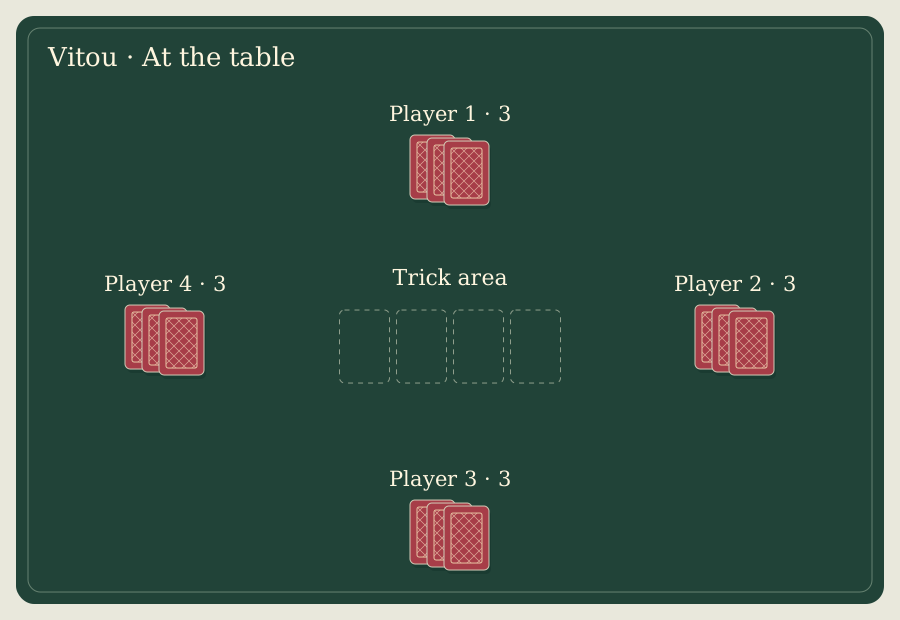
Use 32 cards for 4 players in 2 opposite-seat partnerships. Rank is 10, 9, A, K, Q, J, 8, 7; suits have no effect, and there are no trumps. Draw for first dealer: lowest deals; our explicit convention redraws only tied lowest players. Shuffle, have an opposing player cut, and deal clockwise, starting on the left, a packet of 3 to each. The unused cards remain out of play. Dealer passes left after each hand.
02 /
Win the hand and handle tied tricks
Dealer’s left leads any card; clockwise, everyone plays any card. Highest rank wins and leads next. Matching highest cards tie the trick; the previous leader leads again if needed. Normally win 2 of the possible 3 tricks to take the hand. Stop as soon as the result is determined.
If the first trick ties, the winner of the second wins the hand. If the first is won and the second tied, the first winner wins the hand. If the first 2 tie, the third decides. If the third ties after earlier decisive tricks, the earliest trick winner wins the hand. With all tricks tied, nobody scores and the next dealer deals. The cards have no individual point values.
03 /
Raise, accept or refuse
Without a bid the hand is worth 1. Before playing your card, unless you are last to the current trick, you may open at 3. Further raises follow 6, 12, then baraque, meaning the whole game; no jumps. Only the opposite partnership to the latest bidder may raise, again before playing and never from last position. You cannot raise your partner.
Immediately after a bid or raise and its accompanying card, the next player may accept by playing without raising, raise if entitled, or refuse and concede the hand. Only that immediate follower may refuse, and must decide without consulting the partner. A refusal awards the bidding side the preceding value: 1 if 3 is refused, 3 if 6, 6 if 12, and 12 if baraque. Accepted play awards the final value to whichever side wins the hand, not automatically the bidders. An accepted baraque gives the winners the match.
04 /
The twenty-point ending
Normally add the hand’s 1, 3, 6 or 12 to the winners’ total; first to reach 21 wins. Once a side reaches exactly 20, all bidding stops. Before each new hand that side may privately show its cards to each other and decide whether to play. Declining gives opponents 1. Playing and winning gives 1 and the match; playing and losing gives opponents 3. A hand with all tricks tied still scores nothing.
At 20–20 neither side may share cards or signal, and there are no bids. Deal 3 to the player on the left, who says pass or play. After a pass, deal to the next player and ask again. The first “play” causes the remaining hands to be dealt; resolve the hand normally and its winners win the match. If all 4 pass, change dealer and repeat. If all tricks tie, repeat with the next dealer.
05 /
Refusal is a score decision
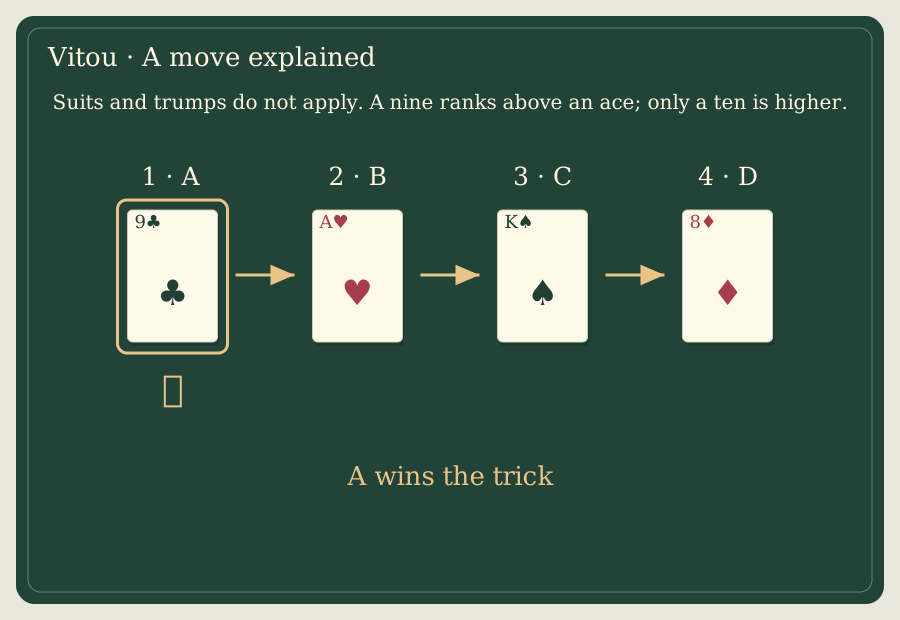
North opens 3 and plays; East raises to 6 and plays. South, the immediate follower, refuses without asking North. East–West score 3, the previously accepted level. They do not score 6 and no trick comparison is needed. In another hand, 9♣ beats A♥ despite different suits: only rank matters.
← On a small screen, scroll the diagram horizontally. →
06 /
Context, signals and variants
Vitou belongs to the Truc/Put family and is associated with Nice and neighbouring regions. Morlino’s account explains its unusual ranks through adaptation to a French short pack. It does not establish a precise inventor or date. Open discussion of cards is forbidden except the special pre-play consultation of the side at twenty. Conventional gestures are otherwise allowed: right-eye wink for a ten, left-eye wink for a nine, pursed lips for an ace, eyes upward for none of these high ranks. All gestures stop at twenty each. Two-player adaptations require their own profile.
Common questions
Can the last player raise?+
No, even if holding the strongest card. The immediate follower of a bid may still refuse.
Must I follow suit?+
No. Suits are ignored throughout.
Does baraque mean a fixed number of points?+
No. If accepted, the hand decides the whole match. Refusing it concedes the preceding level.