← On a small screen, scroll the diagram horizontally. →
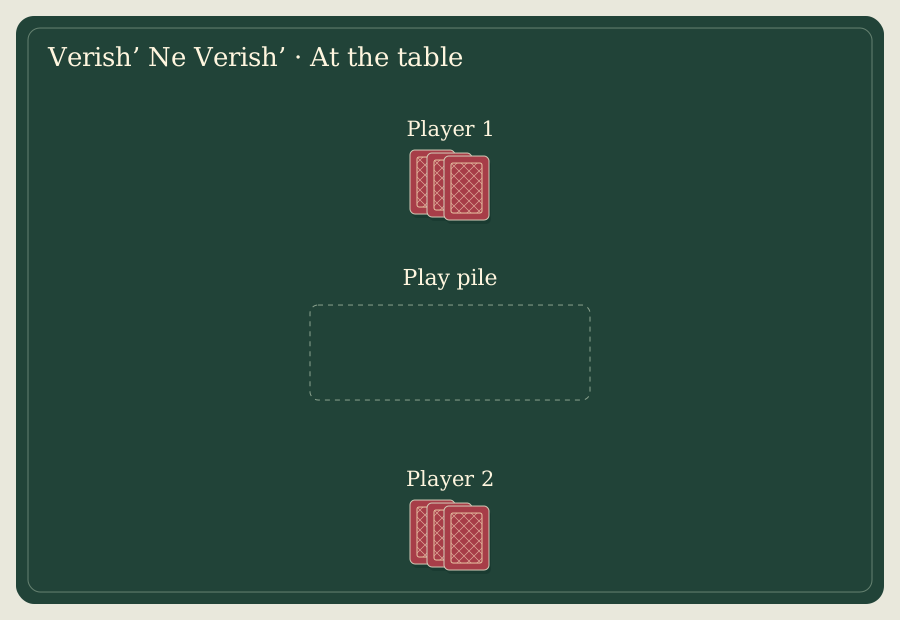
01 /
History and selected form
Verish’ Ne Verish’ belongs to the family of concealed shedding games with challenges. Pagat records this Russian form from Leo Broukhis and Andrew Savinykh. No exact inventor or starting year is established. Unlike English-language Cheat with a different required rank each turn, this game keeps the rank until a challenge.
02 /
Setup and objective
2–6 play individually. For 2–3 use 36 cards from 6 to A; for 4–6 use 52 cards from 2 to A. There are no trumps or rank comparisons. Choose the first dealer randomly; our later-deal agreement rotates left.
Shuffle, randomly remove 1 card face down until the game ends, and deal all others singly clockwise. A difference of 1 card is harmless. The first recipient begins. Empty your hand to leave; the last player with cards loses.
03 /
Face-down play and trust
Begin a round by placing 1–3 cards face down and stating their number and rank, such as “two queens”. The cards may match or be a bluff. Keep the latest packet distinguishable from the older table pile.
The next active player clockwise either challenges it or trusts and adds 1–3 concealed cards claiming the same rank. Once a new packet is played, the older packet cannot be challenged. Passing without an action is forbidden. State the card count honestly; only the rank may be false.
04 /
Challenge and the next round
Say “I do not trust” before playing and expose only the latest packet. If any card has the wrong rank, its player picks up the entire table and the challenger opens a new round with any rank. If every card matches, the challenger takes the entire table; the next active player after that challenger starts. Do not inspect older packets for further offences.
After a pickup, only the player who took the pile may expose and remove complete sets of four equal ranks from their hand. Doing so is optional. Sets cannot be removed at other times. This reduces cards in circulation; the initially removed card never returns.
05 /
The final play and result
A player placing their last cards awaits the next player’s decision. If the next player continues without challenging, the empty hand leaves. If a challenge reveals a bluff, the player takes the pile and stays. A truthful last packet releases its player while the mistaken challenger takes the pile. Removing the whole hand in complete fours after a pickup also permits leaving.
Skip departed players. The three cards of the rank missing its initially removed card cannot make a complete four, so a loser eventually remains. No point score is needed; sessions may count defeats. Exposing cards while saying “I trust”, then discarding the whole pile, belongs to a different form.
06 /
The cost of one wrong card
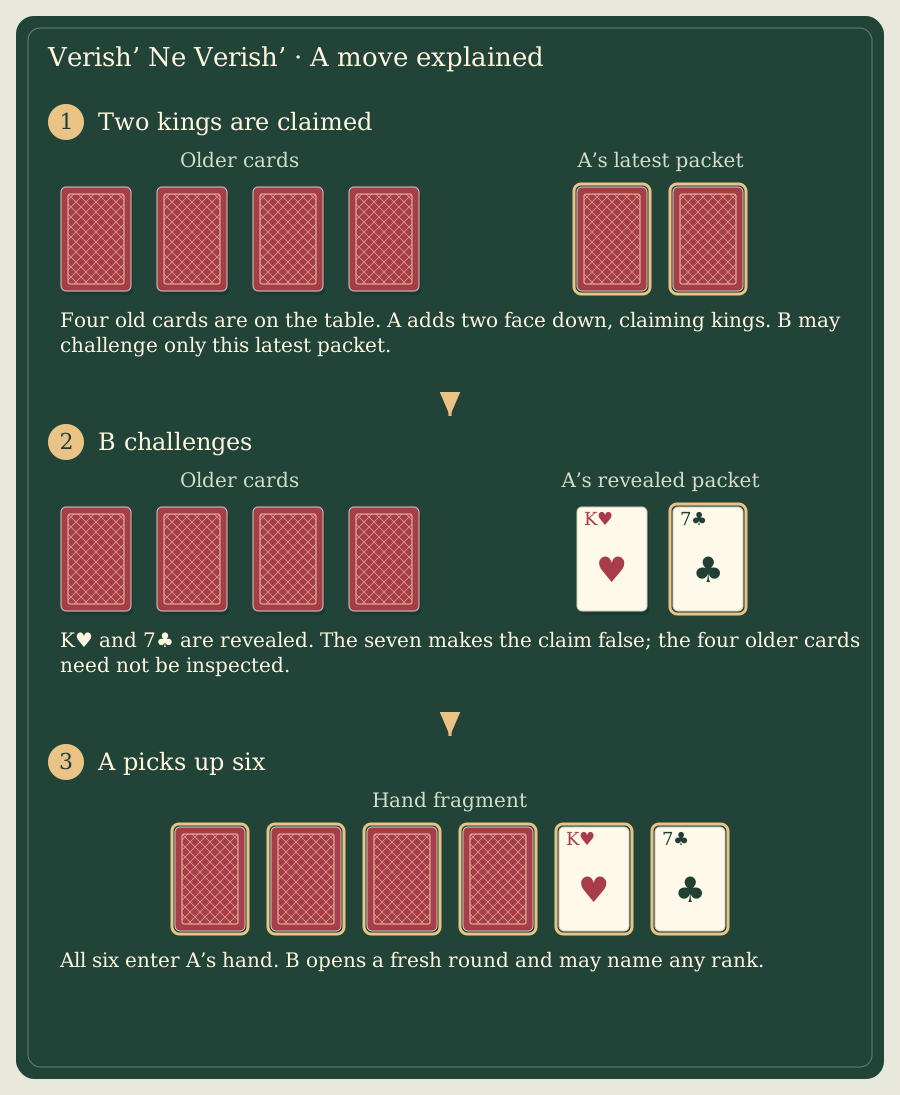
The table already holds 4 cards. A adds 2 and says “two kings”, but plays K♥ and 7♣. B challenges. The seven makes the claim false: A picks up all 6 cards and B opens the next round.
Had the packet been K♥ and K♦, B would be wrong, taking all 6 while the next active player starts. The older 4 cards do not affect whether the latest claim was truthful.
← On a small screen, scroll the diagram horizontally. →
Common questions
Can I challenge a player after another turn?+
No. A new concealed play accepts the older packet; only the latest may be checked.
Does each player name a new rank?+
No. The rank remains for the round and changes after a challenge.