← On a small screen, scroll the diagram horizontally. →
01 /
Players and cards
Choose the classic 108-card pack for 2–10 players, excluding extra cards supplied in newer editions. Each of 4 colours—red, yellow, green, blue—has one 0, two each of 1–9, and two each of Draw Two, Skip and Reverse: 25 per colour. Add 4 Wild and 4 Wild Draw Four cards. This is a proprietary pack, not ordinary playing cards.
02 /
Deal and opening
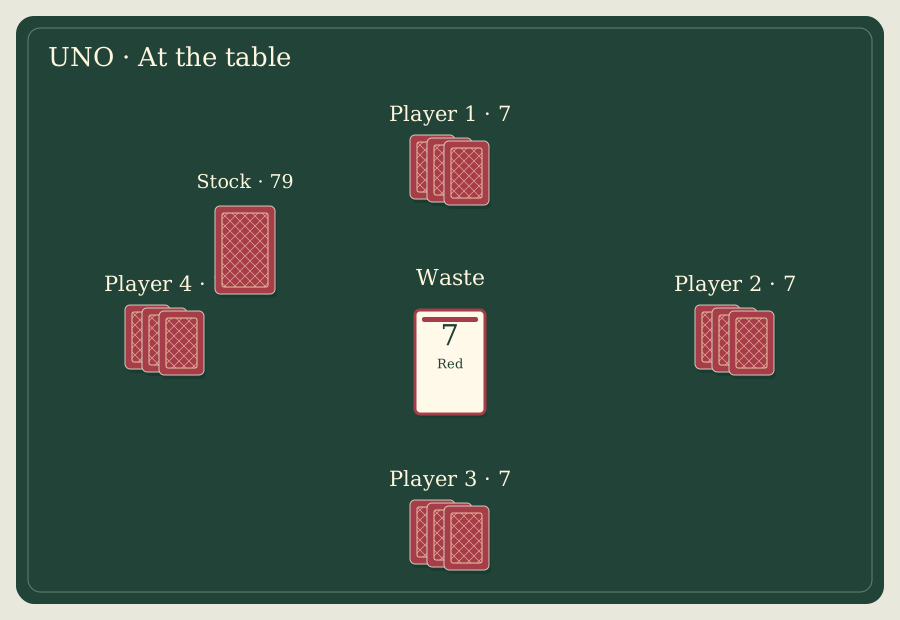
Draw to choose dealer: highest number deals, symbols count 0; our tie convention redraws among leaders. Shuffle and deal 7 each; the remainder is stock and its next card starts the discard. Normally dealer’s left starts clockwise. Initial Draw Two makes that player draw 2 and miss; Skip skips them; Reverse makes dealer start and play run right; Wild lets dealer’s left name a colour; return an initial Wild Draw Four to the pack and expose another.
03 /
Playing a turn
On your turn play 1 matching colour, number or symbol, or a legal Wild. Multiple-card plays and out-of-turn plays are excluded. If unable or unwilling to play, draw 1: you may play only that drawn card immediately if legal, or keep it and end the turn. After drawing you cannot play a different card from the old hand.
When stock empties, keep the top discard and shuffle the others into a new stock. Conceal card faces, not hand size.
04 /
Actions and two-player play
Skip removes the next turn; Reverse changes direction. Draw Two makes the next player draw 2 and miss. They cannot play another Draw Two or Wild Draw Four instead: penalties do not stack. Matching a Draw Two symbol is legal only when an ordinary turn actually reaches you. An ordinary Wild is legal even with another playable card: name any colour.
With two players, Reverse and Skip return play to their user. After Draw Two or a legal Wild Draw Four, the opponent draws and misses, also returning play. A noticed wrong card is taken back, its player draws 2 and turn passes; advising another player also costs 2 under this older code.
05 /
Wild Draw Four and challenge
Wild Draw Four is legal only with no current-colour card in hand; a matching number or symbol of another colour does not bar it. Name the new colour. Its target accepts 4 and a missed turn or challenges before drawing: the user shows only that challenger the hand. If a matching colour was held, the offender draws 4 instead and challenger retains the turn. If legal, challenger draws 6 instead of 4 and misses. The declared colour remains. This tests colour, not the presence of just any playable card.
06 /
Ending the game
Say “UNO” when playing your penultimate card, before being caught. If caught before the next turn begins, draw 2. Correcting yourself before a catch avoids the penalty. Starting a turn means drawing from stock or taking a hand card out to play.
The final card ends the round. With a final Draw Two or Wild Draw Four, resolve the draw and any challenge first; penalty cards enter the score. If a challenge gives the finisher cards again, play continues. Then count hands. If the target remains unmet, shuffle everything for another deal; our agreement rotates dealer left.
07 /
Scoring
Round winner scores all opposing leftovers: numbers 0–9 at face value, Draw Two/Skip/Reverse 20, either Wild 50. Others score 0 for that round. Accumulate winning scores: first to 500 or more wins the match. Only one scores per round, so there is no simultaneous winning tie. The alternative remaining-hand penalty system is not used.
08 /
History and selected variant
The Strong links UNO to Merle Robbins and 1971, developing the Crazy Eights family with explicit action cards. Mattel publishes differing packs and editions: this article follows its classic 108-card manual. Extra cards from 112-card packs, stacking draws, hand swaps and “7–0” are outside the selected rules.
09 /
Worked example
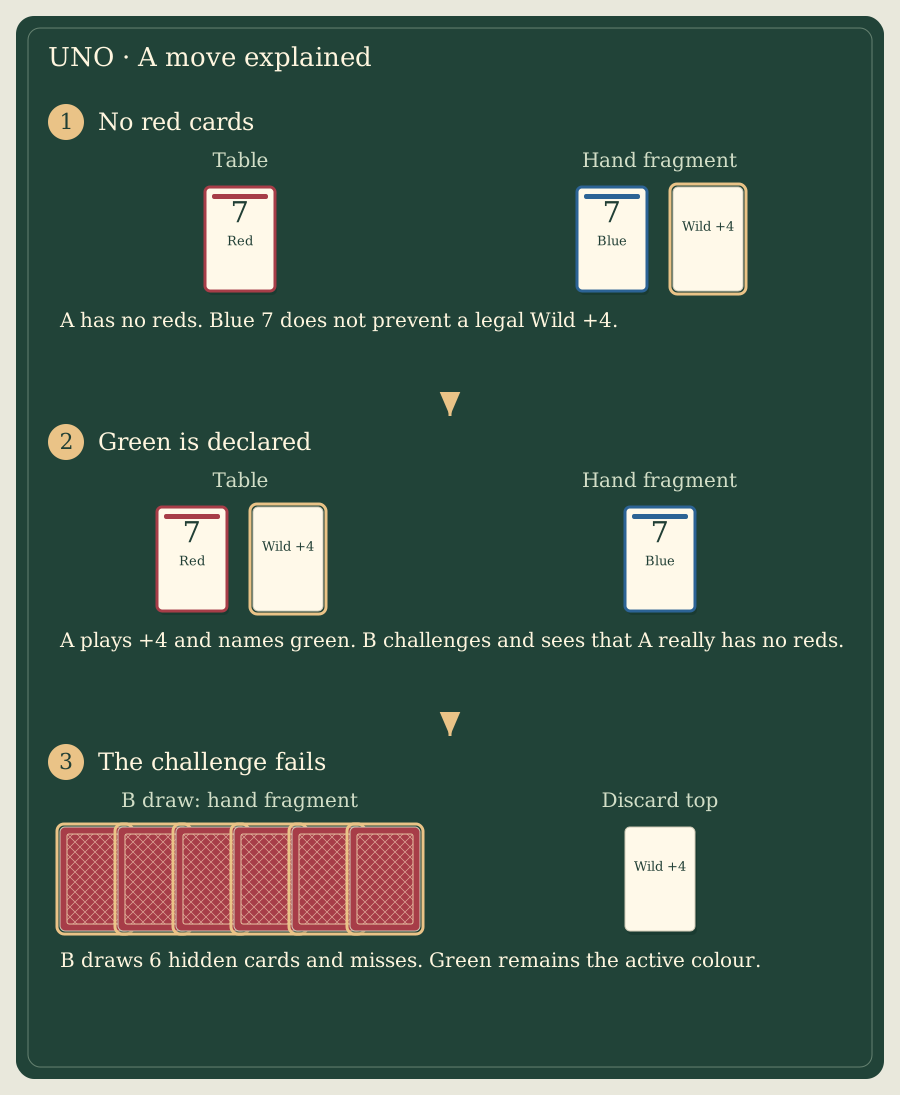
Discard shows red 7. A has no reds, holds blue 7 and Wild Draw Four, and may play the Wild Draw Four: the same number in another colour does not forbid it. A names green. B wrongly challenges: seeing no reds, B draws 6 and misses. Had A held red 2, the challenge would succeed: A would draw 4 and B retain the turn.
← On a small screen, scroll the diagram horizontally. →
Common questions
Can I stack Draw Two on a penalty?+
No: draw the penalty and miss the turn.
When is Wild Draw Four illegal?+
When the hand contains the current colour.
Does Reverse return play with two?+
Yes; it acts as Skip in two-player play.