← On a small screen, scroll the diagram horizontally. →
01 /
Cards, dealer and exceptional redeals
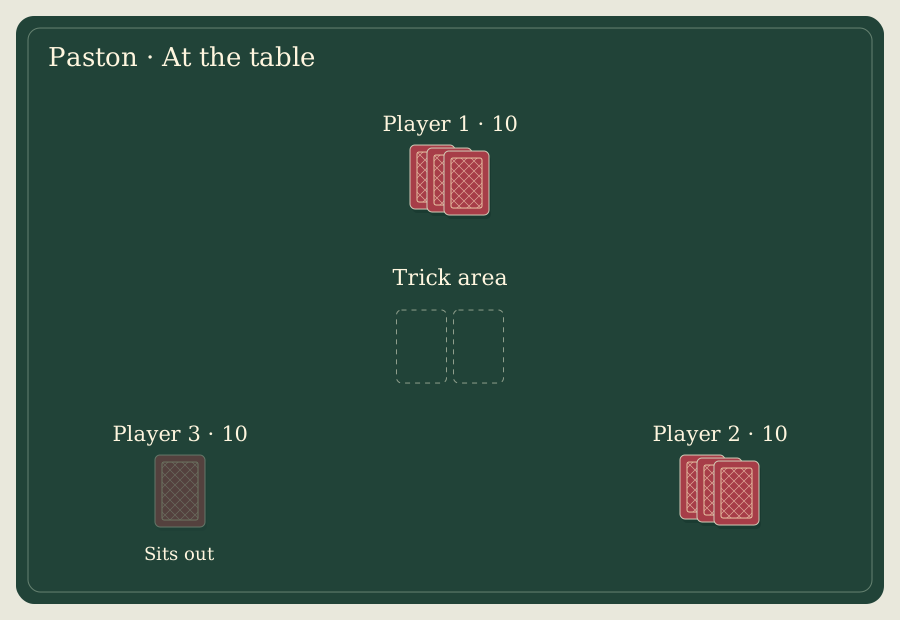
There are 3 individual players and 32 cards, 7 through ace, ranked A, K, Q, J, 10, 9, 8, 7. Deal, auction and play run clockwise. Choose the initial dealer freely. Shuffle, let the player on the right cut; dealer checks the bottom card. If it is 7♠, reshuffle and cut again. Deal 2 to each starting left, then 2 face down to the prikup, then 4 further circuits of 2 each: hands contain 10.
A holder of 7–8–9–10–J–Q of spades with neither K♠ nor A♠ shows the holding for a redeal by the same dealer. In the first deal, J♠’s holder starts the auction; if nobody holds it, 7♠’s holder starts. Our explicit agreement redeals if both are in the prikup and makes that first bidder the second dealer. Thereafter dealer’s left starts and becomes next dealer.
02 /
The suit ladder and declarer
The ladder is paston (spades), glitch (clubs), dineri (diamonds), gupa (hearts), paston grkha (best spades). At your turn pass or bid: the first bid must be spades, and each later bid must be exactly the next step, without skipping. A pass withdraws you. Highest bidder becomes declarer after the others pass; best spades ends bidding immediately.
On all passes, we explicitly retain the source’s reported card-holder rule: J♠’s holder must declare, or 7♠’s holder if the jack is in the prikup. This also applies after the first deal. If neither is held, redeal. The source questions whether later all-pass hands instead belong to the first speaker; we do not use that alternative.
Declarer secretly takes the prikup and discards any 2 face down. Name the bid suit or a higher suit, but best spades is available only if actually bid. An all-pass declarer may choose any ordinary suit. No-trump is unavailable. Instead of naming trump, declarer may surrender.
03 /
Choose defence, then play
After trump is named, declarer’s left opponent says whist or pass, then the other does likewise. With both passing, declarer wins automatically without play. With both defending, each defender needs 2 tricks. With a sole defender, that player needs 4; the passer’s entire hand remains face down and unused. Our selected interpretation gives no access to that hand and no later return to play.
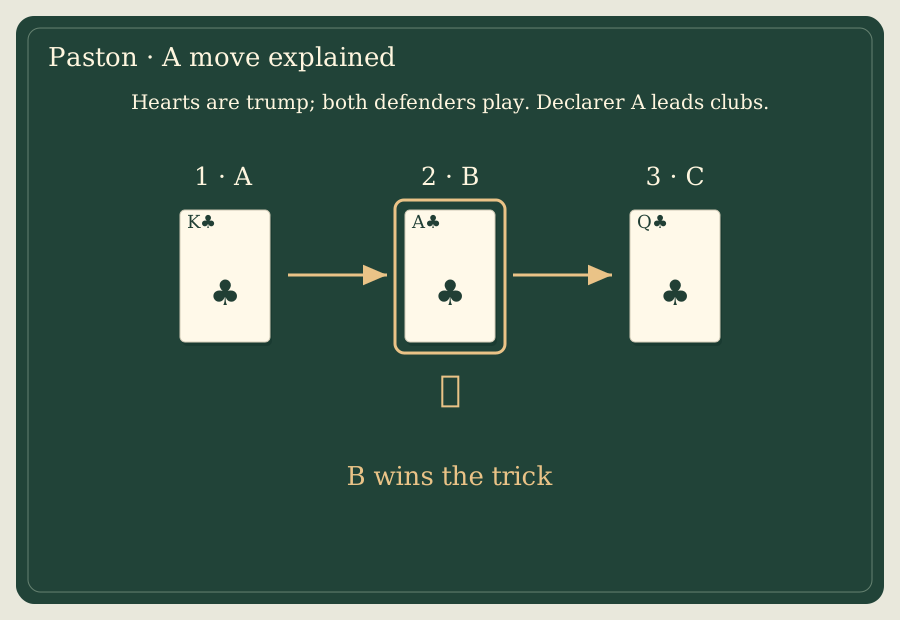
Declarer leads. Follow suit if able; without the suit, play trump if possible, otherwise discard. There is no compulsory overtaking. Highest trump, otherwise highest of the led suit, wins and leads next. Play 10 tricks with either three or two active players. Keep tricks visibly separated for counting. Declarer always needs at least 6.
04 /
The complete score table
At ordinary spades, declarer scores +10 with at least 6 tricks, otherwise −10. With 2 defenders, each scores −10 for 0 tricks, −9 for 1, 0 for 2, then +10 per trick beyond 2. With a sole defender, score −10 for 0, −9 for 1, −8 for 2, −7 for 3, 0 for 4, then +10 per trick beyond 4. The sole-defender values at 1, 2 and 3 are explicitly our selected version of the uncertain published table; a reported alternative is −9 for each of them. A non-playing passer scores 0.
Multiply all those scores by 2 for clubs, 3 for diamonds, 4 for hearts. Best spades also uses factor 4, except a successful declarer receives only +10, not +40. Automatic success after both defenders pass uses the corresponding declarer award; defenders get 0. Surrender instead gives declarer −10 and each opponent +2 without any multiplier. We explicitly choose that reported surrender variant; another informant omitted opponents’ awards.
Add signed results cumulatively. Exactly −121 resets that player to 0; passing below that number does not. After a completed deal, a player reaching 121 or more wins. For simultaneous reachers, our explicit tie agreement selects the highest total and shares victory if still equal. Scores are independent and need not sum to zero.
05 /
Best spades is not ordinary spades
In best spades, declarer takes 6 tricks and the defenders 3 and 1. Declarer receives +10. The first defender earns +40; the other receives −36. The trick counts sum to 10, but scores do not balance: that is expected. In ordinary spades the same trick split gives +10, +10, −9.
← On a small screen, scroll the diagram horizontally. →
06 /
Evidence, local names and agreed gaps
Paston is reported from Gyumri in Armenia; its name denotes spades. Pagat credits Alexey Lobashev’s information from Aram of Gyumri and Aramais Vartanyan of Rostov-on-Don. It classifies the game within Preference, but supplies no exact invention date. The account openly questions first-deal rotation, all-pass designation, sole-defender penalties, surrender awards and the inactive hand. Our decisions above make those points playable without relabelling assumptions as established local history. Prikup and whist are the source’s Russian labels, not verified Armenian terminology.
Common questions
Are ordinary and best spades different trumps?+
Both use spades. Their scoring differs.
Can the sole defender play the passer’s hand?+
No in our selected profile. It remains face down and unused.
Does going past minus one hundred twenty-one reset my score?+
No. Only the exact negative total resets it.