← On a small screen, scroll the diagram horizontally. →
01 /
Partners, cards and the mano
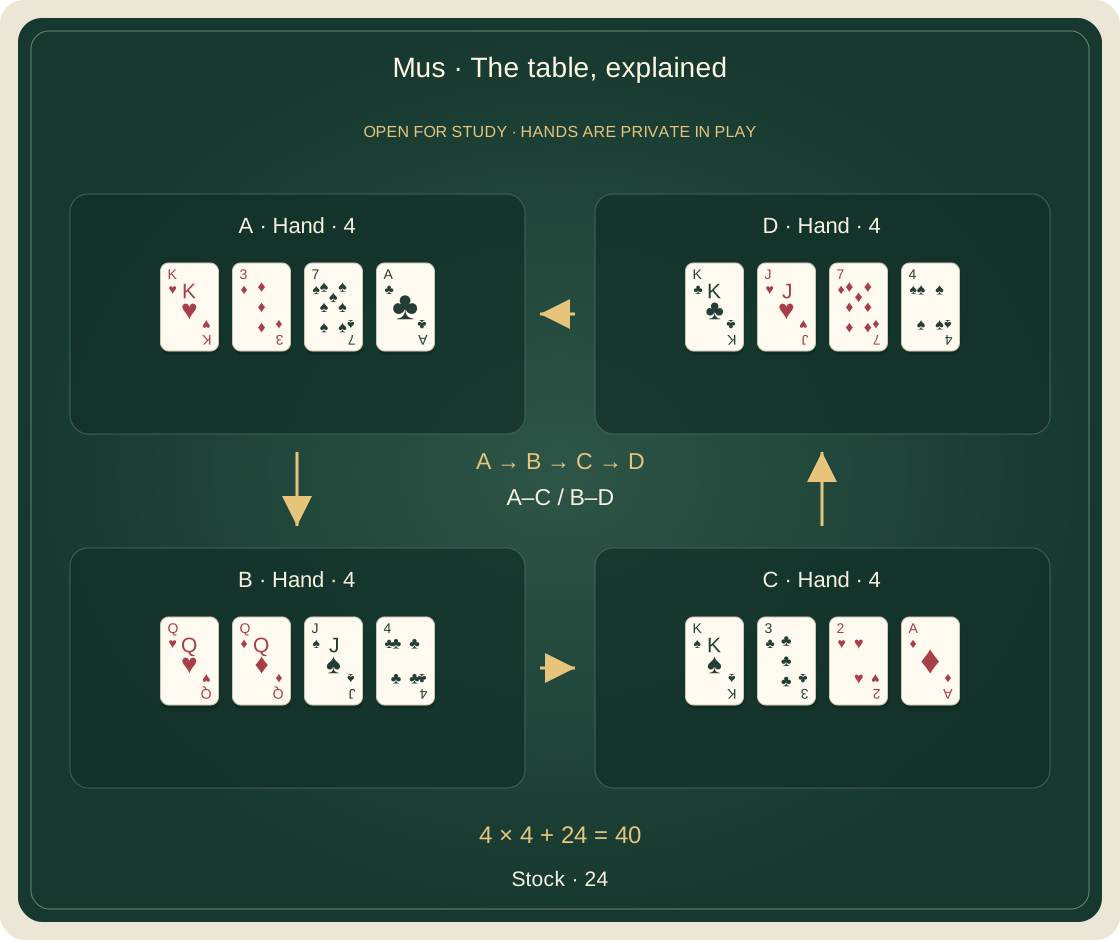
Seat 4 in opposing partnerships A–C and B–D, with A → B → C → D anticlockwise. Use 40 cards. In our French equivalent remove 8, 9, 10; K, Q, J represent Rey, Caballo, Sota. Treat every 3 as K and every 2 as A throughout. Rank: K/3 > Q > J > 7 > 6 > 5 > 4 > A/2. Dealer’s right is mano, first to act; dealer’s left cuts. Deal 4 each singly anticlockwise: 16 held, 24 in stock. Equal combinations favour the earliest player from mano. Choose the first dealer by lot; after each hand the deal moves to the right.
02 /
Mus: exchange only by unanimous consent
Starting at mano, say Mus to request exchanges or No hay mus to stop them. One refusal ends this phase for everyone. If all agree, each discards 1–4 face down, and dealer replaces the same number in order from mano. Repeat the proposal. If stock runs out while several players still need cards, shuffle all discards into stock; if only one needs cards, exclude that player’s latest discards from the reshuffle. Do not reveal discarded cards.
03 /
Four contests, not one poker hand
Order is Grande, Chica, Pares, Juego. Grande compares all cards descending, Chica ascending, until the first difference. Pares ranks two pairs (duples, including four equal) above three equal (medias), above one pair. Compare higher then lower pair for duples; compare only the repeated rank for medias or one pair. Ignore kickers. Juego adds values: K/3, Q, J = 10; A/2 = 1; other cards face value. Best totals: 31 > 32 > 40 > 37 > 36 > 35 > 34 > 33. If nobody has at least 31, play Punto instead: highest total up to 30 wins.
04 /
Passing, accepting and declining raises
Mano starts each category. Pass or propose at least 2 points (envido). Opponents may fold, accept or raise by at least 2; accepted bets wait for showdown. Declining the opening bet immediately pays 1, not the offered amount. Declining a raise pays the last previously accepted stake: bet 2, raise by 4 to 6, decline means 2 paid. Before Pares and Juego, everyone truthfully declares eligibility. If only one partnership qualifies, no betting there; if nobody has pairs, no Pares score. Partners decide jointly: ordinarily the more aggressive response prevails, but a clear plural “we fold” or “we accept” binds the side.
05 /
Órdago stakes the current game
Instead of a bet or raise, offer órdago in the current category. If accepted, expose immediately and compare that category: the winner takes the game, regardless of earlier pending bets or score, not automatically the whole match. Refusal pays the normal declined-bet amount. An ordinary large numerical bet is not an órdago: it waits for normal scoring order.
06 /
Count in order and stop at the target
At showdown reveal all hands. Score Grande → Chica → Pares → Juego/Punto, stopping immediately at 40; best of 3 games wins the match. A team reaching 40 from an immediate refusal payment also wins at once. Grande/Chica: accepted stake, or 1 if all passed; a folded category adds nothing further. Pares: winning team adds its own pair values (pair 1, medias 2, duples 3) for both partners, plus any accepted stake, even after opponents conceded. Juego similarly adds 3 for each own 31, 2 for each other own Juego, plus accepted stake. Punto adds 1 plus accepted stake. Do not add a second copy of refusal payments already collected. Five single points may be represented by one counter; money is unnecessary.
07 /
One deal, four different comparisons
These 16 different cards are exposed only for study; A is mano and partners C. Nobody bets.
A: K♥ 3♦ 7♠ A♣
B: Q♥ Q♦ J♠ 4♣
C: K♠ 3♣ 2♥ A♦
D: K♣ J♥ 7♦ 4♠
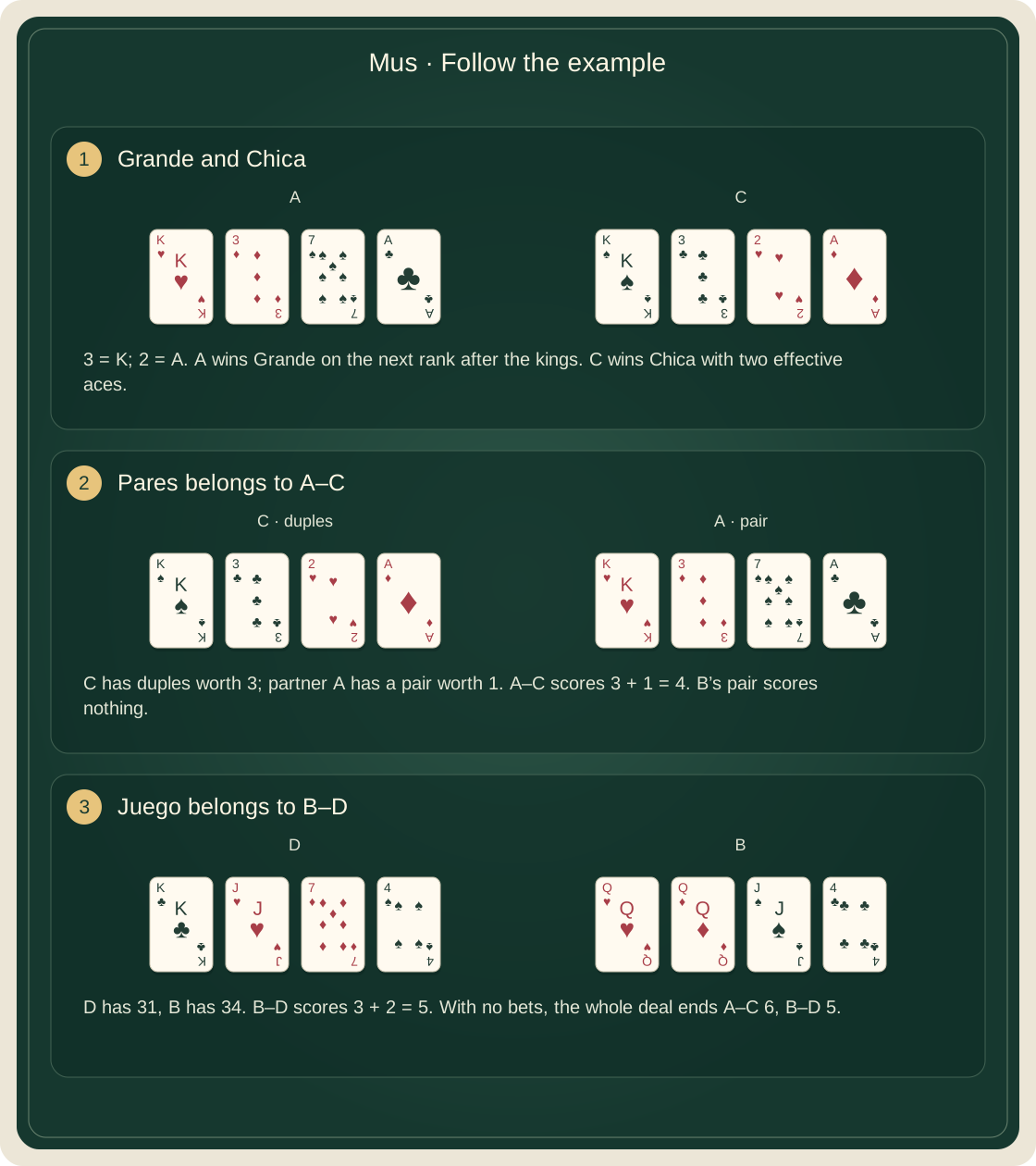
Grande: A beats C because their royal pairs tie and 7 beats A. Chica: C wins with two effective aces. Pares: C has duples, A a royal pair, B a horse pair. Team A–C scores 3 + 1 = 4 for its own pairs. Juego totals A 28, B 34, C 22, D 31: D beats B, and B–D scores 2 + 3 = 5. A–C earns 1 + 1 + 4 = 6 overall; B–D earns 5. If A–C had begun on 39, its Grande point would already reach 40; later categories would not score.
← On a small screen, scroll the diagram horizontally. →
08 /
Signals are information, not extra cards
Agree permitted signals before play; opponents may observe them. In this profile: bite lower lip for two effective kings, tongue tip for two effective aces, mouth to one side for medias, raised eyebrows for duples, wink for a total of 31. A signal about a holding must be truthful. Do not invent private signs. Spoken betting can bluff about strength, but required Pares/Juego declarations cannot lie.
09 /
Basque tradition and regional agreements
Mus is associated with Basque culture and spread widely in Spain. The documented rules show regional diversity rather than one universal tournament code. Some play with four actual kings and four aces, where threes and twos keep their values; others recognise Juego Real, different signals or a different target. Those changes affect hand comparisons and scoring. They are not silently combined with this eight-kings profile. The exact inventor and date are not established here.
Common questions
Does órdago win the whole match?+
It wins the current game; the best-of match still follows its agreed format.
Are four equal cards better than all other duples?+
No. They are two equal pairs; compare pair ranks normally.
Do partners add their cards into one hand?+
No. The best individual hand wins a category; only the winning side’s eligible pair/game values combine for scoring.