← On a small screen, scroll the diagram horizontally. →
01 /
Context and objective
Cribbage developed from Noddy in early modern England. Five-card play is the older form, still documented in British local leagues; six-card play is now more widespread. This guide selects the 6-card game, not a mixture. First to reach 121 wins immediately, including during play or turning the starter. Scores cannot tie because they are counted in a fixed order.
02 /
Deal and discard
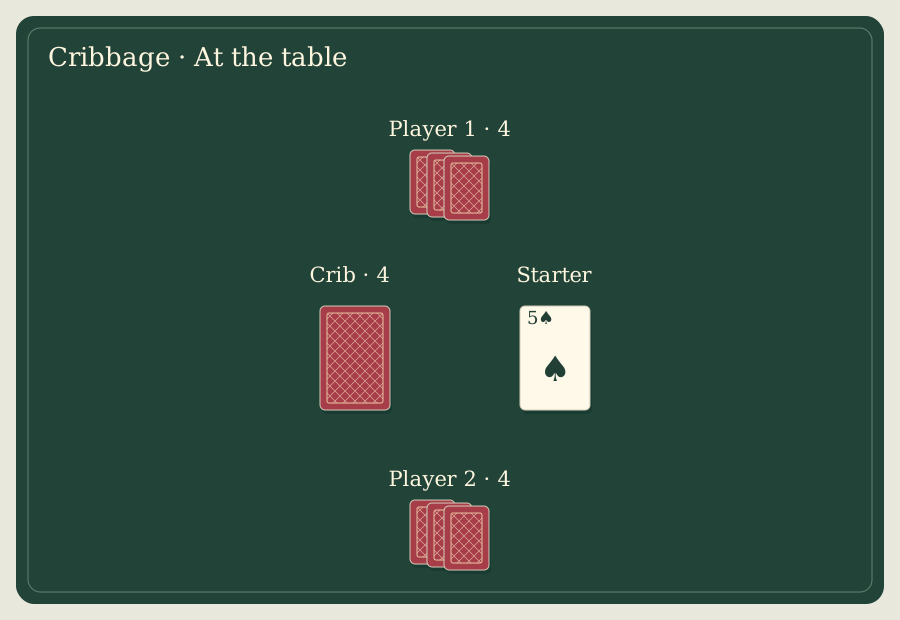
Use 52 cards without jokers; ace is low. For totals A=1, numerals face value, J/Q/K=10. Cut for first dealer: lower card deals; recut equal values. Alternate dealers thereafter. Dealer shuffles, opponent cuts, then deal 6 each singly. Each secretly discards two into the dealer’s four-card crib, keeping 4. Opponent cuts the remainder; expose the top of the lower packet as starter. A jack starter gives dealer 2 immediately. The starter is never played.
03 /
Play and immediate scores
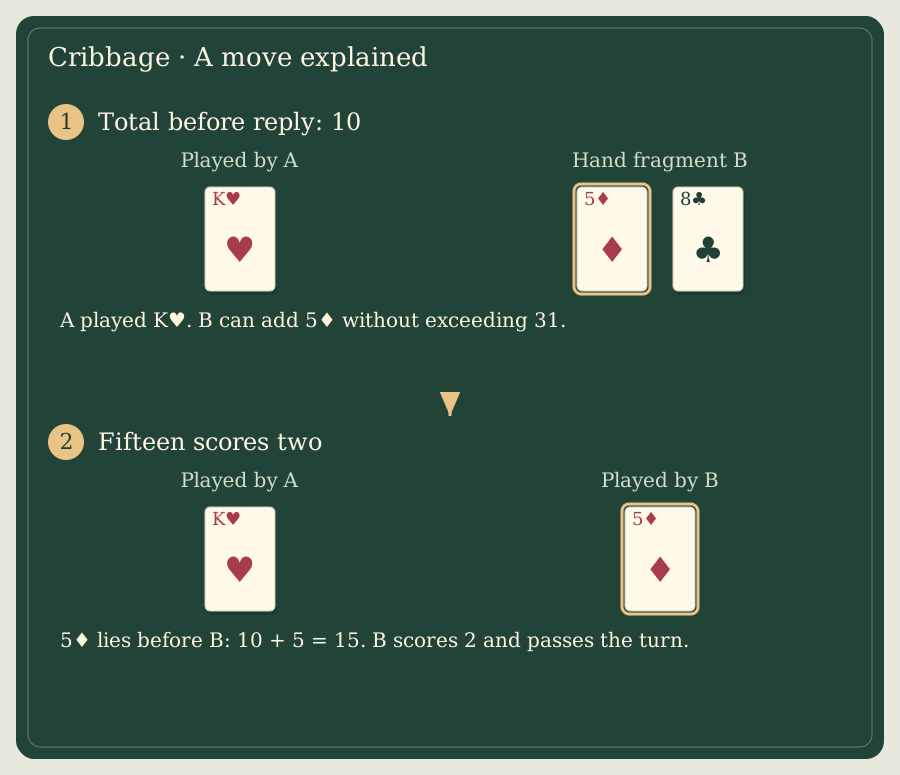
Non-dealer starts; alternate single cards, keeping each player’s cards separate. Announce the combined running value, never exceeding 31. If unable to play, say go; opponent continues while able. Score immediately: total 15 gives 2; same-rank consecutive pair/triple/quadruple gives 2/6/12 to the latest player; a suffix of at least three consecutive ranks gives its length, in any order, with no duplicates or gaps. Only the longest suffix run counts. Aces are low; suits do not matter.
When neither can play, turn played cards down and restart at zero; the opponent of the last player leads. Continue until all eight cards are played; an empty-handed opponent is skipped. Each new count resets pair/run history. The last player gets 2 for exactly 31, otherwise 1 for go or last card; never both. Other combinations score in addition.
04 /
Counting hands and crib
Reassemble the original 4-card hands. Count non-dealer first, dealer second, dealer’s crib last; add the same starter to each. Every distinct subset totalling 15 scores 2; every pair scores 2. Count each distinct longest run of at least three at its length, including multiplicity from duplicate ranks, but not shorter contained runs. A card may score in several different combinations. A hand jack matching the starter’s suit adds 1.
All 4 hand cards of one suit score 4, increased to 5 if the starter matches. A crib flush requires all four crib cards plus starter of one suit, worth 5. No flush is scored during play. Correct missed counts openly; our profile has no muggins point stealing. Gather all cards, shuffle and change dealer if nobody has won.
05 /
Worked example
Hand:4♣,5♦,6♥, K♣; starter 5♠. The pair scores 2. Two runs:3+3=6. Four totals of 15:2+2+2+2=8. Total 2+6+8=16. No flush or matching jack.
← On a small screen, scroll the diagram horizontally. →
06 /
Choose before starting
Partnership play, different targets, muggins and match bonuses for a heavily defeated opponent require separate agreements. They do not alter this individual game. The older five-card game stops after one count to 31 and has a different target and initial compensation.
Common questions
Can a queen and ten make a pair?+
No. Their counting values match, but their ranks differ.
Do I finish the deal after reaching the target?+
No. The first player to reach the target wins immediately.