← On a small screen, scroll the diagram horizontally. →
01 /
The rummy name comes from buying
May I? is a North American contract-rummy name associated with asking permission to take a discard outside your turn. Families use it for different schedules. This guide follows the Greg Petras variant: larger initial melds, permanently fixed jokers and an ordinary final round, unlike the all-in finish of some Contract or Liverpool Rummy versions. The contract family developed through changing household rules; a single inventor of this named variant is not securely established. Fix the profile before dealing.
02 /
Seven rounds with two full packs
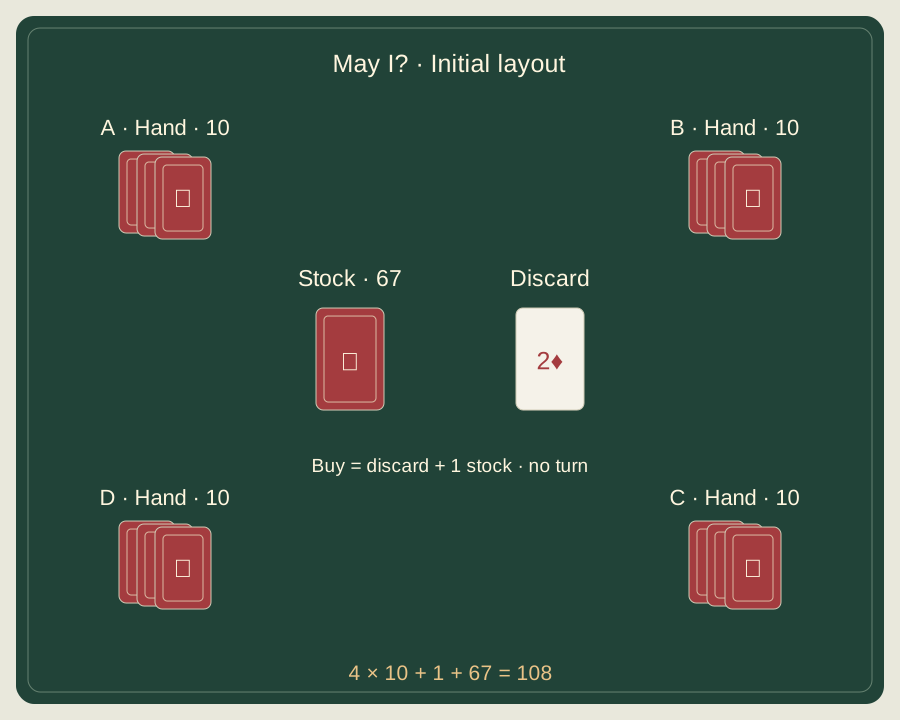
This base deal is for 3–4 people: 2 packs with 4 printed jokers, 108 cards. Deal clockwise, 10 each in rounds 1–3 and 12 each in 4–7. Random first dealer rotates left. Turn 1 discard and keep rest as stock; left neighbour starts. With 4 players in the first round, stock has 67. For 5–6 players the same rules need 3 packs with 6 jokers, 162 total; do not silently keep the smaller pack. All players progress to the next contract together whether or not they completed the previous one.
03 /
Books and runs for every round
A book has at least 3 equal ranks, duplicate suits allowed; a run at least 4 consecutive same-suit cards. Ace low or high, no K A 2 wrap. Joker substitutes for a missing card and its represented identity must be clear. Contracts: round 1, 2 books; 2, 1 book + 1 run; 3, 2 runs; 4, 3 books; 5, 2 books + 1 run; 6, 1 book + 2 runs; 7, 3 runs. Complete all required melds at once. They may exceed minimum length. Contiguous runs of the same suit are allowed as separate contract runs here. Each physical card serves one meld.
04 /
Open first, lay off on a later turn
On turn take the latest discard, or announce stock draw and first allow out-of-turn buys. Then draw stock if chosen. You may expose your full contract once per round; you cannot add unrelated new melds later. On subsequent turns only, add cards to any existing books or run ends. Larger initial contract melds are permitted, but opening does not permit same-turn additions to other melds. Exposed jokers never move or get replaced. Finish every turn by discarding 1, including the final round. Empty your hand with that final discard to win the round.
05 /
A purchase does not buy a turn
Active player has first right to the discard, without penalty. If declined, others may ask “May I?”. Priority goes to the earliest next seat clockwise, not the loudest caller. Buyer takes that discard plus 1 stock penalty and neither melds nor discards; active player resumes. Another player may buy the newly uncovered discard similarly; the same buyer cannot take consecutive exposed discards. No per-round purchase cap in this profile. Each purchase adds 2 held cards. If a penalty cannot be supplied after recycling, do not complete that purchase.
06 /
Fixed joker cost and an ordinary last round
In round 7 the contract still requires 3 runs, but you may open without going out and continue on later turns; there is still a final discard. When stock is empty, shuffle all old discards except top into a new stock. If neither draw nor discard pickup is available, end without a winner and score all hands. Otherwise the first empty hand scores 0; others count all held cards: joker 25, ace 15, K Q J 10, numerals face value. Add 7 rounds; lowest total wins, ties share. Do not apply the smaller joker penalty or compulsory all-in final of the neighbouring variant.
07 /
Buying enlarges the hand before a later opening
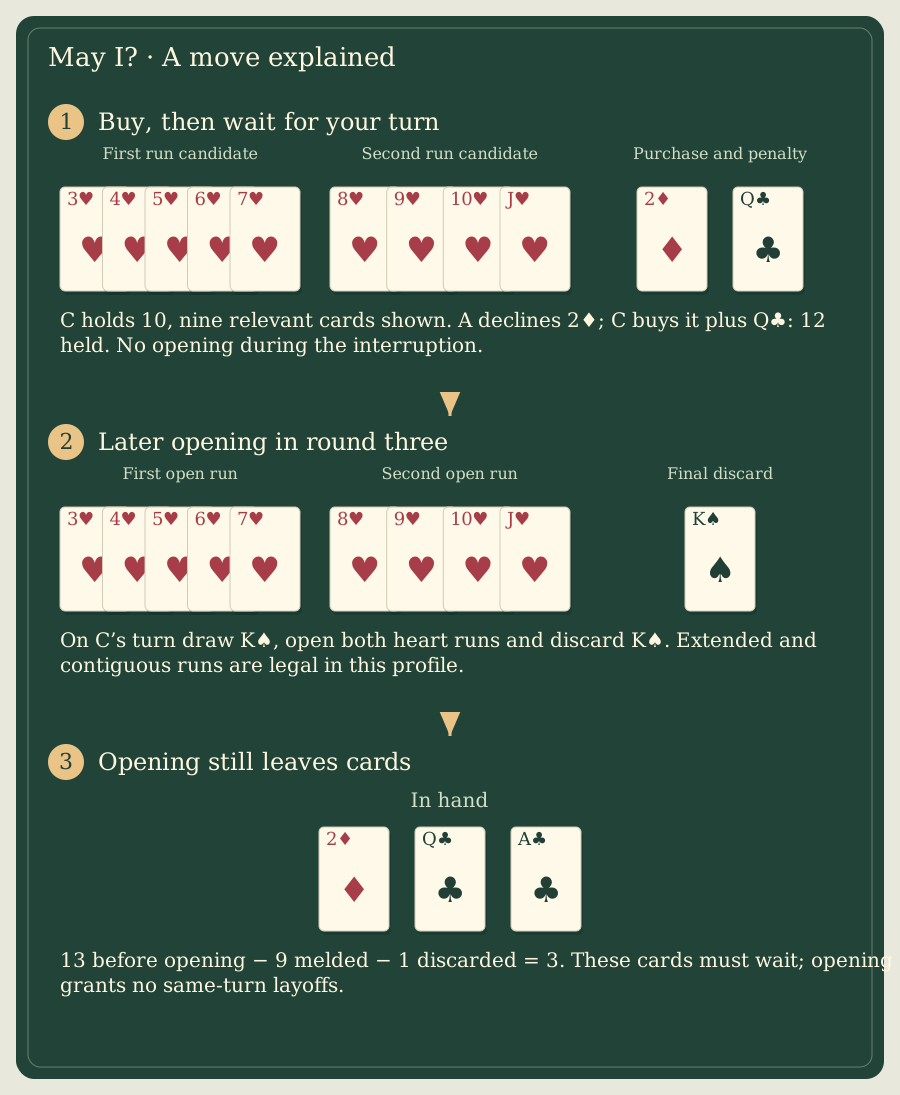
Round 3: C has 10 cards including 3♥ 4♥ 5♥ 6♥ 7♥ and 8♥ 9♥ 10♥ J♥. A declines top 2♦; C buys it plus stock Q♣, holding 12. C cannot open during the interruption. On C’s later turn draw K♠, holding 13. Open the 5-card and 4-card heart runs, even though contiguous, then discard K♠. Three cards 2♦ Q♣ A♣ remain: opening is not an automatic win and no same-turn layoff is allowed. The two runs use distinct physical cards.
← On a small screen, scroll the diagram horizontally. →
Common questions
Does buying give a turn?+
No, the active player resumes; the buyer only adds cards.
Can I reclaim a joker?+
Not in this variant; exposed jokers are fixed.
Must the last round end on opening?+
No, an opening may leave cards for later turns.