← On a small screen, scroll the diagram horizontally. →
01 /
Prepare and choose trump
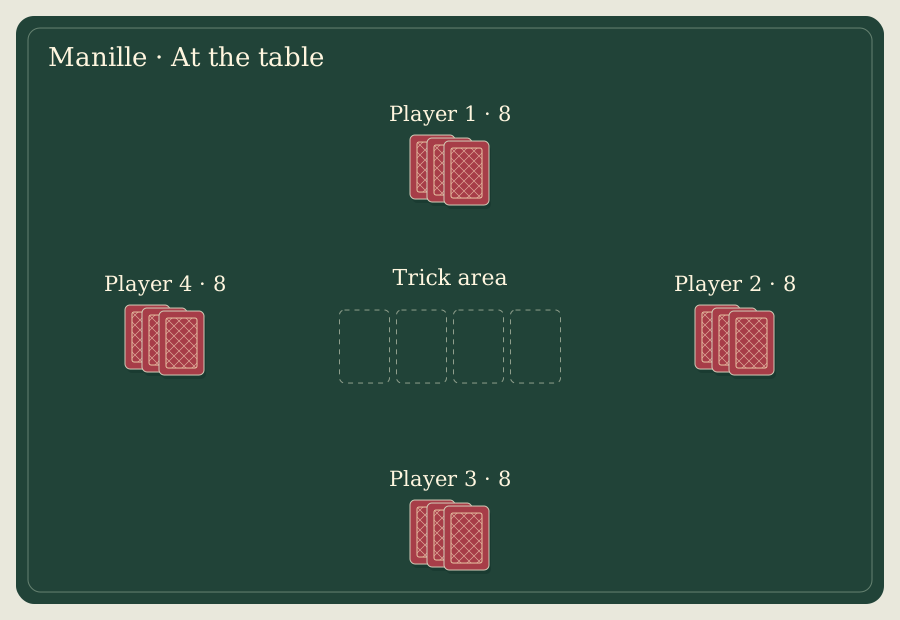
Seat 4 players in 2 fixed partnerships, partners opposite. Use 32 cards, 7 through ace. Every suit ranks 10, A, K, Q, J, 9, 8, 7; their values are 5, 4, 3, 2, 1, 0, 0, 0. Choose the first dealer randomly. Shuffle, have the right neighbour cut and deal clockwise, starting on the left, in packets of 3, 2, 3: everyone has 8 cards. The dealer rotates left.
The dealer’s partner must wait to look at the hand until the dealer names a trump suit or no-trump. If the partner looks prematurely, discard the deal without scoring and move to the next dealer. There is no auction, exchange or draw. The dealer cannot pass the choice; no-trump doubles the eventual award. There is no communication about hidden cards.
02 /
Mandatory play
The player on the dealer’s left leads any card. Follow suit if able. When an opponent is currently winning with the led suit, overtake if possible. If the opponent has trumped but you can follow the ordinary led suit, you still follow and need not try to beat the trump.
If void in the led suit and an opponent is winning, trump or overtrump if able. If your partner is winning, you need not overtake or trump. However, after an ordinary suit has been trumped, playing a lower trump is forbidden unless your entire remaining hand consists only of lower trumps; otherwise discard another suit. This ban does not excuse failing to follow a trump lead. Without trumps, following suit is still compulsory and there is no cutting. Highest trump, otherwise highest of the led suit, takes the trick and leads next. Complete all 8 tricks.
03 /
From card points to match points
Count captured card values: 60 in the pack, with no last-trick or per-trick bonus. The partnership above 30 scores only its excess over 30; the other scores nothing. Apply a factor of 2 for no-trump, 2 if the preceding deal was tied, and 2 if the winners took all the tricks. Factors combine. A sweep therefore scores 60 before other factors.
At 30–30 neither side scores and the next deal is doubled. For consecutive ties our explicit table convention keeps a single pending tie multiplier, rather than multiplying it repeatedly; a decisive deal clears it. The first partnership reaching 101 after a complete deal wins. Because only one side scores on a decisive deal, a simultaneous final tie cannot arise.
04 /
The compulsory overtake
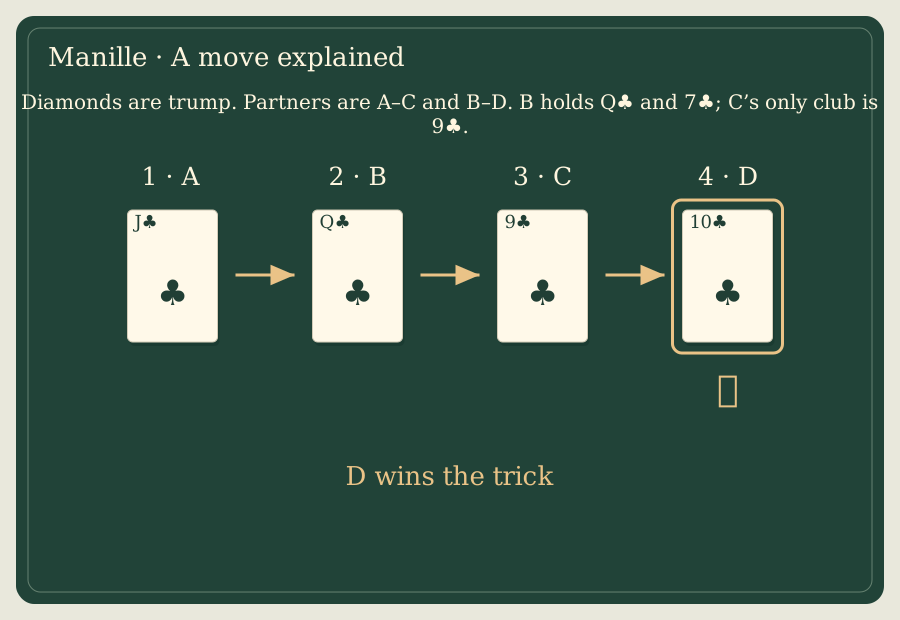
Diamonds are trumps. An opponent leads J♣ and your available clubs are Q♣ and 7♣. You must play Q♣ because it can beat the opponent. In a separate completed no-trump deal your partnership captures 38 card points: the excess is 8, doubled to 16 match points. Do not write 38 in the match column.
← On a small screen, scroll the diagram horizontally. →
05 /
History and regional profiles
Pagat’s description, based mainly on Lennert Lanssens’s contribution, places Manillen in West Flanders and traces its family through French Manille to Spanish Malilla or Manilla. This is a reported relationship rather than proof of an exact inventor or date. French Manille and local Belgian tables may use different trick bonuses, targets or doubles. In particular, importing a per-trick point would change both the total and the threshold used throughout this guide.
Common questions
Does an ace beat a ten?+
No. The ten is highest in every suit, whether trump or not.
Must I beat my partner?+
No, but following suit remains compulsory and the undertrumping ban still applies.
Can the dealer’s partner help choose trump?+
No. That partner must not even look at the cards before the choice.