← On a small screen, scroll the diagram horizontally. →
01 /
The Mexican seven is the malilla
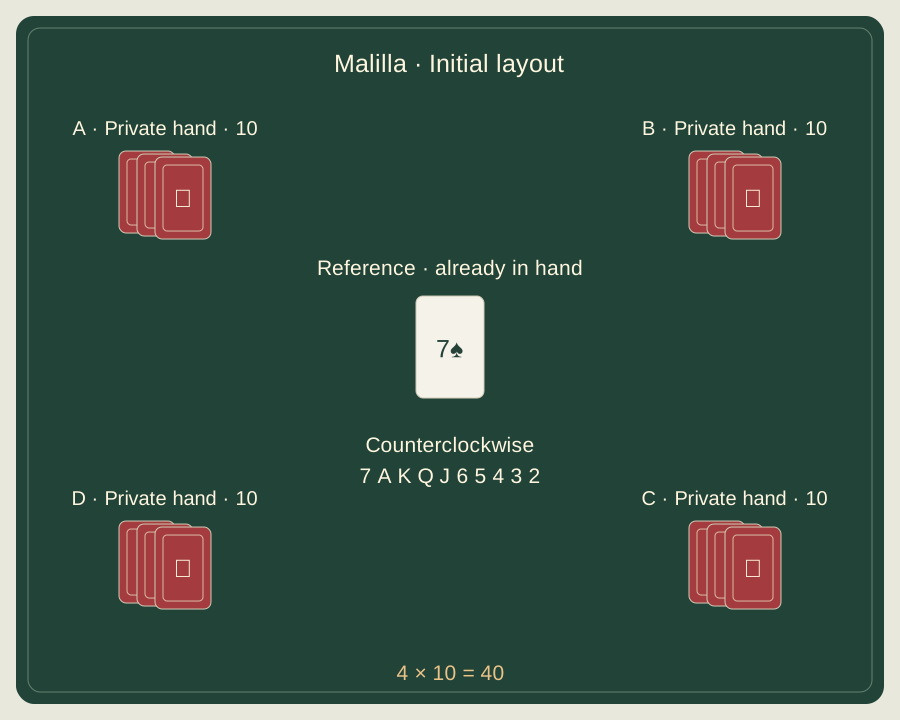
Malilla is played in Mexico and belongs to a family that travelled from Spain to France and Belgium. It is not simply French Manille with translated names: the Mexican top card is the seven, and every trick adds a point. The traditional pack is Spanish-suited. This guide uses the Mexican partnership profile with a declared French-card substitute, preserving the seven restriction and the special dealer bonus.
02 /
Forty cards, four partners
Play 4 in fixed opposite partnerships. Use 40 Spanish cards, or remove 8 9 10 and jokers from a French pack. French K Q J stand for rey caballo sota. Highest-to-lowest ranks are 7 A K Q J 6 5 4 3 2; point values are 5 4 3 2 1 then 0 for all smaller cards. Each suit contains 15 points, total 60; 10 tricks add 10, making 70. No stock or talon.
03 /
The dealer’s last card sets trump
Highest cut deals first. Shuffle, offer a cut to dealer’s left, deal singly counterclockwise starting at the right: 10 each. Turn the dealer’s last card up, announce its suit as trump, then return it to that hand. Its point value gives the dealer’s side an immediate match bonus, unless it would win the match; that case is delayed as explained below. Dealer rotates right. An exposed wrong card or incorrect deal ends the attempt and passes the deal to the next player.
04 /
Beat opponents, follow before trumping
Dealer’s right leads, then play counterclockwise. Follow suit whenever possible. If an opponent is winning, beat that card if possible while following suit; without the suit, trump an untrumped trick or overtrump if possible. If a winning trump cannot be beaten, no undertrump is required. When your partner wins, you need not overtake or trump, but must still follow. Highest trump wins, otherwise highest led suit; winner leads next. Both partners share captures.
05 /
Protect an unled side-suit seven
When void in the led suit, you cannot discard a non-trump 7 whose own suit has never been led. Earlier discards of that suit do not unlock it. You may always lead that seven, follow its suit with it, or discard it after its suit has been led. If your only remaining cards are otherwise forbidden sevens, allow the forced discard. Track suits led openly. A confirmed illegal play loses the match in this strict profile; check the actual trick before applying that penalty.
06 /
Seventy card-and-trick points
After all 10 tricks, add card values and 1 per trick. The two totals must sum to 70. Above 35, score only your excess over 35 as match points; opponents score 0. At 35 each, neither scores. First to 35 cumulative match points wins. A dealer bonus that would reach 35 is postponed until after this hand’s play points: if either side then wins, ignore that bonus; otherwise add it. Taking every trick gives 70, scores 35 and wins immediately. No extra multiplier for that sweep.
07 /
Seven beats ace, then count the trick
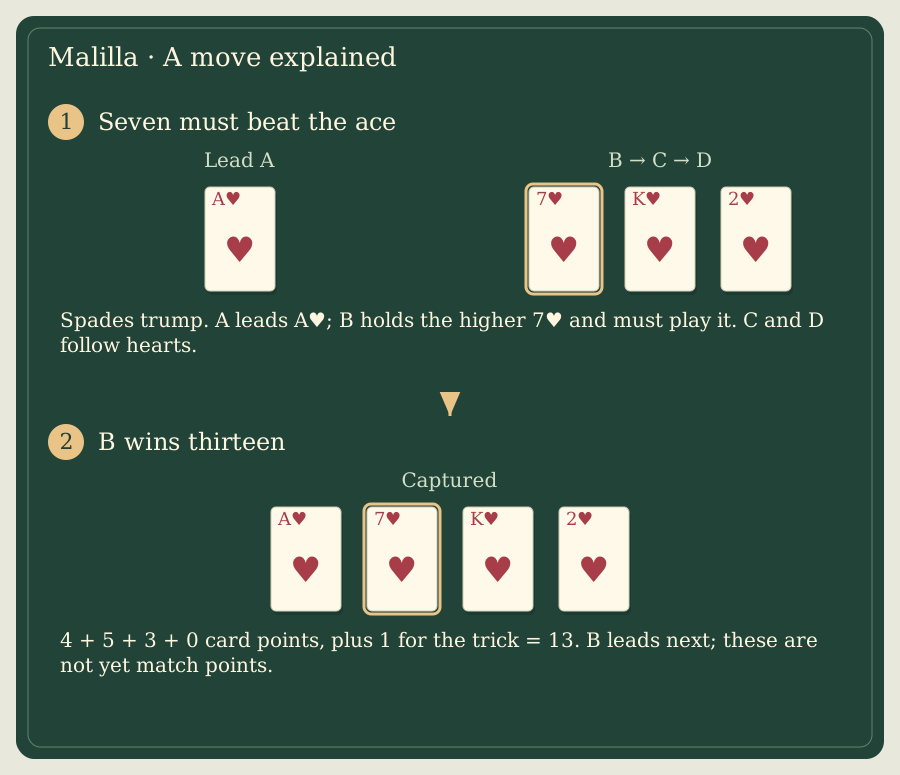
Spades trump. A leads A♥, B holds 7♥ and must overtake with it. C follows K♥, D 2♥; B wins. The capture is worth 4 + 5 + 3 + 0 + 1 for the trick = 13. In a separate match-ending example both sides have 33, and the dealer shows K♦ for a potential 3 bonus. Opponents take 37 in play, score 2 and reach 35 first: they win before that delayed dealer bonus is added.
← On a small screen, scroll the diagram horizontally. →
Common questions
Is the ace highest?+
No, the seven is highest in every suit.
Can an unled seven be discarded?+
Not as a side-suit discard unless forced with nothing else legal.
Are points awarded for tricks too?+
Yes, add a point per trick to captured-card values.