← On a small screen, scroll the diagram horizontally. →
01 /
Memory becomes a team skill
Literature turns family-collecting into a partnership deduction game. Reports connect it with southern India and later North American play, sometimes under the name Canadian Fish. Its inventor and exact date remain uncertain. Unlike a simple request game, your team can claim cards spread across several hands, but must identify their owners correctly. This guide uses the six-player, eight-half-suit form; larger-table and alternative claim penalties are separate variants.
02 /
Remove the eights, not the tens
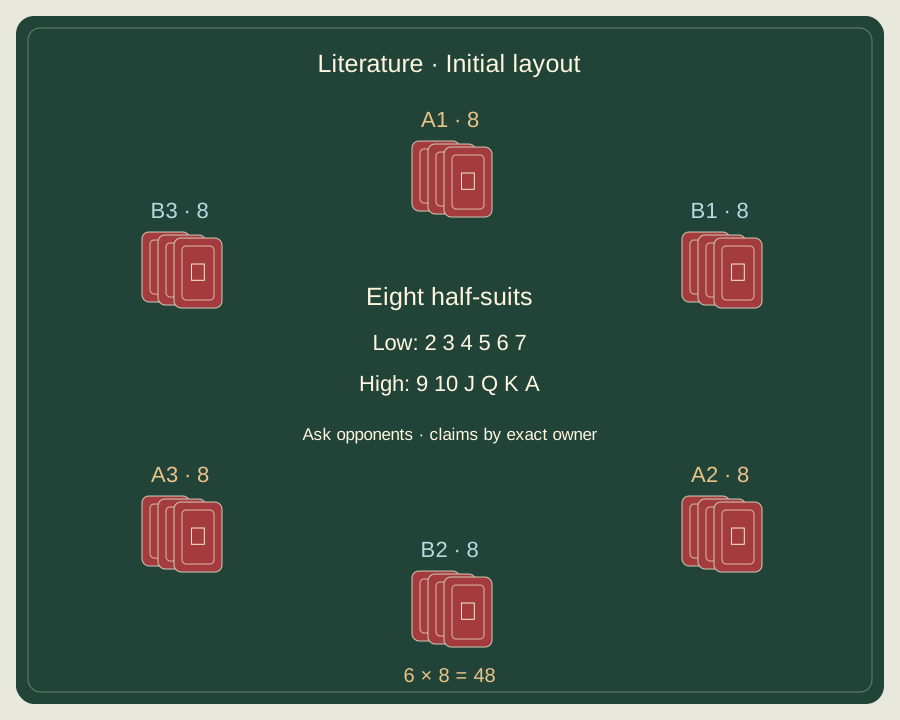
From 52 cards remove all 4 eights, leaving 48 with no jokers. Each suit makes 2 half-suits: low 2 3 4 5 6 7 and high 9 10 J Q K A. There are 8 sets of 6. Form 2 teams of 3, seated alternately. Choose a dealer randomly and deal all cards singly: 8 each, no stock. Redeal an accidentally exposed deal. Keep hands private even from partners. The dealer asks first.
03 /
Ask an opponent for an exact card
On your turn name one card and one opponent who still has cards. You must hold another card of that same half-suit and must not already hold the requested card. A successful request transfers the card face up and you ask again, possibly elsewhere. On failure, the opponent asked takes the turn. You cannot ask partners or empty hands. Holding Q♠ permits asking for A♠ but not 7♠: these belong to different half-suits.
04 /
A claim names every owner
On your own turn you may claim a whole half-suit, even without holding any of it. State exactly which teammate, including yourself, holds each card. Reveal the half-suit only after the declaration. Correct ownership earns your team the set. If your team owns all of it but locations are wrong, cancel the set: neither scores. If any card belongs to an opponent, that team wins the set. Remove all claimed cards and continue your turn.
05 /
What may be said aloud
No coaching, coded signals or showing partners your hand. Anyone may ask for the last question and answer, or for a truthful hand-card count. Older question history may not be discussed; written or electronic notes are not allowed. Make claims only on your turn: an out-of-turn claim cancels a wholly friendly set or awards it to opponents if they hold any card. For an invalid request or withheld card, stop openly and agree a fair correction before continuing.
06 /
Empty hands and the final claims
An empty hand cannot receive a question. If claiming empties your own hand, choose a teammate with cards to continue. Once a whole team has no cards, questions stop. If the turn belongs to the team still holding cards, that active player must locate all remaining sets without consultation. Otherwise the empty-handed active player chooses an opponent with cards to make those final claims. Each won set is 1 point; cancelled sets score 0. Most points wins, equal scores tie.
07 /
Deduce the missing diamond
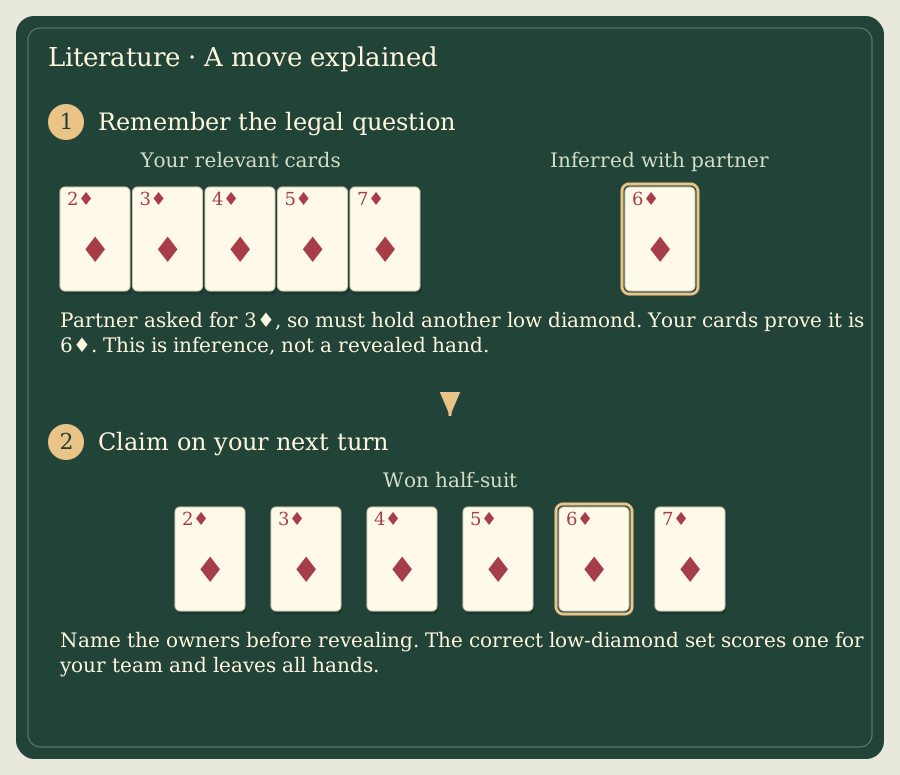
You hold 2♦ 3♦ 4♦ 5♦ 7♦. A teammate legally asks an opponent for 3♦ and receives “no”. That teammate must hold another low diamond; because you own all the others, it must be 6♦. When you next have the turn, claim low diamonds with that teammate holding 6♦ and yourself holding the rest. Do not claim during the opponent’s turn. Remember the request, not just the refusal: the permission to ask supplies the crucial clue.
← On a small screen, scroll the diagram horizontally. →
Common questions
May I ask a partner?+
No; questions target opponents with cards.
Which cards are removed?+
All eights; tens remain in the high half-suits.
Can I keep written notes?+
No; remembering the history is part of play.