← On a small screen, scroll the diagram horizontally. →
01 /
A historical banking game
Lansquenet takes its name from the German Landsknecht, a mercenary foot soldier. Rabelais mentions it in the Renaissance; later French descriptions use a banker and a shared opposing card. Here we explain that French form, with counters rather than money. Skin and Sicilian Zecchinetta have different procedures and are not interchangeable names for these exact rules.
02 /
Prepare the bank
Use 52 cards without jokers for 2–10 participants in this table profile. Traditionally several packs were used; here shuffle the single pack before every deal. Suits and rank order do not matter: only matching values count. Choose the first banker randomly; the player on the left cuts. Give everyone an equal recorded counter balance and agree a finishing time. The banker announces the amount committed to the bank before any cards are exposed.
03 /
Covering the bank
Beginning at the banker’s right, proceed anticlockwise. A player may pass or commit part of the bank still uncovered. Alternatively, someone may cover the whole bank alone; all earlier opposing stakes are then returned. Repeat around the table until the bank is fully covered or everyone declines to increase. Total opposing stakes cannot exceed the bank. Uncovered bank counters are not won or lost. Once exposure begins, stakes are fixed.
04 /
Which value appears first?
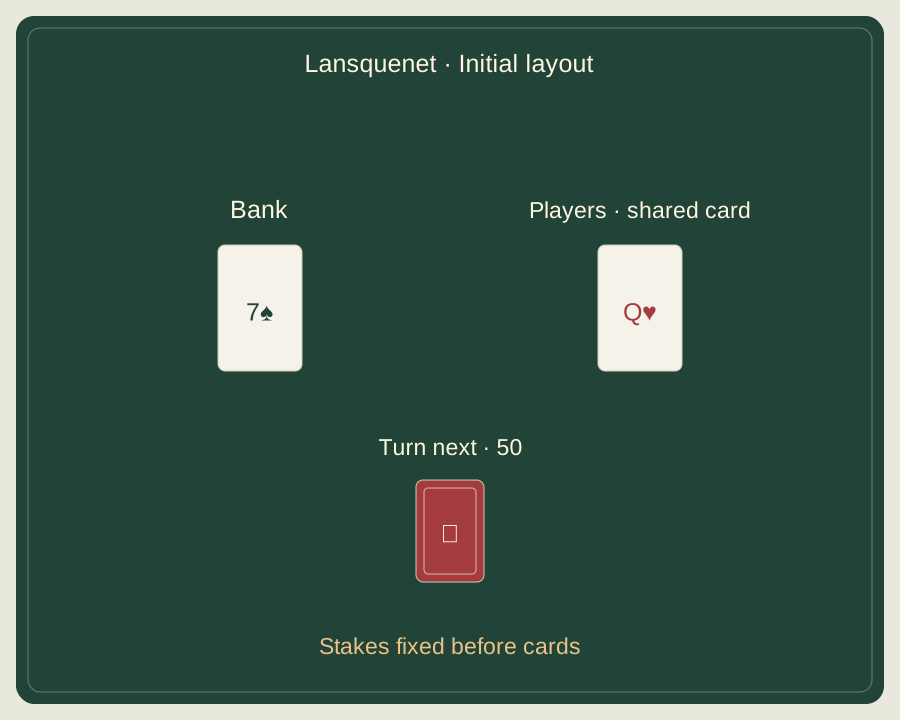
Turn a card to the banker’s left for the bank, then a card to the right for all opposing players. Equal ranks mean an immediate bank win. Otherwise expose further cards singly. A match to the bank’s card wins all opposing stakes for the bank; a match to the players’ card makes the bank pay each stake at 1 to 1. Other ranks do nothing. Stop at the first decisive match; do not compare poker hands.
05 /
Keeping or passing the bank
After a loss, the bank passes to the right of its original holder. After a win, keeping the bank normally requires staking its old amount plus the winnings; an immediate opening pair allows the winnings to be withdrawn instead. To leave after winning, offer the bank for purchase at the required new amount, priority nearest on the right. A buyer supplies fresh counters; the seller takes the old bank. Allow at most 3 sales. A fourth holder cannot resell. With no buyer, resume at the original holder’s right with a newly chosen bank.
06 /
A complete counter settlement
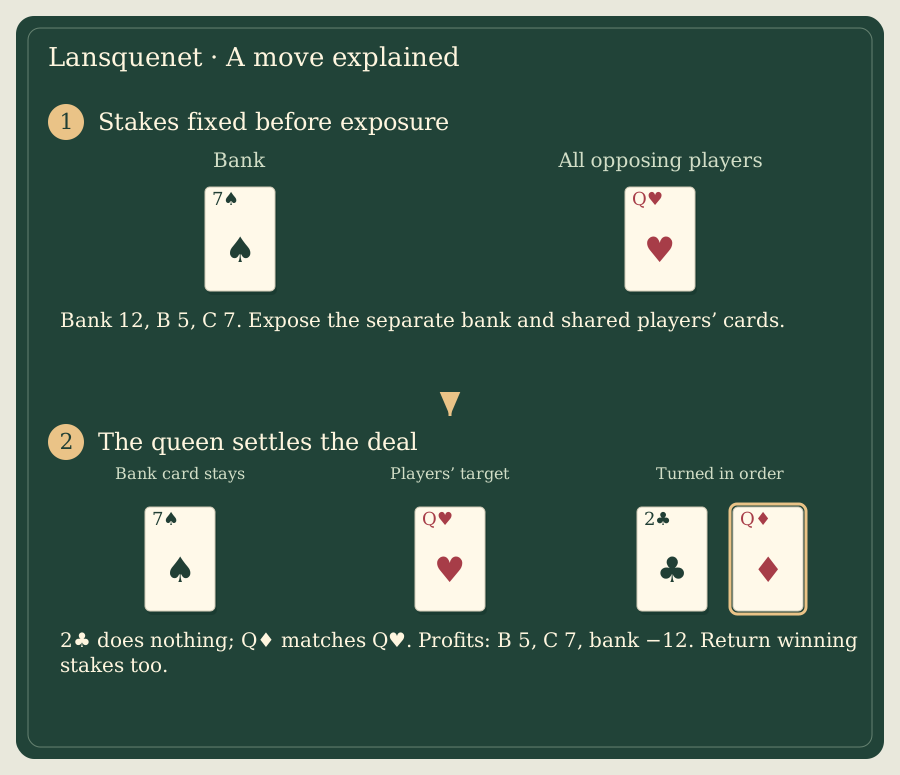
Bank 12; B covers 5 and C covers 7. Bank card 7♠, players’ card Q♥. The next cards are 2♣ then Q♦: the queen decides for the players. B receives the original 5 plus 5 profit; C receives 7 plus 7 profit. The banker loses 12. If 7♦ had appeared first, the banker would collect 12 and need a bank of 24 to continue. At the agreed finish, compare counter balances; ties share the result.
← On a small screen, scroll the diagram horizontally. →
Common questions
Do suits matter?+
No, compare ranks only.
What if the opening cards match?+
The bank wins immediately.
Can bets exceed the bank?+
No; return earlier stakes if someone covers the entire bank alone.