← On a small screen, scroll the diagram horizontally. →
01 /
Greek Xeri, not an interchangeable Pişti
Kseri, also written Xeri or Ξερή, is a Greek pile-capturing game whose name means dry or plain. It resembles Turkish Pişti, but their point tables are not interchangeable. Greek Xeri also contributes ideas to Diloti. A precise inventor or first date is not established. Here the complete guide uses the two-player Greek game, six-card packets and cumulative match scoring. The big moment is a single card captured by its matching rank: an ordinary capture becomes a kseri bonus. A jack matched against a lone jack has its own larger bonus.
02 /
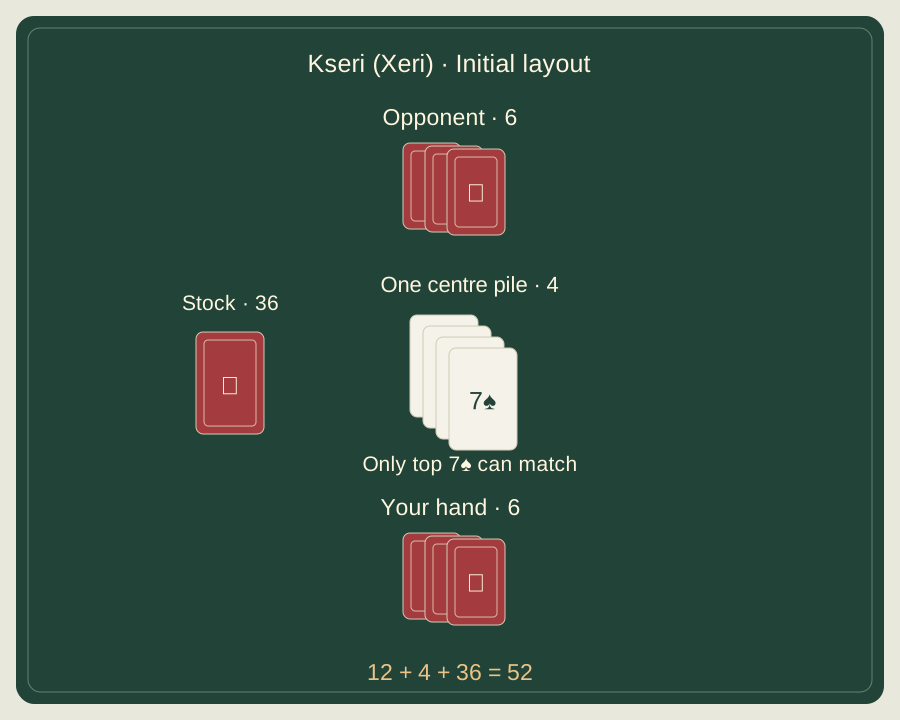
Six each, four in one pile
Use 52 ordinary cards without jokers for 2 players. Choose first dealer randomly; the other cuts. Deal 6 each and 4 face up to one central pile, in order, so only the fourth is top. If that top is J, or the top 2 have equal ranks, shuffle those 4 back into the undealt stock and form a fresh pile, repeating as needed. Remaining stock is 36. Non-dealer starts. Suits have no strength for capture. All hand cards stay private, and captured piles cannot be inspected again during the round. Dealer alternates after a full pack, not after each six-card packet.
03 /
Match only the exposed top
Alternate turns, playing 1 hand card onto the central pile. A rank match with the previous top takes the entire pile plus your played card. J takes any nonempty pile even without a rank match. A nonmatching non-J stays as new top, hiding the older cards. On an empty table any played card, including J, simply starts a new pile. There are no sums, suit matches or partial captures. Remember what is buried, because you cannot spread the pile to check. A captured pile goes face down in your own area.
04 /
The single-card bonus
Exactly 1 card in the pile, captured by its matching rank, is a kseri worth 10 extra. Mark that captured single sideways and visible under your capture stack; it still counts as a captured card. A J on a lone non-J is a normal capture, no kseri. A J on a lone J is the exception: jack kseri, worth 20 extra instead of 10. J placed on an empty table captures nothing. This profile also allows a genuine kseri on the very last played card; tables forbidding that or valuing jack kseri at 25 use other rules.
05 /
Four packets use the whole pack
When both six-card hands empty, the same dealer gives 6 new cards each from stock. Leave the central pile as it is; do not deal another opening pile. Non-dealer starts again. Four packets of 12 hand cards plus the initial 4 use all 52. After the last packet, last capturer takes any remaining central pile, without an extra kseri merely for receiving it. All captured cards, including sideways bonus markers, are counted once. Gather the pack only after scoring, then swap dealer for the next round.
06 /
The Greek twenty-five-point base
Each captured A K Q J 10 gives 1 point. The 10♦ has 1 extra, for 2 total; 2♣ gives 1. More captured cards earns 3; exactly 26 each earns neither the majority award. Thus base points total 25, or 22 when card count is tied, plus kseri bonuses of 10 or 20. This differs from Pişti’s card table. Add round totals cumulatively toward 151. If exactly one player reaches the current target, that player wins. If both do in the same round, raise target by 100 to 251, then 351 if needed, and continue; do not award the game mid-round. Equal totals alone never create an extra bonus.
07 /
Matching a lone ten or a lone jack
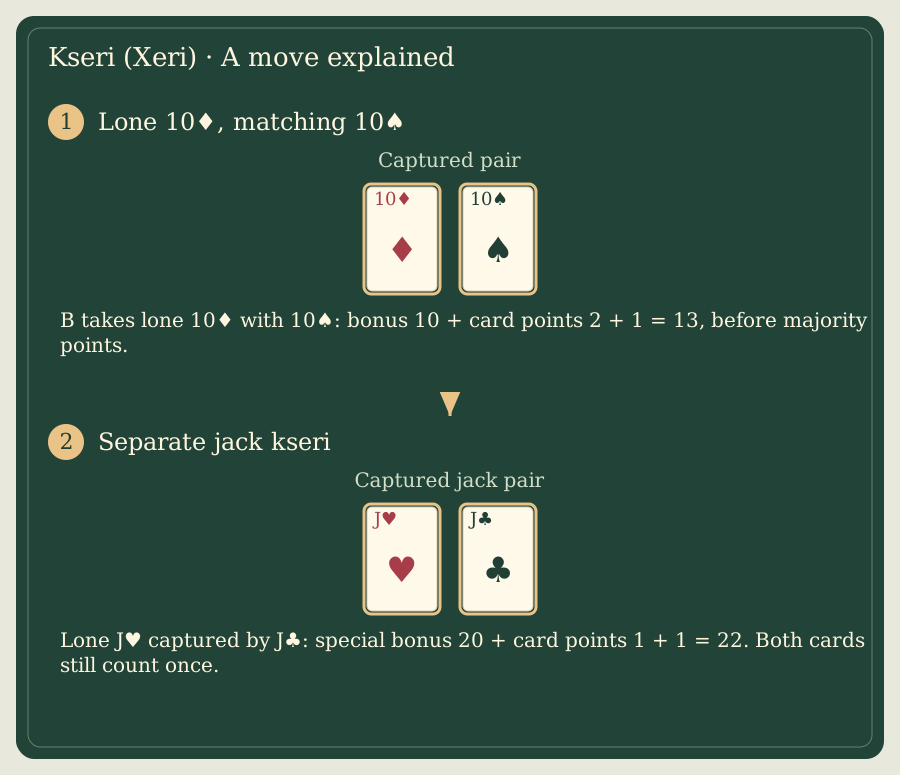
A leaves 10♦ alone on an empty table. B plays 10♠ and captures both: bonus 10 plus card points 2 for 10♦ and 1 for 10♠, total 13 before any majority award. If B used J♠ instead, the same pile would be captured but without kseri: those cards give only 3. Separate example: a lone J♥ taken with J♣ gives jack kseri 20 plus 1 for each jack, total 22. A jack is therefore not a universal no-bonus card; the rank of the lone target matters.
← On a small screen, scroll the diagram horizontally. →
Common questions
Is every jack capture without a kseri?+
A jack on a lone jack scores the special jack kseri. A jack on a lone other rank does not.
Do Greek and Turkish scores match?+
No. This Greek profile scores captured tens and all picture cards as well as aces.
Do I deal a new centre each packet?+
No. The opening pile is dealt once. Later packets replenish hands only.