← On a small screen, scroll the diagram horizontally. →
01 /
History
Pagat relates Kryt’-navalivat’ to Duraki s nakladkoy, with printed accounts dated to the eighteenth century. Modern rules were supplied by Alexey Lobashev. This records a relationship and tradition rather than a sole inventor. Unlike throwing-in Durak, play uses a continuous pile and a compulsory new lead after covering.
02 /
Setup
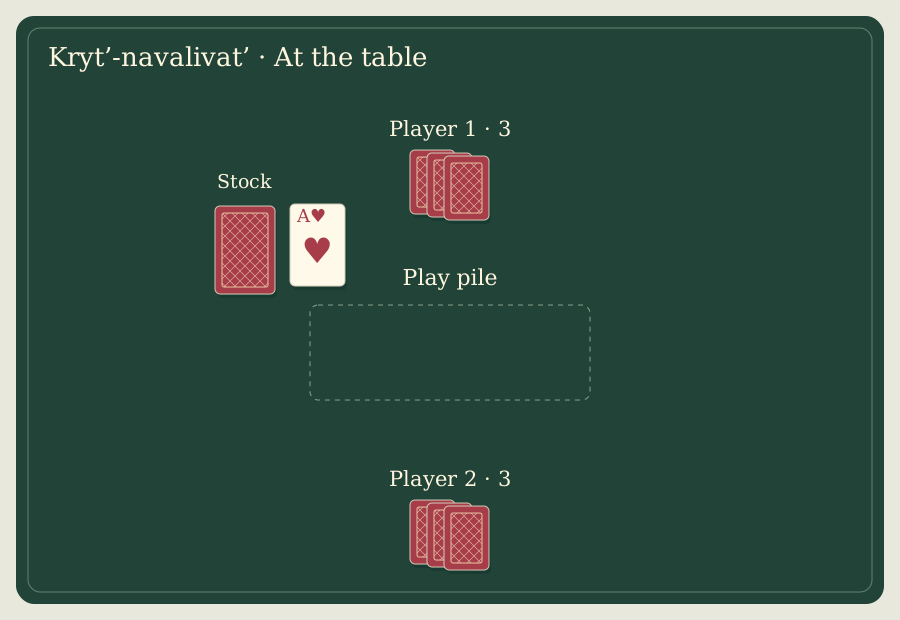
2 play. Use 36 cards ranked A–K–Q–J–10–9–8–7–6. Choose first dealer randomly; later the loser deals. Shuffle, offer the opponent a cut, deal 3 each singly. Expose the next for trumps and stack stock crosswise above it. Nondealer starts with any single card.
After a completed turn replenish your hand to 3 by taking its whole shortage; keep larger hands. For a two-card play, lay both before drawing. The exposed trump is drawn last. Until stock is exhausted, trump 6 may be exchanged for that card.
03 /
Cover and lead
Play onto a shared face-up pile with its top visible. On your turn either beat that top card and immediately lead any other card from hand over it, or pick up the required number of top cards. Never draw or pick up between covering and the new lead. Beat a nontrump with a higher card of its suit or your trump; a trump needs a higher card of its suit. Following suit is optional.
After completing the action, turn passes on. If a pickup leaves a pile, the next player faces its newly exposed top. If empty, that player leads any single card. Before deciding, you may inspect cards you would have to pick up and the next card beneath. Show the covering card on request if both cards were played together.
When no replenishment is available and the covering card empties your hand, leave without making a further lead. Apply the final-card rules below.
04 /
Pickup quantity
Declining to cover an ordinary top card, take only that 1 card. With a trump other than ace, take the top 3, or all if fewer remain. With trump ace, take everything. This is no discard: remaining cards expose an old threat for the next player.
05 /
Final cards
After stock exhaustion there are no draws. A player with no cards leaves after the completed action. Games with more players need a special free-lead rule after an exit by final cover; this guide selects ordinary two-player play. The variant with permanent diamond trumps and spade anti-trumps is also excluded.
The last holder of cards loses. Exception: if their sole card can beat the opponent’s final free lead and it is now their turn to answer, the game is drawn. If the opponent’s card was only a cover without a new lead, there is no final response: the remaining player loses even holding a higher card. After a draw, keep the same dealer. No points are required; a session may count defeats.
06 /
Worked chain
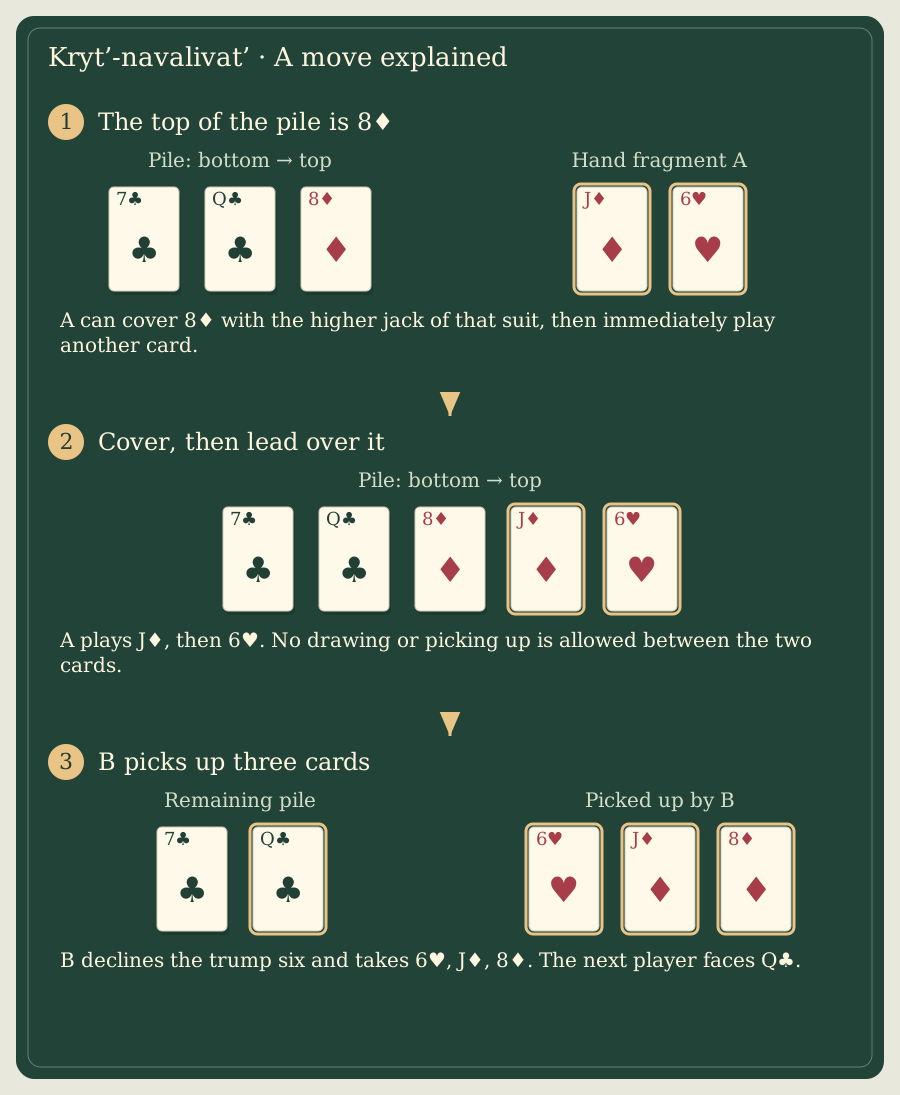
Hearts trump. Bottom to top, the pile holds 7♣, Q♣, 8♦. Cover 8♦ with J♦ then lead 6♥. The pile now has 5 cards. Opponent declines the trump six and picks up the top 3: 6♥, J♦, 8♦.
Q♣ is exposed, so the next player now faces it. A pickup does not automatically clear the whole table. Had A♥ been on top instead of 6♥, all 5 would have to be taken.
← On a small screen, scroll the diagram horizontally. →
Common questions
May I draw after covering and choose my new lead from that draw?+
No. Play both from the existing hand before replenishing.
Does pickup always clear the table?+
No. Ordinary top means one, trump three, trump ace the whole pile.