← On a small screen, scroll the diagram horizontally. →
01 /
Swedish Casino with the objective reversed
Krypkasino is a Swedish reverse-Casino game. Its name refers to creeping: placing a card without capturing anything. Avoiding points is only half the puzzle, because leaving a forced sweep for the next player earns a negative score, which is good here. It belongs to the fishing family, not to a casino-banking game despite its name. An exact inventor and first publication are not established. This guide uses individual play with the double deck, mandatory maximal captures and the balancing sweep scores; team play is a separate variant.
02 /
Deal the first packets correctly
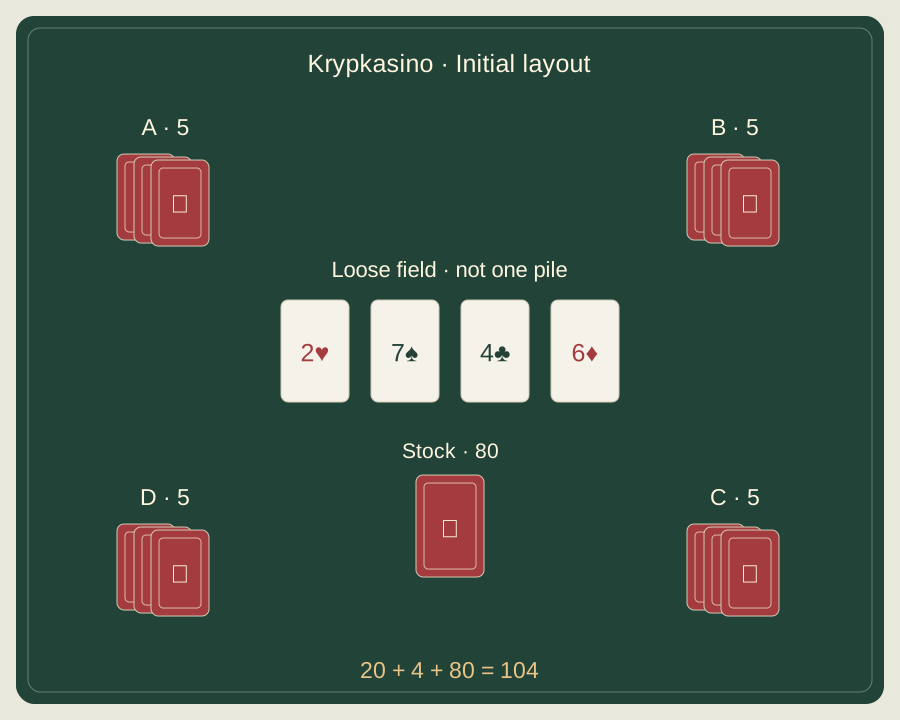
Use 2 ordinary 52-card packs without jokers, 104 total, for 2–6 players. Clockwise first dealer is random. Initial hand/table counts by player count are: 2 → 6/4; 3 → 5/5; 4 → 5/4; 5 → 4/4; 6 → 5/2. Deal batches split as 3+3 for a hand of 6, 3+2 for 5, 2+2 for 4. The illustrated four-player opening has 20 held, 4 table and 80 stock. Immediately set aside any table J Q K, keeping spade pictures separate. Before each new packet also remove remaining table pictures; removing them is not a sweep.
03 /
Choose a card, then take every legal group
Player left of dealer starts; play 1 card each clockwise. Capture values are numerals as printed, J 11, Q 12, K 13. Ace from hand is 14 but on table only 1, so an ace does not capture a lone ace. A played card captures equal-valued single cards or disjoint groups adding to its value. Capture your played card too. You must take every additional available group, with no table card reused; if options overlap choose a maximal legal collection. There are no stored builds. If nothing matches, leave the card face up: krypa. Unless a full sweep is possible, you may choose a non-capturing card even while holding other capturing cards.
04 /
A possible sweep forces your choice
If any hand card can capture the entire field, you must play a sweeping card, not creep with a different card. Ordinary tabbe gives sweeper +5 and the immediately preceding player −5, awarded only when the sweep actually occurs. If dealer’s cleaned initial field already offers a sweep, dealer gets the setup credit if it is taken. Mark the capturing card face up in captures. A lone non-ace captured with its identical rank and suit copy is a double sweep: +10 and −10, marked by both cards. An identical card within a larger captured field is only an ordinary sweep. If another suit avoids the double while still sweeping, choose it.
05 /
Keep table numerals between packets
When all hands are empty, remove table pictures as described, leave numeral cards and aces, then deal 4 new cards each, in 2+2 batches, from the same stock. Do not add new field cards or reshuffle. The same player left of dealer starts each packet. Opening and later packets together use all 104 cards exactly. Announce the last packet. After all cards are played, the last capturer receives remaining field and the set-aside spade pictures; non-scoring removed pictures do not affect points. This final award is not automatically a sweep, though an actual final-play sweep still counts.
06 /
Forty-two points remain conserved
For captured cards count each 10♦ as 3, each 2♠ as 2, each A♠ as 2, each other spade or ace as 1. Everything else is zero. Both copies count, so card points total 42. Add sweep penalties and subtract setup credits; these cancel across players, leaving total 42 per full deal. No points for most cards or last capture are added here. Lowest cumulative total wins after one full dealer rotation in our finite session; ties share. Scores can be negative. Keep captured card points separate from sweep transfers so the invariant remains easy to audit.
07 /
You cannot dodge a full capture
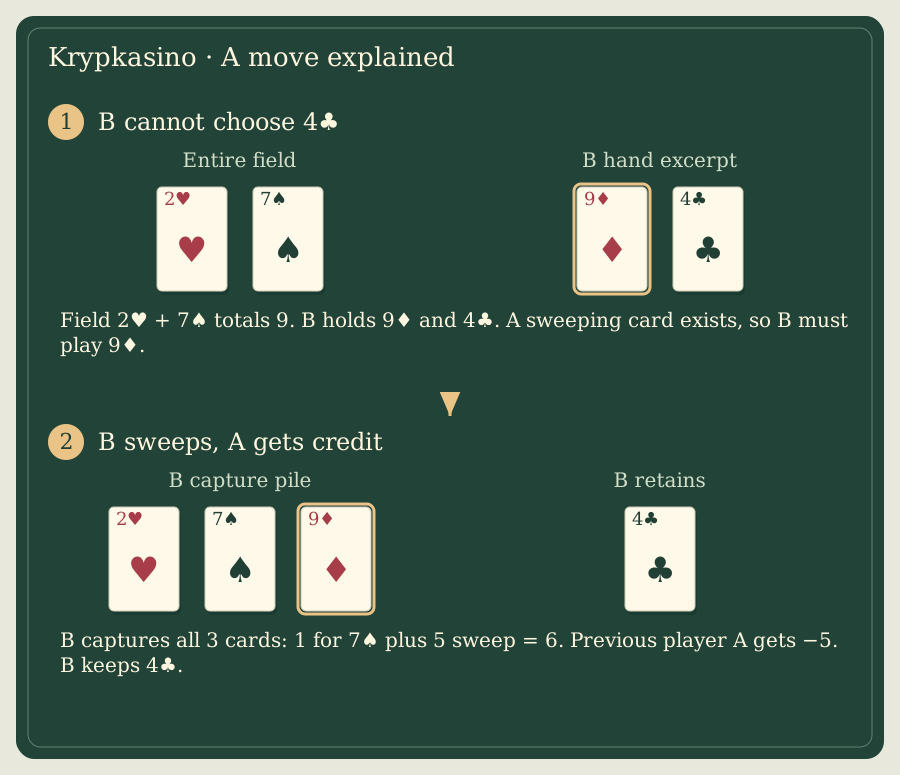
Field has 2♥ and 7♠; B holds 9♦ and 4♣. B must use 9♦ to sweep 2 + 7, despite 4♣ being a non-capturing alternative. B takes the three physical cards, scores 1 for 7♠ plus 5 sweep = 6, while preceding A receives −5. Other captured points elsewhere complete the deal’s total. Separate double-sweep example: a lone 3♦ captured by the other 3♦ gives +10/−10, not +5/−5. A lone A♦ cannot be taken by A♦ alone because capture values are 14 in hand and 1 on table.
← On a small screen, scroll the diagram horizontally. →
Common questions
May I avoid a sweep using another card?+
No. If any hand card clears the whole table, you must play a sweeping card.
Can one ace capture another ace alone?+
No. The hand ace has capture value fourteen, while a table ace has value one.
Why do total points remain forty-two?+
Sweep penalties are balanced by equal setup credits; only the deck’s fixed card points remain in the total.