← On a small screen, scroll the diagram horizontally. →
01 /
Players, deal and trick play
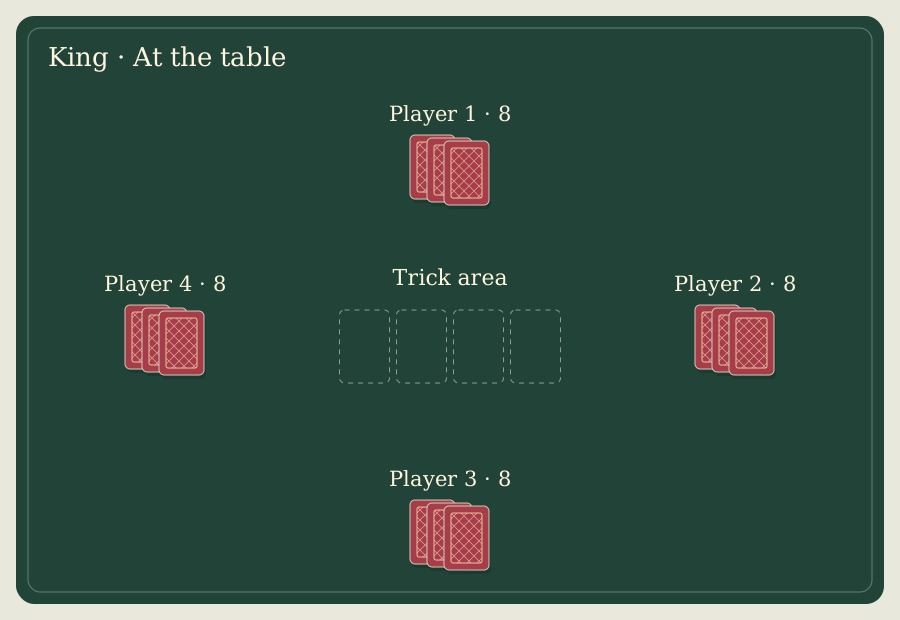
There are 4 individual players and 32 cards, 7 through ace. Every suit ranks A, K, Q, J, 10, 9, 8, 7. Choose the first dealer randomly; our procedural agreement rotates dealer clockwise each round. Shuffle, let the right-hand player cut, then deal 8 each singly clockwise, starting on the left. There is no stock, exchange or partnership. The player on the dealer’s left leads first.
Follow the led suit if able; otherwise discard any card. There are no trumps and no general obligation to overtake. Highest of the led suit wins and leads next. Normally play 8 tricks, but when every scoring item of the contract has been captured, stop and move to the next round.
02 /
The fixed contract sequence
Play these negative rounds in order: 1, No Tricks, −2 per trick; 2, No Boys, −4 per king; 3, No Girls, −4 per queen; 4, No Hearts, −2 per heart; 5, No King, −16 for K♥; 6, No Last Two, −8 for each of the last two tricks; 7, Negative Eralash, all those penalties together. Each isolated round totals −16; Eralash totals −96.
Rounds 8 through 14 repeat those same objectives in the same order with positive values: tricks +2, kings +4, queens +4, hearts +2, K♥ +16, last two tricks +8 each, then Positive Eralash adding all those bonuses. Each isolated positive round totals +16 and the combined round +96. Card face values do not otherwise score, and taking every penalty does not reverse its sign.
03 /
Hearts and the compulsory king discard
In the heart rounds, King rounds and both Eralash rounds, you may lead hearts only when your remaining hand has no other suit. Hearts need not be “broken”: another player’s heart discard does not lift this restriction. Following hearts when led remains compulsory.
In King and Eralash rounds, if you cannot follow the led suit and hold K♥, you must discard it at that first opportunity. On a heart lead you follow normally and may choose another heart if available. This applies on the positive side too. We retain the forced-discard convention; allowing the king to be kept is a different option.
04 /
Record and finish
After each round record each player’s signed result in a separate row, then add it to the running total. The negative half distributes −192 and the positive half +192; all four final totals must therefore sum to 0. Scores may be negative. After round 14, the highest algebraic total wins, even if it is not positive. Our explicit final-tie convention shares victory among equally highest totals, without adding an unequal extra contract.
05 /
One card may count in several ways
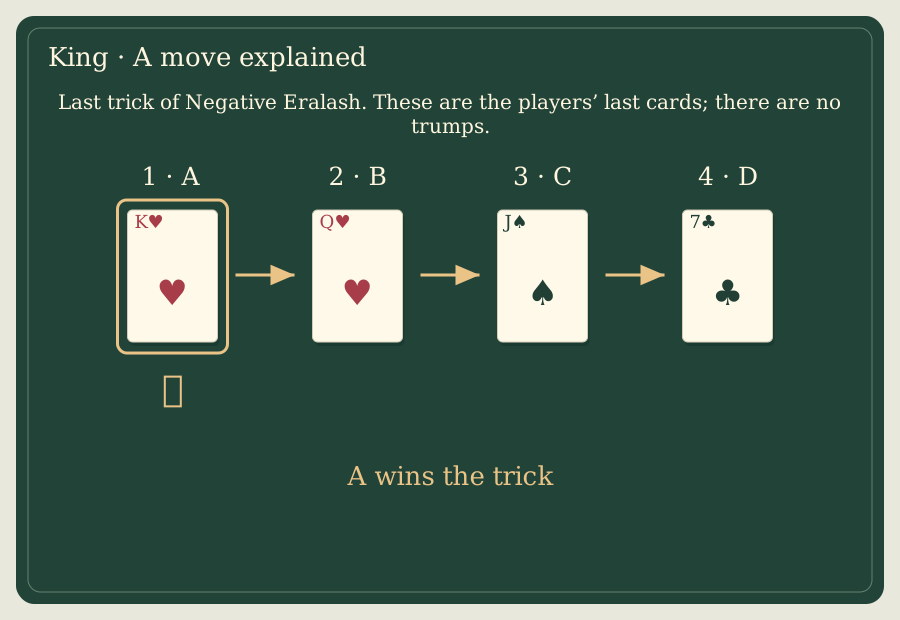
In Negative Eralash, the last trick contains K♥, Q♥, J♠ and 7♣. Its winner receives −2 for the trick, −4 for its hearts, −4 for the king, −4 for the queen, −16 for K♥ and −8 for the last trick: −38. The jack has no boys penalty in this selected profile. In Positive Eralash the same captured items give +38.
← On a small screen, scroll the diagram horizontally. →
06 /
Context and regional versions
Russian King is part of an international compendium family alongside Barbu and related games, but its pack, round sequence and scoring distinguish it. Gambler documents several Russian conventions, while Pagat’s family page warns that an English name is not evidence of an English origin. We therefore do not repeat an unverified invention story. Other countries’ King games and Russian “ordered King” should be described separately rather than folded into these rules.
Common questions
Do boys include jacks?+
Not here. Only kings count; the kings-and-jacks convention changes their individual value.
May I lead hearts after somebody discards a heart?+
Not in restricted rounds unless you have only hearts remaining.
Do I need a positive final total to win?+
No. Highest signed total wins.