← On a small screen, scroll the diagram horizontally. →
01 /
A quartet and a silent message
Kemps combines matching cards with reading a partner’s expression. It circulates internationally under several names, including Kent in some groups; its exact birthplace and inventor are uncertain. Published accounts describe different scoring systems and call words. This guide uses the penalty-letter game: partners privately agree a visible nonverbal signal, collect a quartet, and try to get the partner to call before opponents interrupt. Bluffing gestures are part of play, but signals carrying other tactical messages are not.
02 /
Partners opposite, four cards each
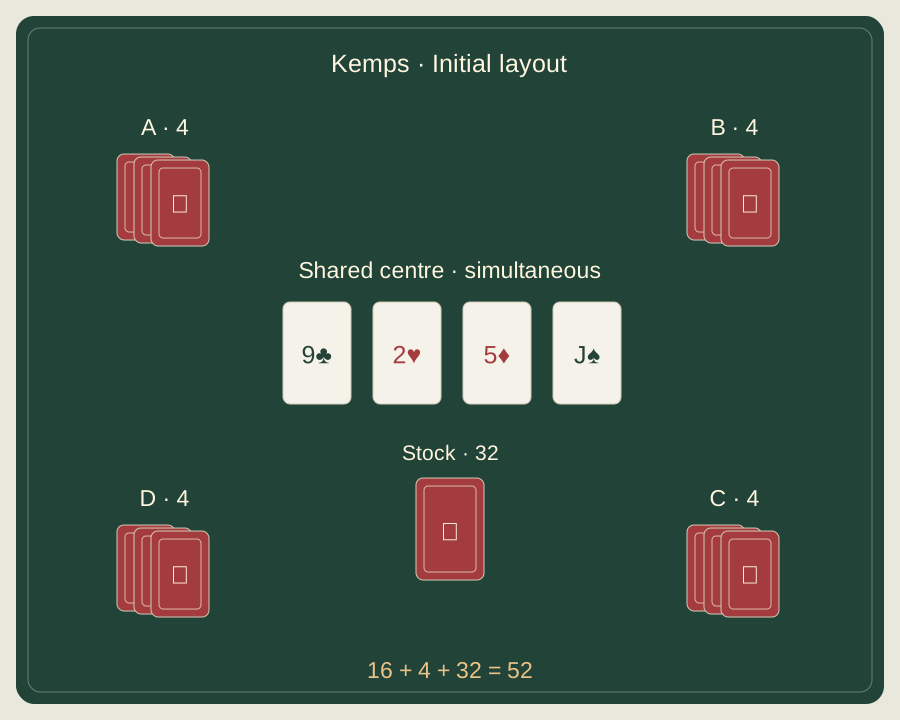
Use 52 cards without jokers for 4, 6 or 8 people in pairs; the clearest beginner table has 4. Any rank quartet counts; suits have no strength. Before sitting opposite, each pair privately agrees one or more gestures meaning only “I have four equal ranks”. No spoken codes or hidden touching. Dealer gives 4 cards each and exposes 4 centre cards; rest stays as stock. With 4 players that is 16 in hands + 4 centre + 32 stock. Play starts when the last centre card appears. Choose a new dealer for each deal.
03 /
Swap simultaneously
There are no turns. Pick up centre cards and immediately replace them with the same number of different hand cards; return to a four-card hand before signalling or calling. For an orderly first game, agree one card per exchange, a documented variation used here. First touch has priority for a contested card. No direct hand-to-hand passing or private exchanges with a partner. If nobody wants the centre, dealer sweeps its 4 cards aside face down and deals 4 fresh ones. Swept cards are not recycled during that deal. Keep hands visible as packets, with faces private, so opponents can verify the hand size.
04 /
Kemps and Stop Kemps
When you think your partner has a quartet, call “Kemps”: freeze all exchanges and reveal that partner’s hand. A correct call penalises every opposing pair by the next letter of KEMPS; a false call penalises your pair instead. You cannot win by calling your own quartet. To interrupt an opponent, name the opposing pair and call “Stop Kemps”; check both their hands. If either holds a quartet they receive a letter; if neither does, your pair receives one. You need not identify the secret gesture correctly. The call ends the deal, so no completing a quartet after hearing it.
05 /
Letters, exhaustion and close calls
Continue with new deals until a pair receives its fifth letter, spelling K–E–M–P–S: that pair loses. With several pairs, the others share survival rather than inventing a unique winner. When stock is exhausted and nobody wants the final centre, end without any letter and redeal. Decide close calls before play: our table resolves an audibly first call first; an indistinguishable Kemps/Stop Kemps tie gives Stop Kemps priority, a house agreement. If players accidentally hold an incorrect card count, stop and restore a verifiable exchange before resuming; do not award a quartet made with excess cards.
06 /
Trade, signal, then call
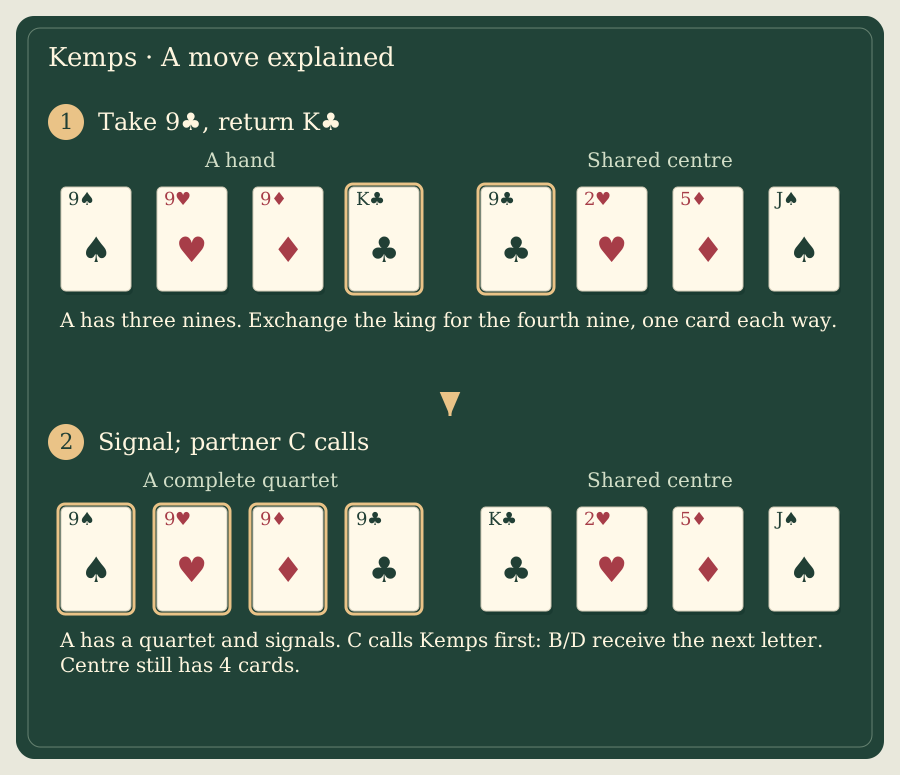
A holds 9♠ 9♥ 9♦ K♣. Centre shows 9♣ 2♥ 5♦ J♠. A takes 9♣ and returns K♣, leaving exactly 4 nines in hand and 4 cards at centre. A gives the agreed eyebrow signal. Partner C says Kemps before rivals: B/D receive a letter. If C calls before the exchange is complete, A has no valid four-card quartet yet and the call is false. In a separate deal B wrongly calls Stop Kemps against A/C with neither hand complete: B/D receive the letter. Watch partner after every refresh, rather than staring only at your own collection.
← On a small screen, scroll the diagram horizontally. →
Common questions
Can I call my own quartet?+
No. Signal and let your partner call Kemps; opponents may intercept with Stop Kemps.
May signals tell which rank I need?+
No. Agreed signals mean only that a complete quartet is held.
What happens when stock runs out?+
Continue with the final centre. Once nobody wants it, redeal without a penalty letter.