← On a small screen, scroll the diagram horizontally. →
01 /
The Jamaican contract game
Kalooki is a social and tournament rummy tradition in Jamaica, also found elsewhere in the Caribbean. Its name is shared with European and South African games whose opening requirements differ. Here Kalooki means the Jamaican nine-deal contract form, not an opening based on a fixed point minimum. Its defining pressure comes from changing contracts and costly calls for discards. A precise inventor or single origin date is not established; local and tournament variants should be identified by their actual rules.
02 /
Prepare the nine deals
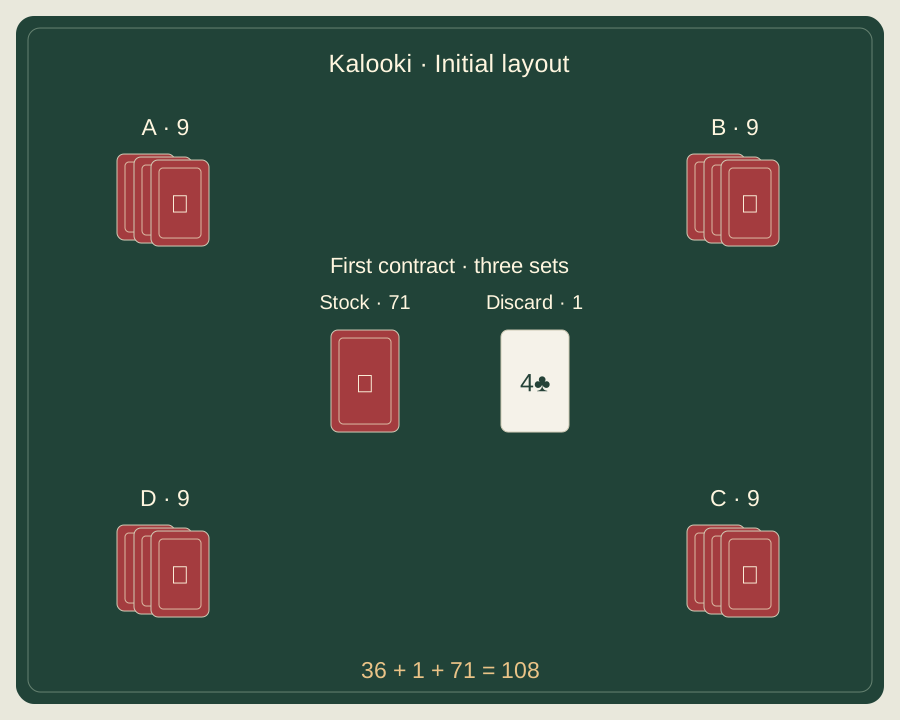
For 3–6 players use 2 standard packs plus 4 jokers, 108 cards. Choose dealer randomly and rotate left; deal and play clockwise, singly from dealer’s left. Deal sizes for rounds 1–9 are 9, 10, 11, 12, 12, 13, 14, 15, 16. Turn the next card up as discard and leave the rest as stock. The four-player opening shown has 36 in hands, 1 discard, 71 stock. Contracts, in the same order, are: 3 sets; 2 sets + 1 run; 1 set + 2 runs; 3 runs; 4 sets; 3 sets + 1 run; 2 sets + 2 runs; 1 set + 3 runs; 4 runs. Write this schedule before starting.
03 /
Sets, runs and fixed jokers
A set has at least 3 equal ranks; duplicated suits are allowed, but at least 2 cards must be natural. A run has at least 4 consecutive cards of one suit; jokers may substitute, never in adjacent positions. Ace is low or high only at an end: A–2–3–4 or J–Q–K–A, never K–A–2–3. Your separately laid sets must have different ranks, and your runs different suits. Jokers cannot be discarded or reclaimed into hand. A joker in a set never moves; a run joker can move within that same run under the extension rule below, not to another meld.
04 /
Draw, open and discard
On your turn draw 1 from stock or top discard, optionally lay cards, then discard 1 non-joker unless already out. First opening must satisfy the whole current contract at once; extra cards may make its sets or runs longer. Until then you cannot lay partial contracts or extend anyone’s melds. Once opened, draw only stock on later turns and allow eligible calls for the discard. You may add further valid melds respecting your different-rank and different-suit restrictions, and extend your own or others’ melds on that turn and later turns. Do not rearrange existing melds. Emptying the hand ends the deal immediately, with or without a final discard.
05 /
A call adds two cards
Before opening, you may call a freshly tabled discard out of turn, at most 3 successful calls per deal. The normal next player has priority to take it if still unopened. Otherwise give it to the first caller, who also draws 1 stock card as a penalty: hand grows by 2, with no immediate meld or discard. Resume the interrupted turn with a stock draw. Only one call is allowed per turn; buried discards cannot be called. Opened players cannot call or refuse another eligible caller. Agree how to resolve an indistinguishable simultaneous call before play; our teaching table gives priority clockwise from the active player.
06 /
Extend upwards before downwards
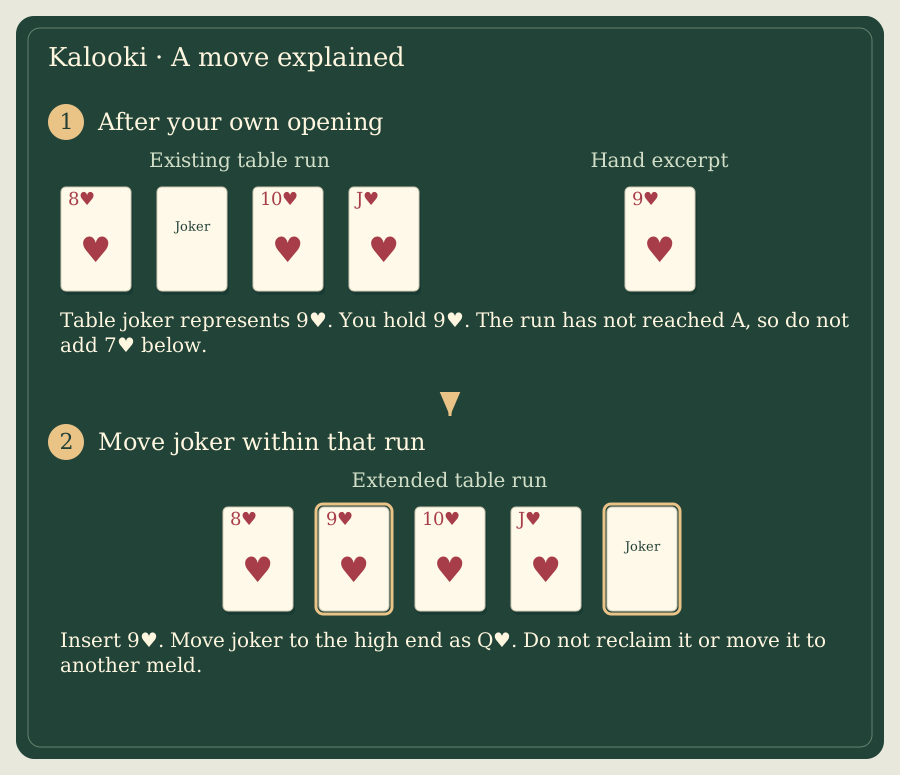
Add equal ranks to a set. A run extends only at its high end until it reaches A; only then may its low end extend downward. To replace a run joker with its exact natural card, move that joker to the high end, or low end if the run already reaches A. It must remain in that run and cannot end beside another joker. Example: 8♥–joker–10♥–J♥ plus 9♥ becomes 8♥–9♥–10♥–J♥–joker, now representing Q♥. A low extension using 7♥ would still be illegal. If stock empties, reshuffle discards except the top once; a second stock exhaustion voids the deal for a replay of the same contract, without scores.
07 /
Penalties and going down-and-out
Winner adds zero; others count only cards remaining in hand: joker 50, black ace 15, red ace 1, K Q J 10 each 10, other ranks 2–9 face value. Going out on the same turn as your first opening doubles everyone else’s hand penalty, including players already open. Otherwise penalties are not doubled. After all 9 contracts, lowest cumulative total wins; equal lowest share our session. Calling can rescue a contract but carries cards that may become expensive liabilities. Do not import Trinidad’s shorter schedule or its more permissive calls and joker retrieval into these Jamaican rules.
08 /
An ordinary first-contract finish
In round 1, a player starts with 9 cards: K♠ K♥ K♦, Q♠ Q♥ Q♦, 6♠ 6♥ 6♦. Drawing 2♣ gives 10 cards. Lay the 3 different-rank sets and discard 2♣: the hand empties on first opening. Another player holding A♠, A♥, joker and 7♦ has 15 + 1 + 50 + 7 = 73, doubled to 146. Those are penalty points, not meld values required for opening. A player who had opened earlier can still receive the doubled hand penalty; exposed cards themselves are not counted.
← On a small screen, scroll the diagram horizontally. →
Common questions
May I take back a joker?+
No. A run joker may shift within that same run, but never returns to hand or another meld.
Can an opened player call?+
No. Once open, draw stock and let eligible unopened callers take the fresh discard.
Can a run extend at its low end?+
Only after its high end has reached the ace. Ordinary rummy’s free extension is not used here.