← On a small screen, scroll the diagram horizontally. →
01 /
A card everyone else can see
Indian Poker, also called Blind Man’s Bluff or Forehead Poker, reverses the usual information in poker: your opponents see your card and you see theirs. This page uses the single-card, single-betting-round form described in ordinary card manuals. Other groups apply Guts settlement instead; matching an entire old pot is not part of this profile. A specific inventor and reliable first publication date are not established. The examples use counters, with an explicit small fixed-limit structure so that beginners can complete a hand without knowing other poker games.
02 /
Deal without looking
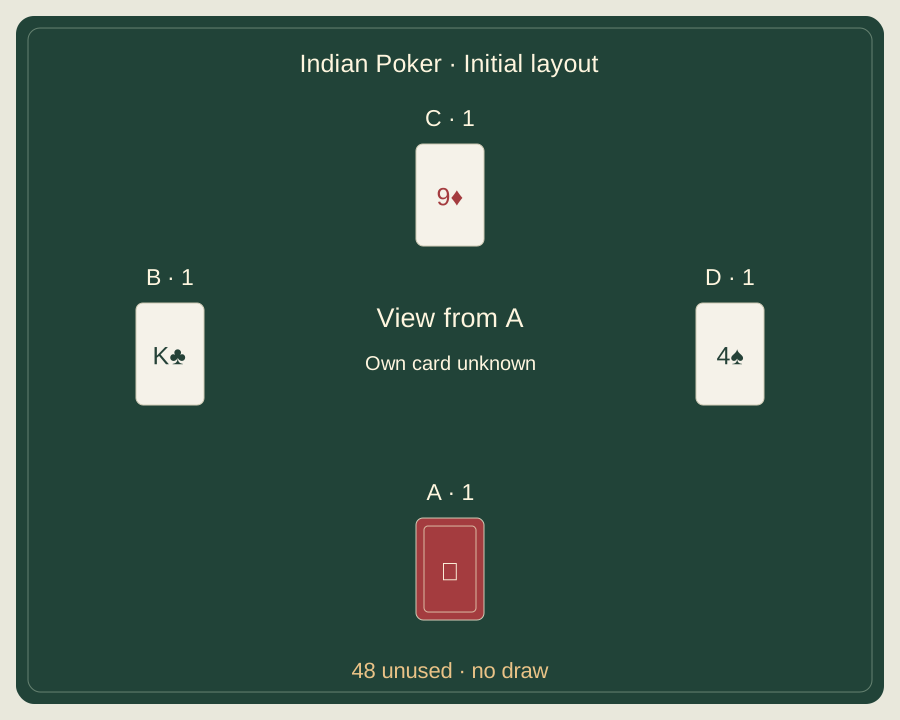
Use 52 cards without jokers for 2–10 players, including dealer. Rank A K Q J 10 down to 2; suits are equal. Give everyone 100 counters and play one full dealer rotation. Each deal everyone antes 1; deal 1 card face down clockwise from dealer’s left. On a signal lift it face outward against your forehead without seeing it. No mirrors, reflections, hints or deliberate exposure of another player’s unknown card. Unused cards stay aside, not as a draw pile. The four-player diagram leaves 48 unused.
03 /
One round with a defined limit
Act clockwise from dealer’s left. Before a bet, check, fold or bet 1 extra counter. Facing a bet, fold, call by adding the difference, or raise the target by 1 if nobody has raised yet. Only one raise is allowed for the whole table: extra contributions never exceed 2 per player, separate from ante. After a raise, all other active players must respond again, including those who checked or called earlier. End when every remaining player has acted after the last bet or raise and matched its target. If everyone checks, go directly to showdown.
04 /
Fold, reveal or split
A fold forfeits all counters already put in, but requires no future payment. If one player remains, that player takes the pot immediately without proving the highest card. Otherwise all remaining players look at their cards: highest rank takes the pot; equal highest ranks split it, with fractional shares written in a ledger if necessary. A folded high card cannot win. There is no matching-pot penalty, draw or carry-over. Collect all cards, rotate dealer left and start a fresh ante.
05 /
A finite counter session
After everyone has dealt once, compare balances; highest wins, equal leaders share. The starting balance covers this chosen short session without all-ins or side pots. The sum of counters must stay unchanged because the pot is redistributed, not newly created. These fixed limits and session length are teaching agreements, not a claim that every table uses them. Other tables rank suits or allow larger raises: choose those before dealing and rewrite the tie or betting rule, rather than switching during a hand.
06 /
A win without the highest known card
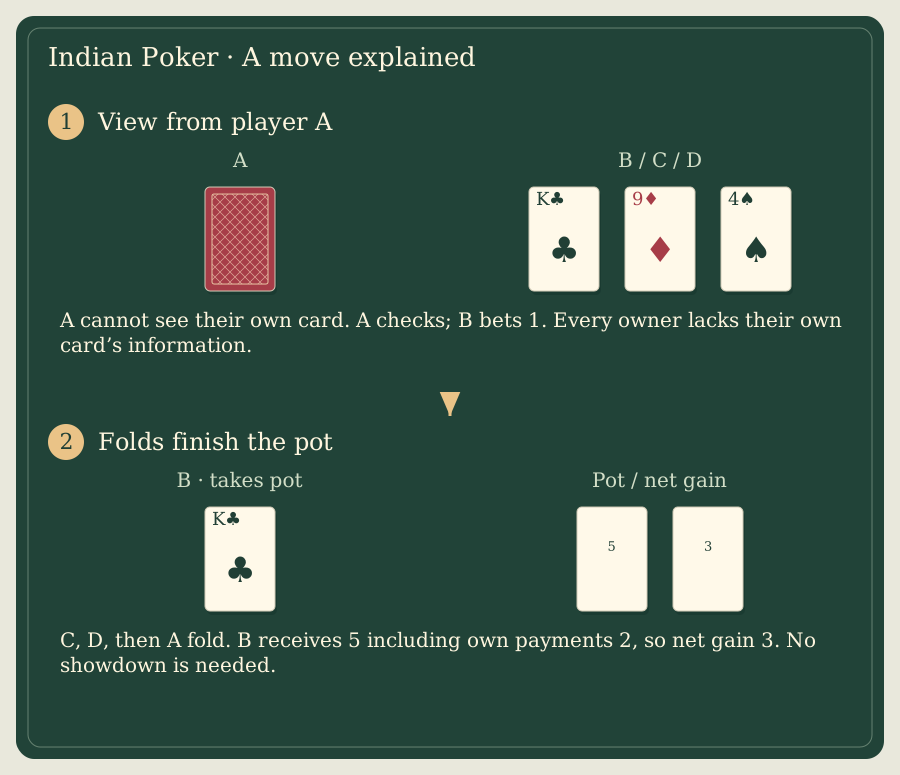
Four players ante 1, pot 4. Actual cards are A 2♥, B K♣, C 9♦, D 4♠, but each owner cannot see their own. A checks; B bets 1; C and D fold; A folds. B receives 5, including B’s own ante and bet: net gain 3, each other player loses 1. B did not need a showdown. In a separate three-player showdown with pot 6 and two surviving kings, each king receives 3; suit does not break the tie.
← On a small screen, scroll the diagram horizontally. →
Common questions
May I look at my card before betting?+
No. Each owner learns their own card only after the betting ends; the other players can already see it.
Do suits break ties?+
Not here. Equal highest surviving ranks share the pot; fractional shares can be recorded.
Must a losing player match the pot?+
No. That is the separate Guts-style settlement. This page settles only the agreed betting contributions.