← On a small screen, scroll the diagram horizontally. →
01 /
A partition game from South Asia
Hazari is played in Bangladesh and Bhutan and shares a family resemblance with games that split a large hand into smaller competing combinations. Its name refers to the target of a thousand. The main decision happens before anyone exposes a group: strengthen a likely winner without wasting cards that could support another group. No precise individual inventor or secure first publication is asserted here. Bhutanese point values and special instant wins are separate traditions, not additions to this scoring profile.
02 /
Deal and lock four groups
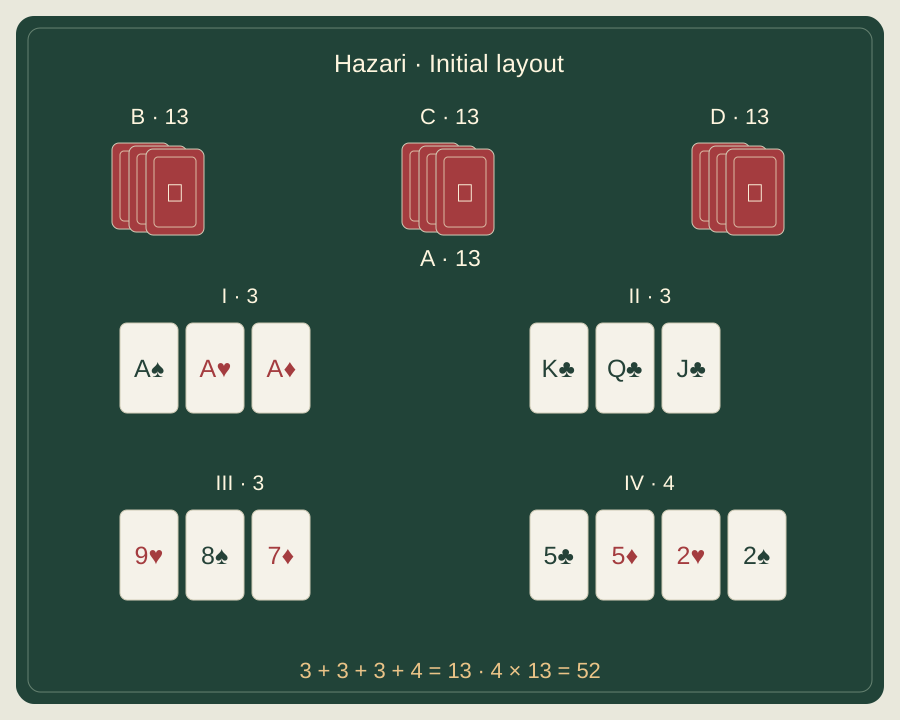
Use 52 cards without jokers for exactly 4 individual players. A is high, then K Q J 10 down to 2. Deal and play counterclockwise; deal all cards, 13 each. Privately split into groups of 3, 3, 3 and 4. Order them strongest to weakest. In the last group choose the best possible 3-card combination from its 4 cards: even that best combination must be no stronger than the preceding group. The extra card still counts for points. Announce ready only after checking; once ready, do not rearrange. Equal-strength neighbouring groups may be placed in either order.
03 /
Six kinds of combination
From strongest: Troy, three equal ranks; Colour Run, a suited sequence; Run, an unsuited sequence; Colour, one suit without a sequence; Pair; Indi, none of these. A higher category always wins. Compare Troys by rank. Runs rank A K Q first, A 2 3 second, then K Q J down to 4 3 2; K A 2 is not a run. Compare Colours and Indi by highest, next, then lowest card. Compare pairs by pair rank, then kicker. Suits do not break ties. The fourth card cannot upgrade the last group into a separate four-card category.
04 /
Four comparisons, with order deciding ties
When everyone is ready, the player right of the dealer exposes the strongest group. Others follow counterclockwise with their own strongest group; nobody may switch groups after seeing a rival. The best group wins all 12 cards and its owner starts the next comparison with the strongest remaining group. Repeat for 3 comparisons, then reveal the 4-card groups and award all 16 cards. For exactly equal combinations the last one played wins, so the lead matters. There is no follow-suit requirement or trump: compare complete combinations only.
05 /
Card points and a thousand-point finish
A K Q J 10 each count 10 points; 2–9 each count 5. Count the captured cards, not the strength of your original groups. The pack contains 20 × 10 + 32 × 5 = 360 points: check all four scores against that total. Add each deal to cumulative totals and rotate the dealer right. Finish a whole deal before checking 1000. If anyone has at least 1000, the largest total wins; tied highest totals share victory in this guide. A Troy is not a fixed bonus, and winning the first comparison does not end the deal.
06 /
A tied run won by the later player
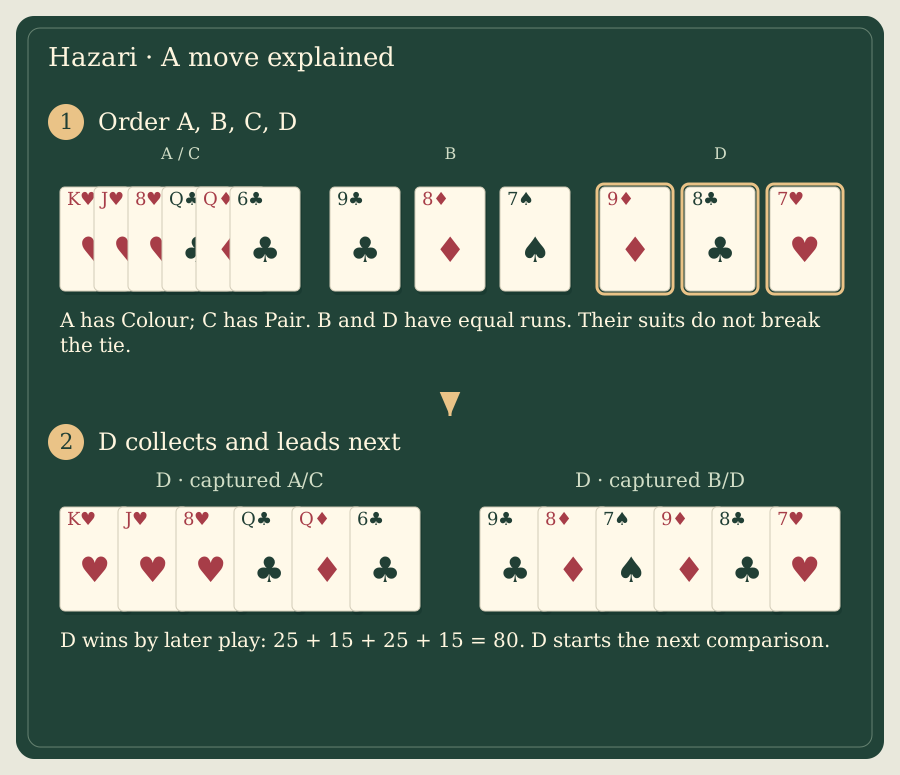
In one comparison A exposes K♥ J♥ 8♥, B 9♣ 8♦ 7♠, C Q♣ Q♦ 6♣ and D 9♦ 8♣ 7♥, in that order. B and D have equal runs, above A’s Colour and C’s Pair. D wins because D played later, collecting all 12 cards. Their point total is 25 + 15 + 25 + 15 = 80. D leads the next comparison. A possible legal partition of a different hand is AAA, KQJ suited, 987 mixed, then 5522: the last group’s best triple is a pair, weaker than the run.
← On a small screen, scroll the diagram horizontally. →
Common questions
Does the spare card break a tie?+
No. Compare the best triple; exact ties go to the later group played. All captured cards still score.
Is A 2 3 the lowest run?+
No. In this profile A 2 3 is second only to A K Q, above K Q J.
Can I rearrange after seeing another group?+
No. Lock the whole partition when declaring ready and play the strongest remaining group.