← On a small screen, scroll the diagram horizontally. →
01 /
A small-hand game beside poker
Guts belongs to the home-poker and dealer’s-choice tradition, but its matching-pot settlement differs from ordinary poker betting. Players choose whether a small concealed hand is worth entering a showdown. Numerous local versions use different hand sizes, declaration methods or a neutral ghost hand. A precise inventor and first publication date are not established for this guide. We explain simultaneous two-card Guts with no ghost and no exchanges. The examples use score counters rather than money; the counters represent the rules of the pot, not a separate card-point score.
02 /
Pack, counters and deal
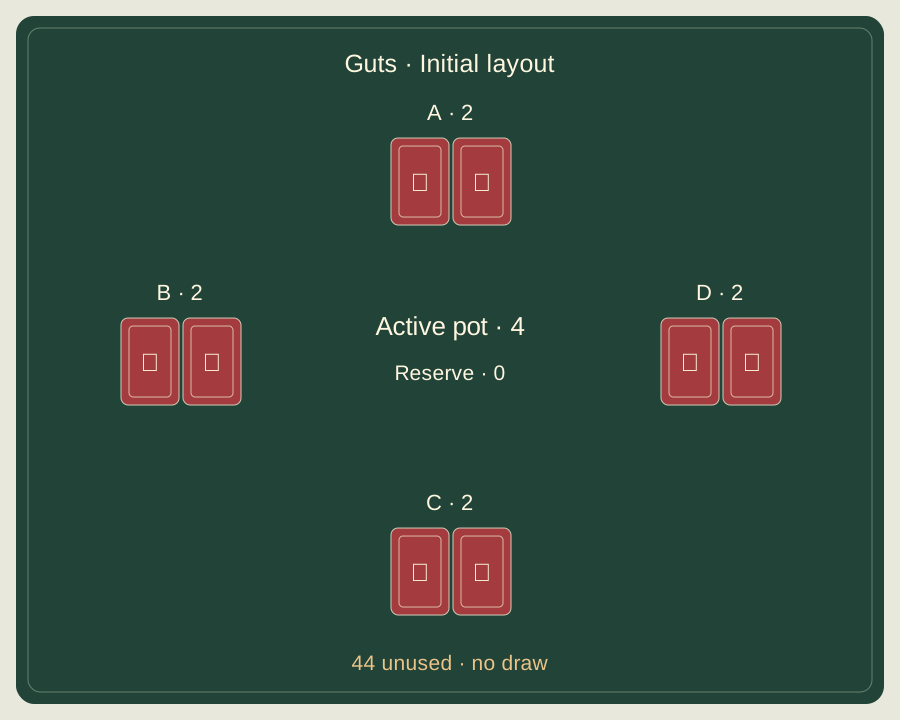
Use 52 ordinary cards without jokers for 2–10 individual players. Agree an ante and an active-pot cap; our teaching table uses ante 1 and cap 20. Also leave a reserve area for any overflow. When both pot and reserve are empty, everyone contributes the ante. Shuffle and deal 2 cards face down to each player, clockwise from the dealer’s left. Players inspect only their own hand. There is no draw, discard replacement or community board. The illustrated 4-player opening has 8 dealt cards and 44 unused cards. Collect and reshuffle the full pack after settlement; rotate the dealer clockwise.
03 /
Commit to in or out together
Each player puts a declaration counter in a closed fist for in, or leaves the fist empty for out. Everyone opens together on the agreed signal. The declaration counter is only a marker, not an extra payment. An out player cannot win this deal and owes no matching payment. With no players in, leave the pot unchanged and redeal without another ante. With exactly 1 player in, that player takes the active pot without showing cards. With several in, only those players expose both cards. No late change, raise, extra card or ghost comparison is allowed in this profile.
04 /
Compare two-card hands
Any pair beats every unpaired hand. Compare pairs by rank, with aces highest and twos lowest. Without a pair, compare the higher card first and the lower card if needed; A–K beats A–Q. Suits never break ties. Two cards in sequence or of the same suit receive no straight or flush status. If several in players tie for the best rank pattern, they share the active pot equally and none of those tied winners matches it. Record fractional counters on paper if an equal split is not whole. Lower in hands are still losers; do not turn a tie at the top into an all-player tie.
05 /
Match the old pot, then rebuild it
First award the active pot. Each losing in player then contributes that same pre-showdown amount to the next pot; it is not divided among losers and does not include their new payments. Keep the next active pot at the agreed cap and move any excess to reserve. If no losing payments remain, refill from reserve up to the cap before taking any fresh ante. Reserve is not part of a showdown prize or matching obligation. A cycle ends only when pot and reserve are both empty. Agree the number of cycles for a session; compare net counter balances, counting contributions as well as prizes. Equal balances share the result.
06 /
One winner and two matching payments
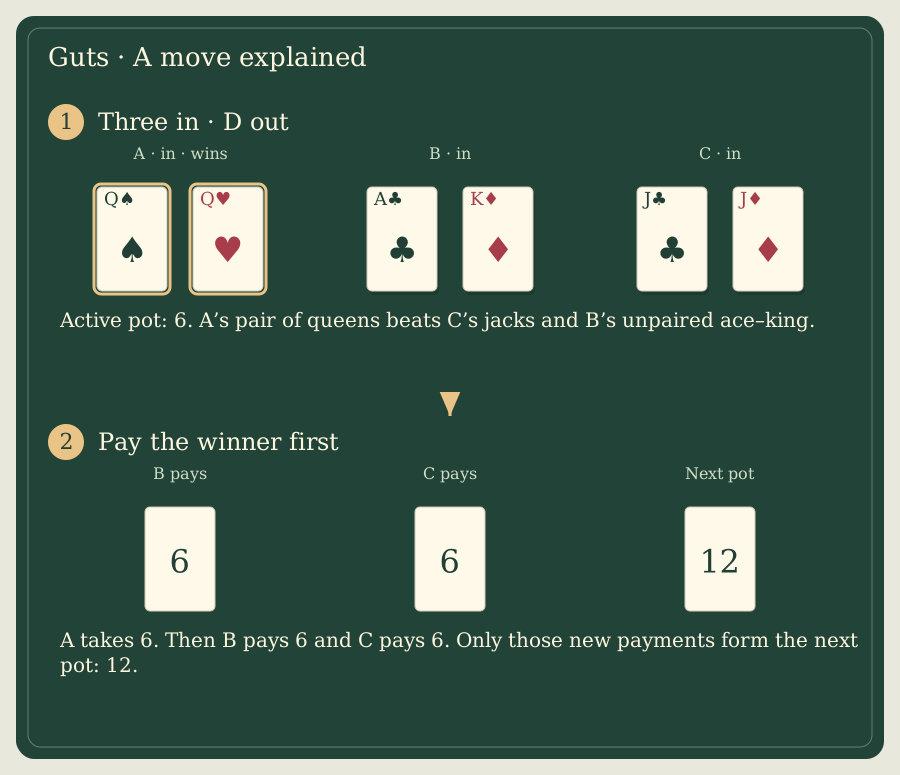
The active pot is 6 counters and reserve is empty. A holds Q♠ Q♥, B A♣ K♦, C J♣ J♦; all declare in, while D declares out. A’s queens beat C’s jacks and B’s unpaired ace–king. A takes 6. B and C each contribute 6, making the next pot 12, not 18: the previous prize has already left. D adds nothing. In a separate cap example, a 12-counter pot with 3 losers produces 36; with cap 20, keep 20 active and 16 reserved. If that active pot is then won uncontested, refill with the remaining 16 rather than demanding fresh antes.
← On a small screen, scroll the diagram horizontally. →
Common questions
Does ace–king beat a small pair?+
No. Every pair beats every unpaired two-card hand; suits and two-card straights add nothing.
Do players who stay out match the pot?+
No. Only losing players who declared in make the matching payment.
What if everyone stays out?+
In this simultaneous profile carry the unchanged pot into a fresh deal without an additional ante.